






CEBU CITY – Despite numerous challenges, the country’s contact center sector, along with the entire information technology and business process management (IT-BPM) industry, is poised to hit the ambitious $49-billion annual revenue goal by 2028.
Manila Bulletin
 Philippines
Visayas
PH contact center sector poised to hit $49-B annual revenue goal by 2028
Philippines
Visayas
PH contact center sector poised to hit $49-B annual revenue goal by 2028
Philippines
Visayas
PH contact center sector poised to hit $49-B annual revenue goal by 2028
PH contact center sector poised to hit $49-B annual revenue goal by 2028
Published May 28, 2025 10:05 pm


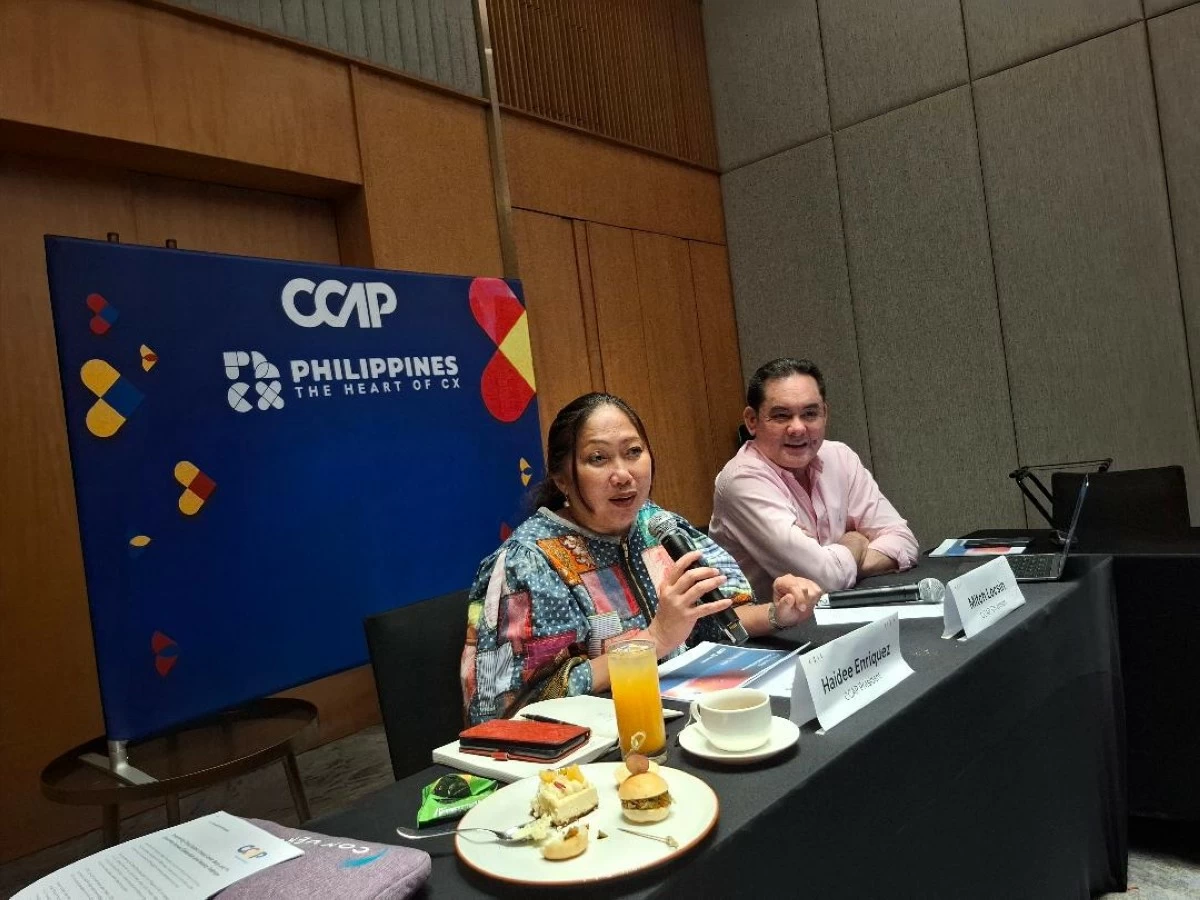
HAIDEE Enriquez (left), president of the Contact Center Association of the Philippines (CCAP), and Mitch Locsin, CCAP president, discuss issues surrounding the 167-strong association. (Calvin Cordova)
Haidee Enriquez, president of the Contact Center Association of the Philippines (CCAP), an organization with 167 member-firms from the local call center sector, attributed the promising forecast to the sector's continuous strength and resilience as the country continues to be the top global digital customer experience provider.
In 2024, the local contact center sector posted a $31.6-billion annual revenue, up 7.1 percent compared to the $29.5-billion revenue generated in 2023.
The sector accounts for about 83 percent of the total annual revenue of the IT-BPM industry, which was $38 billion in 2024.
Enriquez said the sector still faces a lot of challenges.
Among those are geopolitical in nature, particularly the renewed protectionism approach of US President Donald Trump.
The US remains as the primary source of outsource work to the Philippines, accounting for about 85 percent of total contracts, based on data from Nexford University in 2021.
"Fortunately, the current US tariff movements are centered on goods, not on services," said Enriquez.
"But we do not rule out the possibility of a shift, which may affect our sector eventually. Based on the latest pulse survey we did within the industry, the way we do business in our sector is still not bearing impact from Trump's actions. But we are watchful and cautious. Moreover, the US consumer behavior might also affect how we provide solutions."
Enriquez highlighted the continuous and more aggressive upskilling programs across the sector.
"A lot of resources being currently deployed in the industry are for upskilling the current workforce. The industry just received a P500-million upskilling funding from the government through TESDA (Technical Education and Skills Development Authority), a government agency that rolls out skilling and upskilling initiatives for workers across industries," she revealed.
Further trainings will be facilitated by the Department of Information and Communications Technology (DICT). Additional budget allocations will be set for 2026.
The upskilling programs are designed to primarily target digital skills.
Enriquez disclosed that government support will also target new technologies that the sector is currently lacking or are not yet existent in the country to bolster productivity of industry workers.
"However, our sector's advantage as a workforce is that we've been doing this (upskilling) for a long time now. While technology is there, we need the expertise in using it. Technology is only as good as the person using it. We are finding ways to make it easier for our agents to navigate the new technologies."
Enriquez reiterated that technology adoption remains a mindset change.
"This is where the battle begins: To make our employees understand that technology is not a threat. There is a path to using new technology to everybody's advantage. We've been emphasizing, it is humans plus AI (artificial intelligence), instead of humans versus AI," she said.
More insights and discussions are on the table as the annual Contact Islands conference started on Tuesday, May 27, at FILI Hotel in Nustar Cebu here.
With the theme “Beyond the Hype: CX, AI, and the Forces Reshaping Philippine Contact Centers,” the three-day conference will gather top industry leaders, policy makers, and global analysts to engage in crucial conversations shaping the future of the Philippine contact center and business process sector.