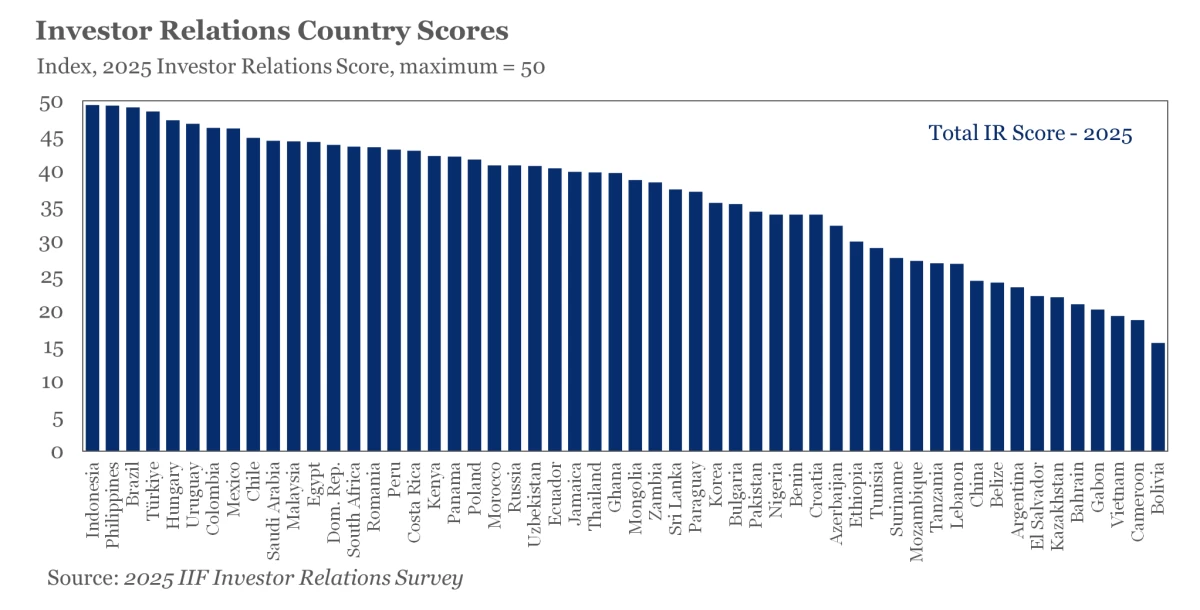
The Philippines has topped the global rankings in investor relations and debt transparency among 57 emerging markets, overtaking last year’s leader, Indonesia, according to the Washington-based Institute of International Finance (IIF). In its July 2026 Investor Relations and Debt Transparency...
The Philippines’ debt as a share of economic output is expected to remain elevated above 60 percent of gross domestic product (GDP) this year as the government ramps up borrowings to support its response to the national energy emergency amid the prolonged war in the Middle East. Based on the...
Philippine economic growth would continue to underperform this year and next as the country faces not only headwinds from a prolonged war in the Middle East but also domestic challenges related to politics and corruption, according to the Institute of International Finance (IIF). The IIF’s latest...
Public debt in the Philippines moved closer to the 60-percent level at the end of the first quarter of 2026, as the government continued to ramp up borrowings while the private sector remained cautious amid risks stemming from the war in the Middle East. The latest Global Debt Monitor of the...
While government debt continued to pile up, private businesses and individuals in the Philippines held back on borrowings amid conditions not too conducive to debt accumulation. The latest data from the Washington-based Institute of International Finance (IIF), released on Thursday, Sept. 25,...
The Tokyo-based think tank Asian Development Bank Institute (ADBI) has flagged rising post-pandemic debt repayments in developing economies across the region, including the Philippines, which are depriving governments of more funding for public goods and services. “Between 2008 and 2019, annual...
The Philippines remained one of the world’s best in investor relations (IR) and debt transparency, even as it lost to Indonesia this year the top spot it held last year in the annual ranking of the Washington-based Institute of International Finance (IIF). In the 2025 IIF Investor Relations and...
Philippine economic growth would likely further slow in the next two years to remain below the government’s more ambitious annual targets amid a global deceleration fueled by trade and geopolitical tensions, according to the Washington-based Institute of International Finance (IIF). A June 25...
Inflation would likely fall to a five-year low in 2025, providing policy space for more interest rate cuts supportive of economic growth, according to the think tank Capital Economics. "We expect GDP [gross domestic product] growth in the Philippines to remain relatively strong in 2025, helped by...
The US dollar's strength is expected to linger for the rest of the year, potentially hiking borrowing costs for emerging markets like the Philippines, according to the Washington-based Institute of International Finance (IIF). "A strong US dollar will be a key feature of 2025 and beyond. While...
The Washington-based Institute of International Finance (IIF) sees the Philippine economy growing below the government's goal this and next year mainly due to external developments—especially the slowing Chinese economy and forthcoming US tariffs—impacting global trade. In a Dec. 11...
The Philippines' public debt as a share to gross domestic product (GDP) rose in the third quarter alongside slower economic growth, even as private-sector debts continued to fall before the onset of downward interest rates. The latest Global Debt Monitor of the Washington-based Institute of...