ADVERTISEMENT

Economists split as Philippine inflation threatens to re-accelerate

Published Aug 3, 2026 12:00 am  |  Updated Aug 1, 2026 02:22 pm
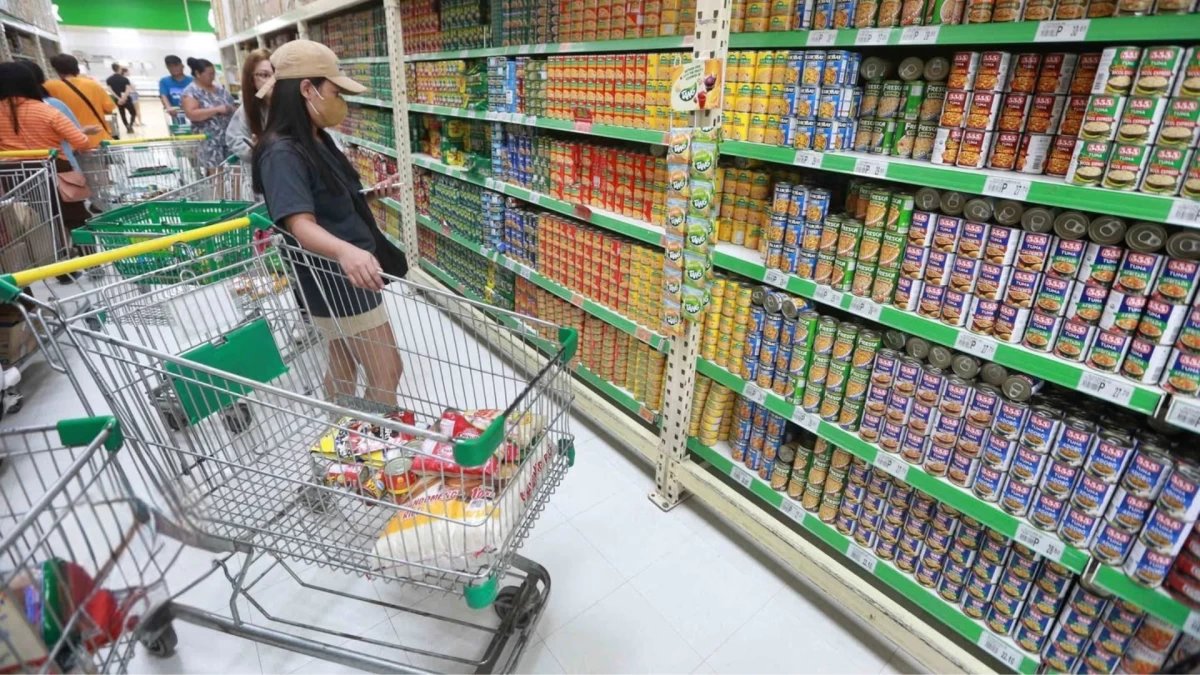
A shopper pauses in a grocery aisle in Manila, where the rising cost of staples has made every purchase a strategic decision. As global price shocks thin the margins for Philippine households, earners are increasingly relying on financial literacy and secure, transparent credit platforms to act as a shield against both inflation and the rising threat of predatory lending scams. (Manila Bulletin file photo)
Private-sector economists are divided over the trajectory of Philippine inflation in July, though they broadly agree that lingering climate risks, geopolitical tensions, and a weaker peso will compel the central bank to keep interest rates elevated.
Forecasts for July headline consumer prices span from 6.2 percent to 6.8 percent, compared with June’s 6.4 percent annual pace.
Higher food costs driven by El Niño weather patterns, renewed conflict between the United States and Iran, and import price pressures stemming from currency depreciation remain the primary drivers threatening price stability across the nation.
Jonathan Ravelas, senior adviser at Reyes Tacandong & Co., projects July headline inflation accelerated to 6.8 percent from 6.4 percent in June, citing higher food prices, weather shocks, elevated transport costs, and the lingering impact of the recent peso slide.
“I expect July inflation to come in at around 6.8 percent, slightly higher than the previous month,” Ravelas said. If his projection holds true, the recent easing trend in inflation will grind to a halt.
“What is equally important is that core inflation likely continued to edge up, suggesting that price pressures are becoming more broad-based as businesses pass on higher operating costs and demand remains relatively resilient,” Ravelas added.
Nomura Holdings Inc. flagged the Philippines and India as the economies “most exposed” to shocks stemming from El Niño, as food accounts for a significant share of their consumer baskets.
Nomura added that the Philippines is particularly vulnerable to higher rice costs because of its status as a net importer, with the staple making up 8.9 percent of its consumer basket.
According to Ravelas, persistent inflation keeps monetary authorities on high alert, reinforcing the need “to keep monetary policy restrictive for longer to ensure inflation expectations remain anchored.”
He noted that the country’s fight against inflation is far from over, asserting that the Bangko Sentral ng Pilipinas (BSP) will likely prioritize price stability over slowing economic growth.
Meanwhile, Dutch financial giant ING offered a more moderate outlook while acknowledging price volatility.
“We expect inflation in July to remain unchanged at 6.4 percent,” said Deepali Bhargava, ING regional head of research for Asia-Pacific, citing a tug-of-war between easing rice prices and rising fuel costs.
Singapore-based United Overseas Bank (UOB) shared a similar view, with economist Lee Sue Ann projecting July inflation at 6.2 percent. Despite the slight dip in her headline forecast, she pointed out that the rate “remains well above” the BSP’s target ceiling of 4 percent. Core inflation—which excludes volatile food and energy items—hit a two-and-a-half-year high of 4.4 percent in June, underscoring persistent demand pressures.
As a result, UOB expects the BSP to raise its policy rate by 25 basis points (bps) to 5 percent in the third quarter.
Since Middle East hostilities erupted in late February, the BSP has raised key borrowing costs twice, bringing the benchmark rate to 4.75 percent. The Monetary Board is scheduled to hold its fourth policy meeting of the year on Aug. 27, followed by meetings on Oct. 22 and Dec. 17.
Economists at MUFG Bank observed that Philippine inflation “could move further above the BSP’s target,” particularly as energy prices surged following the re-escalation of the US-Iran conflict. Similarly, DBS Bank warned that while global energy prices might see a temporary pullback, “food costs are set to turn dearer on El Niño risks.”
In June, the BSP raised its average inflation forecasts for 2026 and 2027 to 6.4 percent and 4.5 percent, respectively, up from previous estimates of 6.3 percent and 4.3 percent—both remaining well above the target tolerance band. 

Related Tags

Inflation US-Iran war El Niño MUFG Bank Ltd. UOB ING Asia-Pacific Jonathan Ravelas Nomura Bangko Sentral ng Pilipinas (BSP) DBS Bank Ltd.
ADVERTISEMENT
.most-popular .layout-ratio{ padding-bottom: 79.13%; } @media (min-width: 768px) and (max-width: 1024px) { .widget-title { font-size: 15px !important; } }

{{ articles_filter_1561_widget.title }}

.most-popular .layout-ratio{ padding-bottom: 79.13%; } @media (min-width: 768px) and (max-width: 1024px) { .widget-title { font-size: 15px !important; } }

{{ static_articles_1562_widget.title }}

.most-popular .layout-ratio{ padding-bottom: 79.13%; } @media (min-width: 768px) and (max-width: 1024px) { .widget-title { font-size: 15px !important; } }

{{ articles_filter_1563_widget.title }}

{{ articles_filter_1564_widget.title }}

.mb-article-details { position: relative; } .mb-article-details .article-body-preview, .mb-article-details .article-body-summary{ font-size: 17px; line-height: 30px; font-family: "Libre Caslon Text", serif; color: #000; } .mb-article-details .article-body-preview iframe , .mb-article-details .article-body-summary iframe{ width: 100%; margin: auto; } .read-more-background { background: linear-gradient(180deg, color(display-p3 1.000 1.000 1.000 / 0) 13.75%, color(display-p3 1.000 1.000 1.000 / 0.8) 30.79%, color(display-p3 1.000 1.000 1.000) 72.5%); position: absolute; height: 200px; width: 100%; bottom: 0; display: flex; justify-content: center; align-items: center; padding: 0; } .read-more-background a{ color: #000; } .read-more-btn { padding: 17px 45px; font-family: Inter; font-weight: 700; font-size: 18px; line-height: 16px; text-align: center; vertical-align: middle; border: 1px solid black; background-color: white; } .hidden { display: none; }
function initializeAllSwipers() { // Get all hidden inputs with cms_article_id document.querySelectorAll('[id^="cms_article_id_"]').forEach(function (input) { const cmsArticleId = input.value; const articleSelector = '#article-' + cmsArticleId + ' .body_images'; const swiperElement = document.querySelector(articleSelector); if (swiperElement && !swiperElement.classList.contains('swiper-initialized')) { new Swiper(articleSelector, { loop: true, pagination: false, navigation: { nextEl: '#article-' + cmsArticleId + ' .swiper-button-next', prevEl: '#article-' + cmsArticleId + ' .swiper-button-prev', }, }); } }); } setTimeout(initializeAllSwipers, 3000); const intersectionObserver = new IntersectionObserver( (entries) => { entries.forEach((entry) => { if (entry.isIntersecting) { const newUrl = entry.target.getAttribute("data-url"); if (newUrl) { history.pushState(null, null, newUrl); let article = entry.target; // Extract metadata const author = article.querySelector('.author-section').textContent.replace('By', '').trim(); const section = article.querySelector('.section-info ').textContent.replace(' ', ' '); const title = article.querySelector('.article-title h1').textContent; // Parse URL for Chartbeat path format const parsedUrl = new URL(newUrl, window.location.origin); const cleanUrl = parsedUrl.host + parsedUrl.pathname; // Update Chartbeat configuration if (typeof window._sf_async_config !== 'undefined') { window._sf_async_config.path = cleanUrl; window._sf_async_config.sections = section; window._sf_async_config.authors = author; } // Track virtual page view with Chartbeat if (typeof pSUPERFLY !== 'undefined' && typeof pSUPERFLY.virtualPage === 'function') { try { pSUPERFLY.virtualPage({ path: cleanUrl, title: title, sections: section, authors: author }); } catch (error) { console.error('ping error', error); } } // Optional: Update document title if (title && title !== document.title) { document.title = title; } } } }); }, { threshold: 0.1 } ); function showArticleBody(button) { const article = button.closest("article"); const summary = article.querySelector(".article-body-summary"); const body = article.querySelector(".article-body-preview"); const readMoreSection = article.querySelector(".read-more-background"); // Hide summary and read-more section summary.style.display = "none"; readMoreSection.style.display = "none"; // Show the full article body body.classList.remove("hidden"); } document.addEventListener("DOMContentLoaded", () => { let loadCount = 0; // Track how many times articles are loaded const offset = [1, 2, 3, 4, 5, 6, 7, 8, 9, 10]; // Offset values const currentUrl = window.location.pathname.substring(1); let isLoading = false; // Prevent multiple calls if (!currentUrl) { console.log("Current URL is invalid."); return; } const sentinel = document.getElementById("load-more-sentinel"); if (!sentinel) { console.log("Sentinel element not found."); return; } function isSentinelVisible() { const rect = sentinel.getBoundingClientRect(); return ( rect.top < window.innerHeight && rect.bottom >= 0 ); } function onScroll() { if (isLoading) return; if (isSentinelVisible()) { if (loadCount >= offset.length) { console.log("Maximum load attempts reached."); window.removeEventListener("scroll", onScroll); return; } isLoading = true; const currentOffset = offset[loadCount]; window.loadMoreItems().then(() => { let article = document.querySelector('#widget_1690 > div:nth-last-of-type(2) article'); intersectionObserver.observe(article) loadCount++; }).catch(error => { console.error("Error loading more items:", error); }).finally(() => { isLoading = false; }); } } window.addEventListener("scroll", onScroll); });

Sign up by email to receive news.