






 Business
The Economy
Inside the delays and shrinking ambitions of Cebu's decade-old BRT project
Business
The Economy
Inside the delays and shrinking ambitions of Cebu's decade-old BRT project
Inside the delays and shrinking ambitions of Cebu's decade-old BRT project


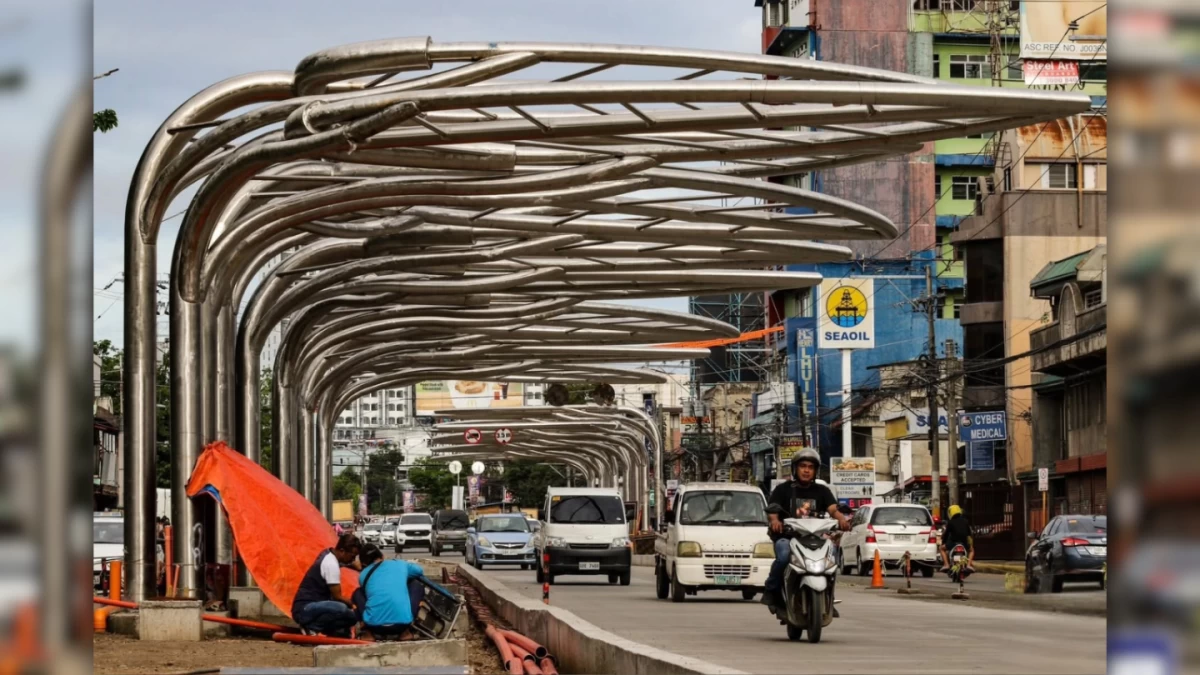
More than a decade after the World Bank approved financing for the Cebu Bus Rapid Transit (BRT) Project, the flagship urban transport initiative remains far from achieving its original objectives, with only a short section of the corridor substantially completed before the loan expires in September this year.
In a restructuring paper published last week, the Washington-based multilateral lender laid out in detailed terms what went wrong in the long-delayed Cebu BRT project, which was first approved in September 2014 and was initially envisioned as a modern mass transport backbone for the Queen City of the South.
The World Bank said implementation “faced repeated delays” despite the project becoming effective in December 2014.
According to the restructuring document, the Department of Transportation (DOTr) placed the project “on hold” following the change in government administration—from former president Benigno Aquino III to former president Rodrigo Duterte—in June 2016.
While the government recommitted to the project in 2018, the World Bank said implementation was again delayed by the Covid-19 pandemic and quarantine restrictions, which limited the deployment of both international and local consultants in the field.
The lender also cited “frequent staff turnover” in the DOTr, delays in filling key positions in the project implementation unit (PIU) and national procurement management office (NPMO), “persistent procurement delays,” and insufficient allocations in the annual national budgets as among the major causes behind the project’s poor implementation record.
The project encountered another major setback during a joint mid-term review in September 2020 involving the World Bank, Agence Française de Développement (AFD)—the other financing institution for Cebu BRT—as well as NPMO and PIU.
That review concluded that the planned 3.8-kilometer (km) dedicated busway from Mambaling to Bulacao in Cebu City would require extensive resettlement and would instead be implemented separately by the Philippine government outside the World Bank-financed project.
This triggered a series of restructurings and deadline extensions.
The project was first restructured in June 2021, extending the loan closing date from June 2021 to June 2023.
However, government approval of the proposed changes remained pending by mid-2023, resulting in two more extensions—to September 2023 and then January 2024.
A fourth restructuring approved in January 2024 further extended the loan closing date by 32 months until Sept. 30, 2026 to allow completion of remaining civil works, traffic management systems, and institutional structures needed for full BRT operations.
But even after the latest extension, the World Bank admitted the project “failed to make progress on the remaining project activities.”
During a July 2025 portfolio review attended by the DOTr, the Department of Budget and Management (DBM), the Department of Economy, Planning, and Development (DEPDev), and the Department of Finance (DOF), officials under the current Marcos Jr. administration agreed that another extension was “undesirable.”
Instead, the government pursued partial cancellation of the loan to remove project activities unlikely to be completed before the September 2026 deadline.
As reported by Manila Bulletin last week, the World Bank subsequently canceled $59.9 million of the International Bank for Reconstruction and Development (IBRD) loan as well as the entire $25-million Clean Technology Fund (CTF) loan effective Jan. 22 this year. IBRD is the World Bank Group’s (WBG) lending arm for developing countries like the Philippines.
Originally, the Cebu BRT project carried total financing of $228.5 million, including a $116-million World Bank loan, a $25-million CTF grant, parallel financing from AFD equivalent to $57.5 million, and $30 million in Philippine government counterpart funding.
Under the restructuring, the World Bank-financed portion was slashed to just $56.1 million from the original $116 million.
The restructuring paper painted a bleak picture of implementation progress over the past 11 years.
The World Bank rated both implementation progress and achievement of the project development objective (PDO) as “unsatisfactory,” citing “long standing gaps in compliance with loan covenants and cumulative implementation delays.”
The lender warned these delays would result in only “modest achievement” of the project’s original goals before loan closure this coming September.
To date, only one section of the BRT corridor has been substantially completed, while major activities—including civil works packages 2 and 3, traffic management systems, establishment of the Cebu BRT management entity, and procurement of a BRT operator—have not even started.
The World Bank said that in the 11 years since the project became effective, only about 29 percent or $40.62 million of total IBRD and CTF loans had been disbursed before the partial loan cancellation earlier this year.
For the AFD loan, only about six percent or three million euros had been disbursed.
The restructuring document also detailed procurement failures that further slowed implementation.
Procurement was likewise rated “unsatisfactory,” with the World Bank saying the procurement process for the area traffic control and intelligent transport system design “has yet to commence,” while bidding documents for the two major civil works packages “have not been issued to date.”
The project also operated for prolonged periods without key personnel required under loan covenants, including a procurement advisor, financial management specialist, and technical support consultant.
According to the report, the financial management specialist position remained vacant from September 2017 to February 2023, and again from February 2024 until November 2025.
Meanwhile, the procurement advisor position was vacant until February 2022 and again from July 2024 to December 2025.
The technical support consultant, which the World Bank described as a loan covenant requirement, was active only from December 2017 to December 2022.
A replacement consultant is expected to be mobilized only by end-May this year—more than three years after the previous contract expired.
Right-of-way (ROW) and resettlement issues likewise slowed implementation.
Out of 891 affected lots and structures, only 52 had been fully compensated while 27 received partial payments. None of the 508 affected businesses had received compensation as of the latest World Bank assessment.
Despite the project’s struggles, the government still intends to begin interim Cebu BRT operations using the existing Cebu interim bus service (CiBUS) route from South Road Properties (SRP) to IT Park, traversing the civil works package 1 corridor.
The World Bank said the trial phase is ongoing and operations are expected to commence before project closure in September.
Still, the lender acknowledged that the contractual and institutional framework needed for full BRT operations had been “delayed substantially and has stalled.”
“Furthermore, at the closing date, BRT infrastructure will be incomplete and full BRT operations will therefore be unable to commence,” the World Bank said.
The restructuring also dramatically lowered project targets.
Average daily passenger ridership targets were slashed to just 3,600 from the original 87,000 target, while dedicated BRT lane targets were reduced to only 2.38 km from 12.16 km.
Projected annual greenhouse gas (GHG) emissions savings were likewise reduced to 400 tons from 12,400 tons previously.
The World Bank also dropped several indicators entirely, including the construction of a BRT bus depot and development of a transport database.
Meanwhile, the Cebu BRT project is not the only World Bank-funded undertaking in the Philippines facing implementation bottlenecks tied to procurement and institutional delays.
A separate May 15 implementation status and results report on the Philippines Digital Infrastructure Project, for which the government borrowed $312.47 million from the World Bank back in 2024, showed a still “moderately satisfactory” overall implementation progress even as its overall risk rating was deemed “substantial.”
“Implementation is underway, with initial progress on the launch of key procurement activities, though delays in procurement have slowed overall implementation,” the World Bank said.
This project being implemented by the Department of Information and Communications Technology (DICT) aims to “improve climate-resilient, secure, and inclusive broadband connectivity” in the country.
Cebu BRT, however, stands out for the scale and duration of its implementation setbacks.
What began in 2014 as the Philippines’ first large-scale modern BRT system backed by multilateral financing is now set to close by September with only a small fraction of its original infrastructure completed, sharply reduced targets, and full operations still unable to commence—underscoring how procurement bottlenecks, staffing gaps, ROW issues, and shifting government priorities continue to plague even high-profile foreign-funded infrastructure projects.