






 Philippines
National
Bulusan’s phreatic eruption accompanied by ash emission, volcanic quakes — Phivolcs
Philippines
National
Bulusan’s phreatic eruption accompanied by ash emission, volcanic quakes — Phivolcs
Bulusan’s phreatic eruption accompanied by ash emission, volcanic quakes — Phivolcs


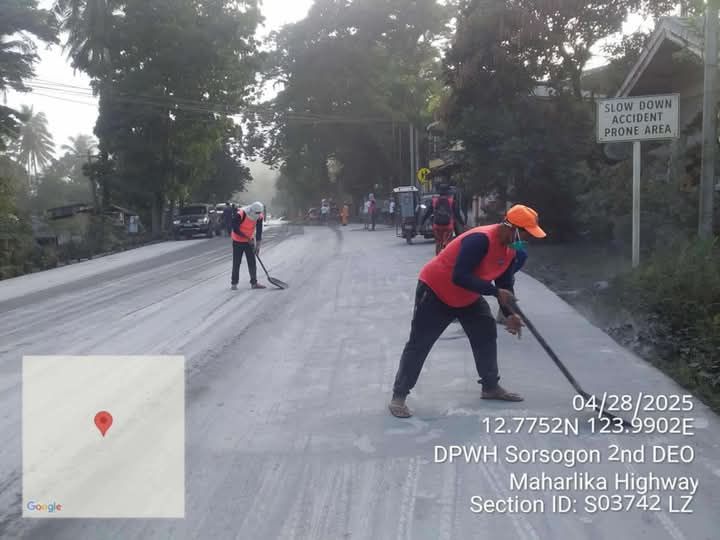
Bulusan Volcano in Sorsogon had a phreatic or steam-driven eruption at 7:43 p.m. on April 29, accompanied by ash emission and volcanic earthquakes, said the Philippine Institute of Volcanology and Seismology (Phivolcs).
The eruption lasted 77 minutes, causing ashfall ranging from significant (~1 cm) to trace amounts across several areas in Sorsogon.
Affected barangays included Cogon, Tinampo, Monbon, Bolos, Gulang-Gulang, Gabao, Bulawan, and Macawayan in Irosin town; Guruyan in Juban town; and Zone 7, Somagongsong, Beguin, Aquino, San Francisco, Calomagon, Inararan, Cadandanan, Dolos, and Polot in Bulan town.
As of 12 a.m. on Wednesday, April 30, Phivolcs recorded 66 volcanic earthquakes, including six volcanic tremors that lasted up to 163 minutes.
Rumbling sounds were also reported in Barangays Cogon and Bagsangan in Irosin during the eruption.
Pre-eruption measurements showed sulfur dioxide (SO₂) emissions averaged 548 tons, twice as much as the usual background level of under 200 tons per day.
Ongoing hazards
Alert Level 1 (low-level unrest) remains in effect for Bulusan Volcano, which indicates that “there are increased chances of phreatic eruptions occurring again after the eruption on April 29.”
READ MORE: https://mb.com.ph/2025/4/29/another-phreatic-eruption-possible-at-bulusan-volcano-phivolcs-warns
The alert status was raised to Level 1 following the first phreatic eruption on April 28.
READ MORE: https://mb.com.ph/2025/4/29/bulusan-volcano-erupts-for-2nd-consecutive-day
Phivolcs reiterated that entry into the four-kilometer permanent danger zone remains strictly prohibited.
Local authorities and residents are advised to exercise caution within the two-kilometer extended danger zone on the southeast flank, which is susceptible to ashfall, pyroclastic density currents (uson), rockfall, and other volcanic hazards.
Those affected by ashfall are urged to take precautions, such as wearing face masks or using damp cloths to avoid inhaling ash, particularly for vulnerable groups, including the elderly, individuals with respiratory or heart conditions, pregnant women, and young children.
Civil aviation authorities have also been advised to instruct pilots to avoid flying near the volcano’s summit, as ash from phreatic eruptions can pose serious risks to aircraft.
Those living near valleys and river channels, especially on the western slopes, should remain vigilant for possible lahars or sediment-laden flows during heavy rainfall following the eruption.