






Manila Bulletin
 Business
The Economy
'I'm not happy with 6% growth': Balisacan says Philippine climb to high-income status by 2040 'not feasible'
Business
The Economy
'I'm not happy with 6% growth': Balisacan says Philippine climb to high-income status by 2040 'not feasible'
Business
The Economy
'I'm not happy with 6% growth': Balisacan says Philippine climb to high-income status by 2040 'not feasible'
'I'm not happy with 6% growth': Balisacan says Philippine climb to high-income status by 2040 'not feasible'
By Derco Rosal
Published Jul 31, 2025 02:11 pm


At A Glance
- Citing a lackluster performance that the Philippine economy has been showing since its recovery from the Covid-19 pandemic, climbing up to the high income status target 15 years from now could be impossible, the country's socioeconomic planner stated.
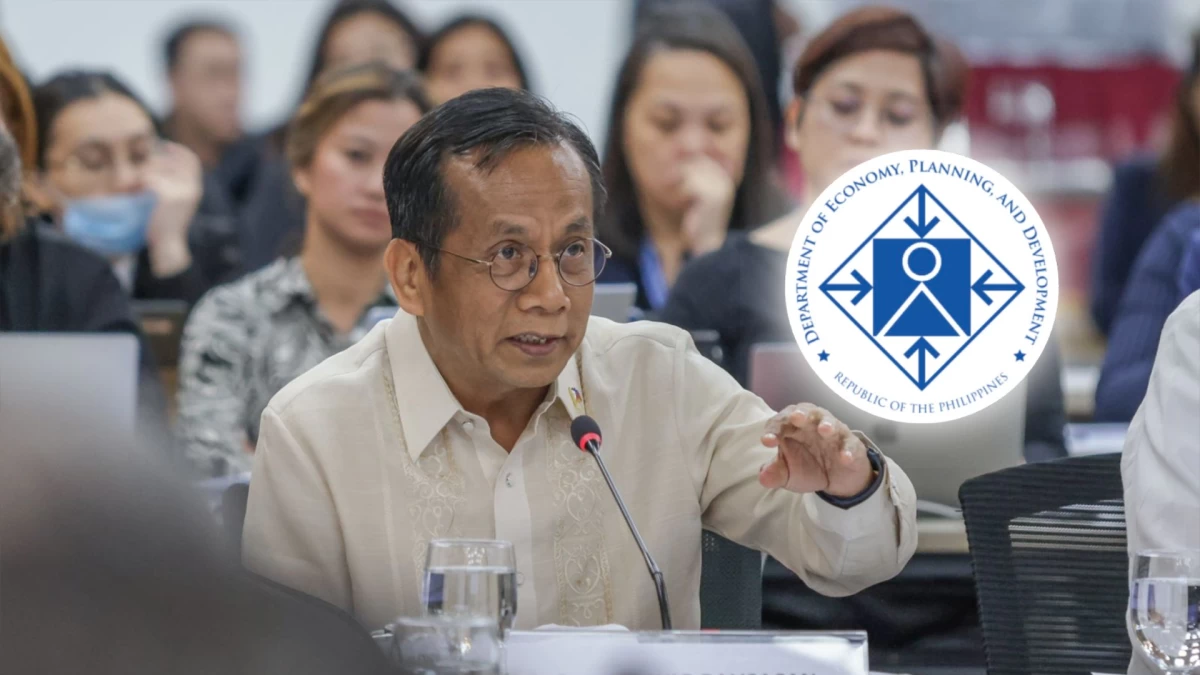
Citing a lackluster performance that the Philippine economy has been showing since its recovery from the Covid-19 pandemic, climbing to the high-income-status target 15 years from now could be impossible, the country’s chief socioeconomic planner stated.
Department of Economy, Planning, and Development (DEPDev) Secretary Arsenio M. Balisacan told reporters during the agency’s midyear press briefing on Thursday, July 31, that the economy had been severely affected by the worst post-war recession experienced at the height of the pandemic in 2020.
“That’s quite a big deal—a lot of contraction. And what that meant is we lost three years of growth momentum,” Balisacan said. “So that 2040 [high-income-status aspiration], at the current growth rate, is not likely going to be feasible anymore.”
Balisacan was the director-general of the state planning agency National Economic and Development Authority (NEDA)—DEPDev’s predecessor—during the Benigno Aquino III administration when AmBisyon 2040 was crafted, a vision that was adopted by the succeeding administrations. This long-term plan outlined the target of making the Philippines a high-income country by 2040.
As earlier reported by Manila Bulletin, the Philippines is seen to become an upper-middle-income country (UMIC)—an aspiration of the current Marcos Jr. administration—before 2040, as projected by DBS Bank Ltd. of Singapore. But the country would be surpassed by Vietnam, which is poised to become a high-income country by that time.
Balisacan recalled that the original plan was for the local economy to accelerate by six to eight percent through 2040 in order join the league of developed nations, following the milestone that South Korea had attained previously.
Among the country’s peers in the Association of Southeast Asian Nations (ASEAN), Balisacan noted that Vietnam and Indonesia have been ambitious with their growth targets. Over two decades, Vietnam “has been growing very rapidly and consistently—and in terms of growth, they are growing faster than us now.”
“They are very ambitious. Now, they are embarking on a march toward becoming a developed country. And to achieve that within the next two decades, they want to grow at a double-digit rate.”
“Indonesia is trying to grow now. The new president is crafting a long-term plan, and they want to grow by eight percent to become a high-income country as fast as possible. That’s the kind of aspiration we must have—not just for our administration, but for the ones that will follow,” Balisacan added.
He then remarked: “I am not happy with six percent,” which is the midpoint of the government’s downscaled gross domestic product (GDP) growth target for the year, at 5.5 to 6.5 percent. “With six percent, we will be overtaken by [our regional peers]—we need to grow faster.”
It can be recalled that the economic managers, which include Balisacan, citing global headwinds, had also narrowed the growth target range for 2026 to 2028 to six to seven percent, from the previously more ambitious six to eight percent.
But to accelerate the growth of the country’s GDP, Balisacan said the country must address various constraints, including structural, technical, and institutional challenges.
“We can still be within that range around 2050. But if we can grow faster while making it more inclusive, perhaps, we may still meet the 2040 target,” Balisacan noted, reiterating the need to expand at a faster pace.
Moving forward, Balisacan said the new DEPDev law mandates the government to craft a long-term vision covering 2025 to 2050, providing a chance to revisit and update the 2040 targets. He added that with sustained momentum, the country can still meet its development aspirations.
In early July, President Ferdinand Marcos Jr.’s chief economic manager said that achieving UMIC status is definitely attainable by the end of 2025 or 2026, citing the still expansionary national budget planned for next year to stimulate the economy.
“Surely, we will attain UMIC status by the end of the year or next year,” Department of Finance (DOF) Secretary Ralph G. Recto earlier told Manila Bulletin when he was asked if he believes the country can finally escape the lower-middle-income trap by next year and climb to UMIC status.
According to the latest data of the Washington-based World Bank, the Philippines’ gross national income (GNI) per capita stood at $4,470 in 2024, setting a record high. Last year’s GNI per capita stood closer to the multilateral lender’s lowered UMIC threshold of $4,496 to $13,935 for fiscal year (FY) 2026, due to the United States (US) dollar’s appreciation versus other currencies.
Based on the World Bank’s latest country income classification, the Philippines remained classified as a lower-middle-income country (LMIC). LMICs are those whose GNI per capita ranged between $1,136 and $4,495 in 2024.
While the country’s GNI per capita last year was within the Philippine Development Plan (PDP) 2023-2028’s goal of $4,454-$4,592 for 2024 it still fell behind Vietnam’s $4,490.
In the coming years, the government aims to raise full-year GNI per capita to $4,814-$4,920 by 2025, $5,256–$5,563 by 2026, $5,645–$6,056 by 2027, and $6,044–$6,571 by 2028, under PDP 2023-2028, which serves as the current administration’s medium-term socioeconomic blueprint.
GNI measures the total income generated by a country’s residents, both domestically and abroad, making it a broader indicator of economic performance than GDP, which only accounts for local output.