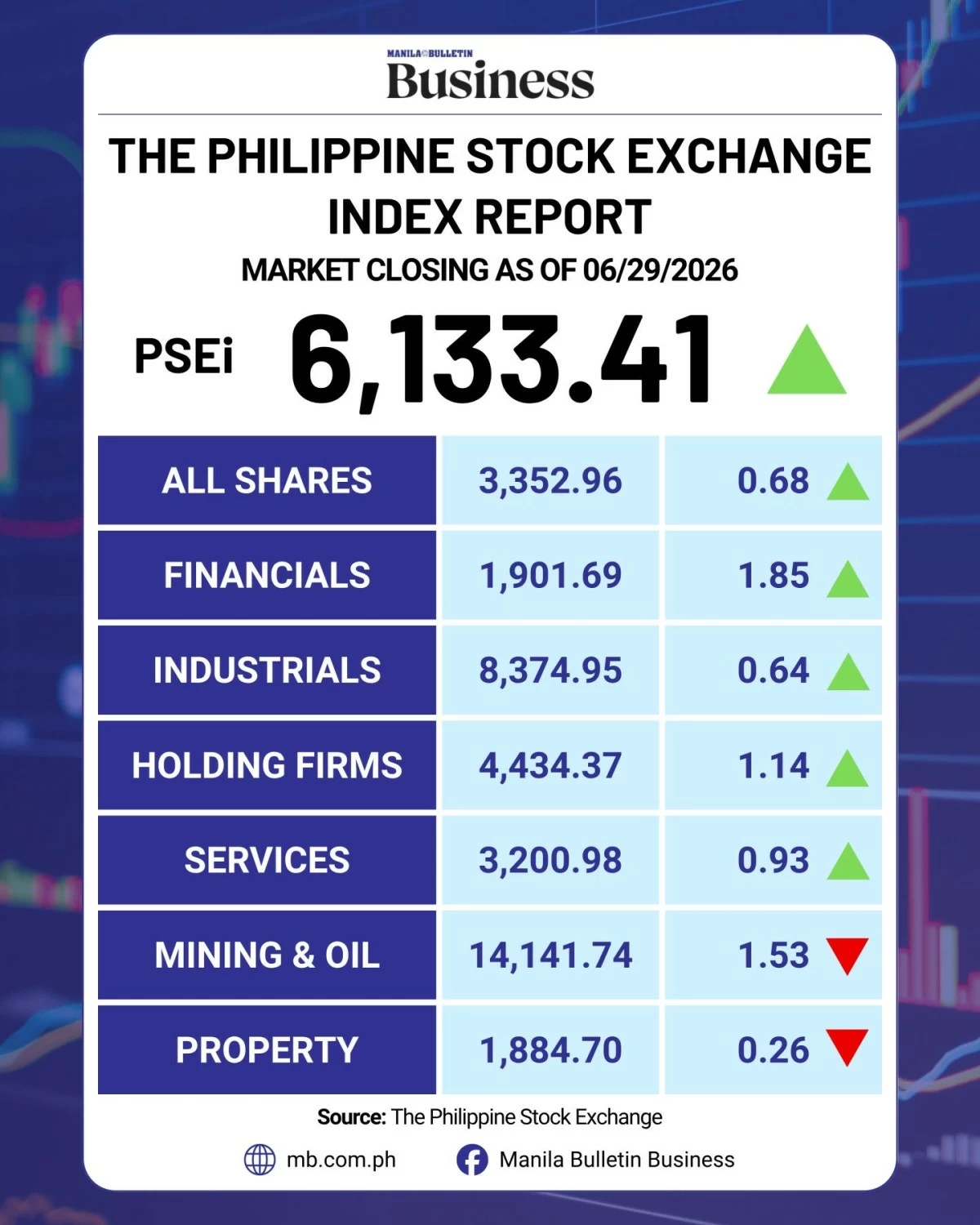
Continuing its recovery from last week’s sell-off, the Philippine Stock Exchange index (PSEi) rose for a third straight trading day on Monday, June 29, as easing concerns over the Middle East conflict and a stronger peso lifted investor sentiment. The main index gained 61.17 points, or 1.01...
The World Bank Group (WBG) has lowered its 2026 growth forecast for the Philippines to 3.7 percent, warning that the ongoing war in the Middle East is weighing heavily on energy-importing economies and threatening to push global growth to its weakest pace since the onset of the Covid-19 pandemic....
The Bangko Sentral ng Pilipinas (BSP) would likely continue hiking interest rates this year despite the lower-than-expected inflation rate in May, even as the pace of monetary policy tightening may be more gradual as economic growth remains subdued, according to Singapore-based United Overseas Bank...
Philippine economic growth is seen falling to a new post-pandemic low of three percent this year as the lingering impacts of last year’s multi-billion-peso flood-control corruption scandal and the prolonged war in the Middle East weigh on investor and business confidence, according to think tank...
Despite the weakening of Philippine peso, Malacañang remains confident that the Bangko Sentral ng Pilipinas (BSP) is on top of the situation. BSP Governor Eli Remolona recently stated that the Philippine peso dipping to P63.50 per US dollar would be acceptable as long as the decline is measured....
The inflation-targeting Bangko Sentral ng Pilipinas (BSP) is expected to continue raising interest rates to contain surging inflation despite the risk of slower economic growth. In a May 22 report, Japanese financial giant MUFG Bank Ltd. said the Philippines is facing one of the most severe...
The World Bank warned that the Philippines’ broad-based economic slowdown in the first quarter of 2026 could spill over into weaker household incomes and higher food prices as the country grapples with an escalating energy price shock triggered by tensions in the Middle East. In its latest...
De La Salle University (DLSU) economists slashed their 2026 Philippine gross domestic product (GDP) growth forecast to 3.11 percent from 3.79 percent previously, warning that the economy is facing mounting pressure from the Middle East conflict, elevated inflation, and lingering domestic...
Malacañang said the Philippine peso breaching another record low value against US dollar was due to "unusually strong" dollar and the ongoing Middle East crisis. In a Palace briefing on Thursday, April 30, Palace Press Officer and Communications Undersecretary said that the weakening of the peso...
The peso pierced the ₱61:$1 level on Tuesday, April 28, as the oil-vulnerable local currency continued to weaken amid uncertainties wrought by the prolonged war in the Middle East. As of 1:52 p.m., the peso hit an intraday low of ₱61.08 against the United States (US) dollar after opening...
While Asian currencies have been on a modest decline since Middle East tensions flared up, Japanese financial giant MUFG Bank Ltd. said the Philippine peso was the biggest loser among regional currencies, given the domestic economy’s high exposure to imported oil. Separately, think tank Capital...
Philippine economic growth in 2026 would have hit the government’s downgraded target range had the war in the Middle East been short-lived, according to the United Nations Economic and Social Commission for Asia and the Pacific (UNESCAP). However, the Bangkok-headquartered UNESCAP said a...