






Manila Bulletin
 Business
The Economy
World Bank sees Philippines growing just 3.7% in 2026 amid Middle East war
Business
The Economy
World Bank sees Philippines growing just 3.7% in 2026 amid Middle East war
Business
The Economy
World Bank sees Philippines growing just 3.7% in 2026 amid Middle East war
World Bank sees Philippines growing just 3.7% in 2026 amid Middle East war
Published Jun 12, 2026 01:45 pm


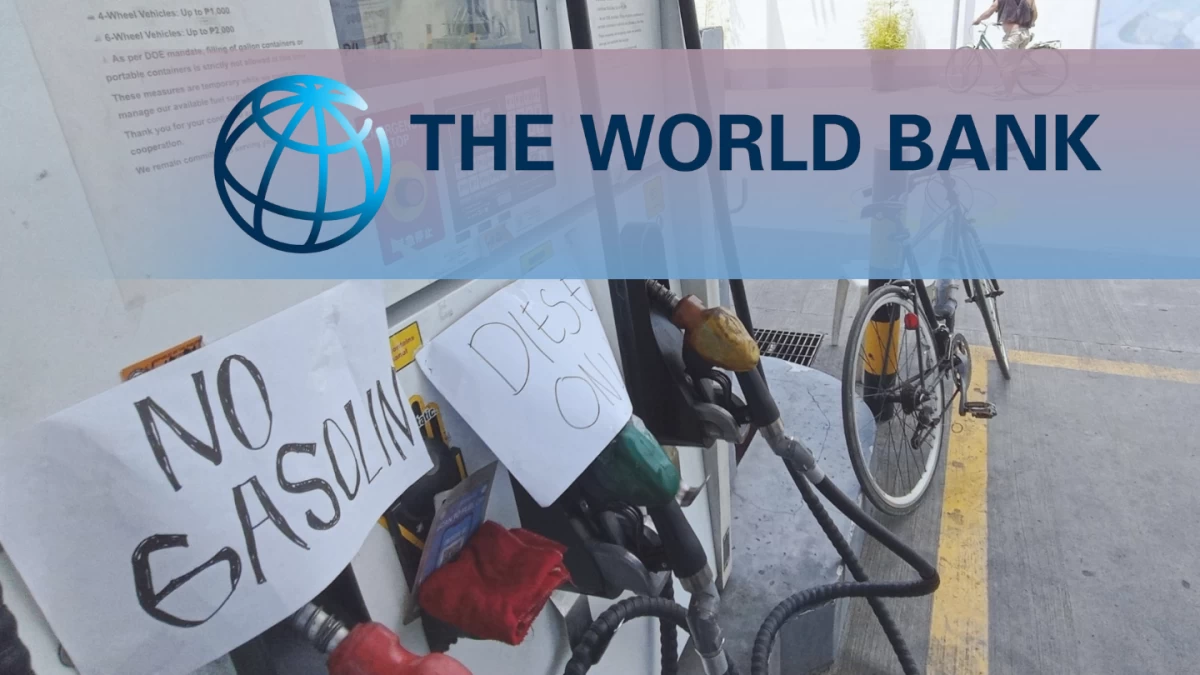
The World Bank Group (WBG) has lowered its 2026 growth forecast for the Philippines to 3.7 percent, warning that the ongoing war in the Middle East is weighing heavily on energy-importing economies and threatening to push global growth to its weakest pace since the onset of the Covid-19 pandemic.
In its flagship June 2026 Global Economic Prospects (GEP) report released Thursday night, June 11 (Manila time), the Washington-based WBG projected Philippine gross domestic product (GDP) growth to slow further this year from 4.4 percent in 2025 before recovering to 5.6 percent in both 2027 and 2028.
If realized, the WBG’s 2026 growth projection would mark the country’s weakest post-pandemic GDP expansion since the 2020 recession at the height of the most stringent Covid-19 lockdowns.
To recall, the Philippine economy expanded by merely 2.8 percent in the first quarter as delays in government infrastructure spending and lingering uncertainty wrought by the multibillion-peso flood-control corruption scandal weighed on both public and private consumption as well as local and foreign investor sentiment.
Meanwhile, the lender’s 2027 forecast falls within the government’s downscaled 5.5- to 6.5-percent growth target, while its 2028 projection is below the also downgraded six- to seven-percent goal.
Despite the regional shock from surging global oil prices, the WBG said economic activity across East Asia and Pacific (EAP) remained resilient in early 2026, with demand for artificial intelligence (AI)-related products supporting industrial production as well as export growth in several economies, including the Philippines.
However, financial conditions tightened across the EAP region following the outbreak of the conflict in the Middle East.
“Currencies depreciated, equity markets declined, and local-currency bond yields rose, especially in Indonesia, the Philippines, and Thailand, with only a partial recovery after the ceasefire,” the report noted. The Philippine peso fell to record-low levels closer to ₱62:$1 amid the prolonged war, while higher bond yields sought by domestic creditors made it more difficult for the government to borrow.
The WBG noted that most economies in EAP, including the Philippines, are net energy importers that depend heavily on Middle Eastern fuel supplies, making them vulnerable to prolonged disruptions in global markets. It warned that fiscal positions in energy-importing economies like the Philippines and Thailand are likely to come under pressure from higher prices as well as conflict-related disruptions.
The lender also noted that governments across the region have rolled out measures to cushion households as well as businesses from the impact of the energy price and supply shock. Among EAP economies, the Philippines and Vietnam were cited by the WBG as having responded heavily through interventions that largely relied on domestic subsidies.
Moving forward, the WBG sees brighter prospects beyond this year.
“Public investment is expected to recuperate in the Philippines,” the report said, helping support a rebound in regional growth as geopolitical uncertainty eases, energy prices stabilize, and demand improves.
Globally, the WBG expects economic growth to slow to 2.5 percent this year from 2.9 percent last year, the weakest pace since the Covid-19 pandemic. The lender said forecasts for about two-thirds of economies worldwide have been downgraded from its January projections.
Global growth is expected to improve to 2.8 percent next year but would still remain 0.4 percentage point (ppt) below the average recorded during the 2010s. The WBG warned that weak growth in developing economies like the Philippines has stalled progress toward narrowing income gaps with advanced economies, with developing countries excluding China and India projected to experience nearly a decade of no progress in income convergence by 2028.
The lender also expects growth in developing economies to slow to a post-pandemic low of 3.6 percent in 2026 from 4.4 percent in 2025 before recovering to 4.2 percent in 2027.
According to WBG, the closure of the Strait of Hormuz has severely disrupted energy markets, with Brent crude oil prices projected to average $94 per barrel this year, or 36 percent higher than last year. Fertilizer prices are also expected to rise significantly, adding pressure on food prices worldwide.
Higher energy and fertilizer prices are expected to push global inflation up to four percent in 2026 from 3.3 percent in 2025, according to the report.
The WBG warned that downside risks remain substantial: if energy supply disruptions become more severe than currently assumed and trigger significant financial stress, global growth could slow to just 1.3 percent this year while inflation could accelerate further to 4.4 percent.
“Developing countries have faced a series of challenges over the last decade. The impact differs by country, but the basic test is the same: protect people and preserve stability today, without giving up on growth and jobs tomorrow,” WBG president Ajay Banga said in a statement.
“In response to the current shock, we are providing liquidity where it is needed now—and we are ready with additional financing, guarantees, and private-sector solutions if pressures deepen. Our job is to help countries steady the ship, keep reforms moving, and emerge stronger on the other side,” Banga added.
To help countries cope with the crisis, the WBG said it is making up to $50 billion to $60 billion immediately available through existing financing instruments, including $25 billion of pre-arranged financing. The lender added that it could scale up support to as much as $80 billion to $100 billion over the next 15 months if the conflict and its economic fallout persist.
According to the WBG, the financing package could be used to support social safety nets for vulnerable households, strengthen fiscal capacity, as well as provide working capital and liquidity support for businesses and farms. It said more than 30 countries are already working with the lender to strengthen preparedness and enable a rapid response should economic conditions deteriorate further.
“The conflict has taken a toll on global activity, but every crisis also brings an opportunity. This moment should be used to strengthen policy frameworks, invest in infrastructure, accelerate business-enabling reforms, and mobilize private capital to support job creation at scale,” WBG deputy chief economist Ayhan Kose said.
The latest GEP also warned that rising debt burdens are making it more difficult for developing economies to respond to crises and invest in long-term development priorities while driving up borrowing costs.
It noted that since 2010, aggregate government debt across developing economies has climbed from below 40 percent of GDP to more than 70 percent.
The report found that countries with already elevated debt levels face disproportionately higher borrowing costs as debt increases, underscoring the benefits of reducing debt burdens to create more room for investments in infrastructure, health, and education that support growth as well as job creation.