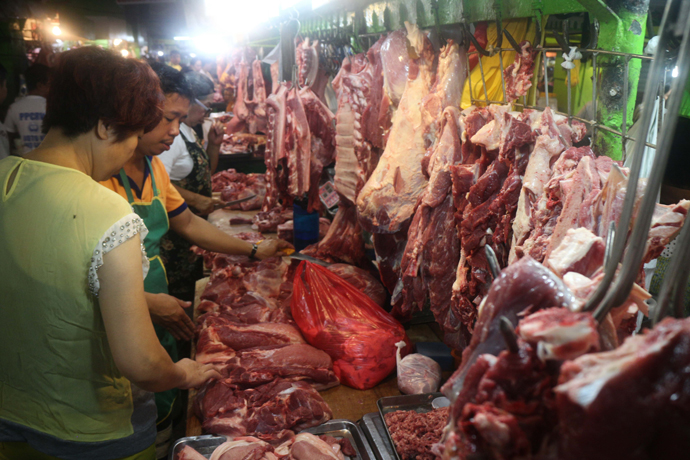
Now that the Philippines is under a state of calamity due to African Swine Fever (ASF), the Department of Agriculture (DA) is hoping to get more budget of at least P6 billion to boost efforts to fight the dreaded animal virus that already resulted in billions of losses to the local hog industry....
The Department of Agriculture should expedite the rollout of programs promoting repopulation and biosecurity measures for local hog raisers in the country, Senator Nancy Binay said on Wednesday, May 12. Binay said that since President Duterte has already declared a state of calamity throughout the...
Department of Agriculture (DA) Secretary William Dar admitted Monday, May 10 that the agency "can't please everyone" even as he noted the huge challenges that the local hog industry has faced as a result of the coronavirus disease (COVID-19) pandemic and the African Swine Flu (ASF) problem....
Despite a 12-month tariff cut imposed on pork, a group of local meat importers began lobbying for a much longer period wherein the pork import tariff rate is kept at 15 percent from the original 40 percent until 2025. A customer pays for pork at a roadside market stall in Mandaluyong City, Manila,...
The government’s failure to stop smuggled pork imports has put the country at more risk of contracting new variants of African Swine Fever (ASF) that began to cause further damage in China, the world’s largest pork-producing country....
Senate Minority Leader Franklin Drilon on Tuesday, April 27, expressed belief that the government can maintain the tariff rates and adjust the minimum access volume (MAV) in the importation of pork to more reasonable levels. (MANILA BULLETIN File photo/Keith Bacongco) At the Senate Committee of the...
Amid the prevalence of African Swine Fever (ASF), state-run lender Land Bank of the Philippines (LANDBANK) has doubled its credit commitment to the local swine industry from P15 billion to P30 billion. This, according to the bank, will help local pork producers and feed millers to repopulate and...
Meat prices continued to rise despite the recent 150 percent surge in pork import volume, casting doubt on the government’s recent move to bring down tariffs on imported pork. A customer pays for pork at a roadside market stall in Mandaluyong City, Manila, the Philippines. (Bloomberg file) “The...
It may have taken some time since the alleged kickback scheme in pork importation was exposed, but Agriculture Secretary William Dar is more certain now that the Department of Agriculture (DA) has nothing to do with this so-called tongpats scandal. During a recent senate hearing, Dar denied any...
The tariff cuts on imported pork under Executive Order 128 is expected to result in P14 billion loss in government revenue, according to the Kilusang Magbubukid ng Pilipinas (KMP). A customer pays for pork at a roadside market stall in Mandaluyong City, Manila, the Philippines, on Sunday, March 14,...
The validity of Executive Order (EO) 124, which imposed a price ceiling on pork and chicken in Metro Manila, will end this week, and the government and private sector have two completely different sentiments about its effectiveness. For one, Noel Reyes, the spokesperson of the Department of...
Samahang Industriya ng Agrikultura (SINAG) wrote to Tariff Commission Chairperson Marilou Mendoza to raise the tariff on HS 0203 meat of swine (fresh, chilled, or frozen) to 44 percent. The formal proposal was also forwarded to Senator Cynthia Villar, who also serves as chairperson of the senate...