

ADVERTISEMENT

Philippines, UK eye expanded space cooperation, satellite to boost disaster response

Published Aug 29, 2026 07:29 am

At A Glance

  • The Philippines and the United Kingdom are looking to expand cooperation in space science and technology, satellite data, artificial intelligence, and innovation.
  • The upcoming launch of the Multispectral Unit for Land Assessment (MULA) satellite is expected to strengthen the country's capabilities in disaster response, agriculture, and environmental monitoring.
  • MULA is undergoing space environment testing in the UK, with PhilSA eyeing a possible April 2027 launch aboard SpaceX's Transporter-20.
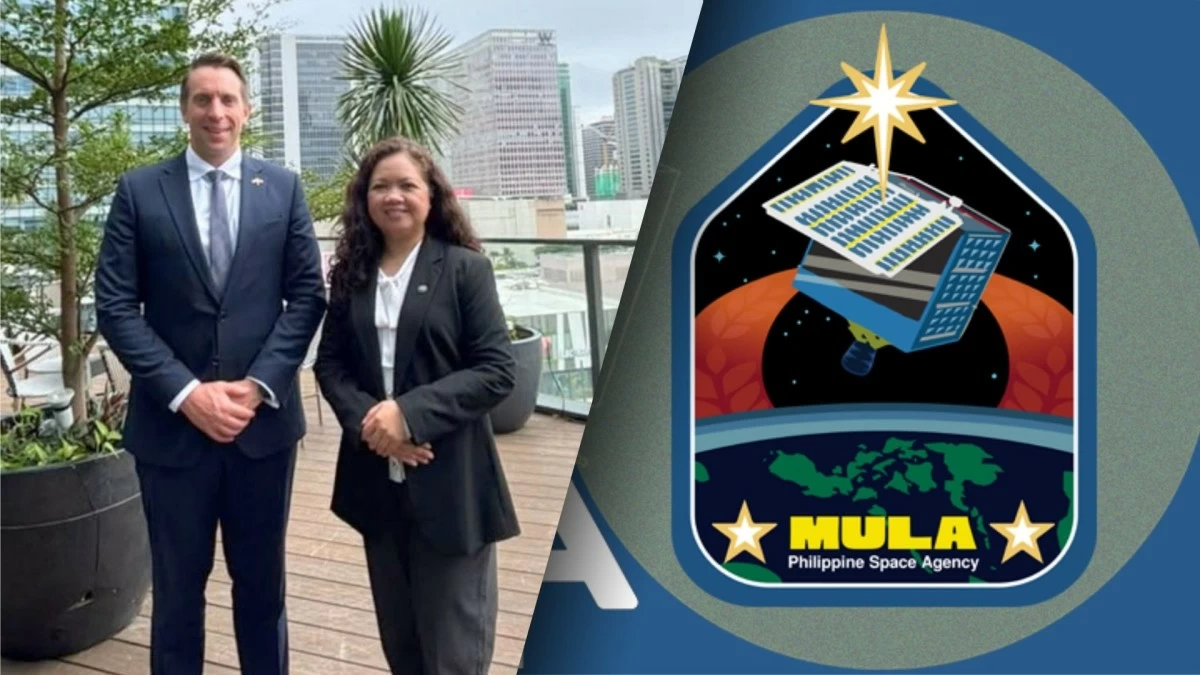
Philippine Space Agency (PhilSA) Acting Director General Dr. Gay Jane Perez (right) meets with United Kingdom Trade Commissioner Martin Kent (left) to discuss the upcoming launch of the MULA satellite and opportunities to expand UK-Philippines cooperation in space science and technology applications. (British Embassy in Manila/PhilSA)

The Philippines and the United Kingdom are looking to deepen cooperation in space science and technology, satellite data, artificial intelligence (AI), and innovation, as the two countries prepare for the launch of the Multispectral Unit for Land Assessment (MULA) satellite.

Philippine Space Agency (PhilSA) Acting Director General Dr. Gay Jane Perez met with United Kingdom Trade Commissioner Martin Kent to discuss MULA's upcoming launch and future opportunities to strengthen bilateral cooperation in space technology applications, according to posts by the British Embassy in the Philippines and PhilSA.

The British Embassy said MULA, developed in partnership with the United Kingdom, would support disaster response, agriculture, and environmental monitoring across the Philippines.

The satellite is expected to give the Philippines greater capacity to use Earth observation data for disaster risk reduction and management, as well as for monitoring land, resources, and environmental conditions.

PhilSA has said MULA will provide data for agriculture, maritime monitoring, disaster risk reduction and management, and national security applications.

The agency has also cited the importance of satellite data in disaster operations, including the production of maps showing landslide and earthquake damage, oil spills, burned areas, and flood extents for government disaster response agencies and local governments.

PhilSA previously said MULA's higher-resolution imaging capability would allow the country to better monitor terrestrial ecosystems, land and marine resources, agricultural activity, and environmental conditions for more proactive disaster management and mitigation.

“From Earth observation to space innovation, the UK and the Philippines are reaching new heights together,” the British Embassy said.

Possible 2027 launch

MULA, described by PhilSA as the country's most advanced satellite to date, is now fully built and undergoing space environment testing in the United Kingdom to verify that it meets technical and mission-assurance requirements.

During the ninth meeting of the Philippine Space Council in June, Perez reported that MULA could be launched in April 2027 aboard SpaceX's Transporter-20, although PhilSA stressed that the development schedule could still change depending on the results of testing.

The satellite will carry a TrueColour camera capable of producing 5-meter-resolution images, as well as Automatic Identification System and Automatic Dependent Surveillance-Broadcast payloads for detecting and tracking ships and aircraft.

“As MULA paves the way for a new era of capability, the UK looks forward to deepening its partnership with PhilSA and advancing even more ambitious space collaborations,” the British Embassy said.

UK partnership

The UK-Philippines space partnership has been closely linked to MULA's development, with Filipino engineers receiving satellite-development training and hands-on experience from Surrey Satellite Technology Ltd. (SSTL) in the United Kingdom.

PhilSA said most MULA engineers have completed intensive know-how transfer and hands-on training with SSTL, allowing them to apply advanced satellite engineering expertise in the Philippines.

The agency also previously reported that a UK trade envoy met with PhilSA and MULA engineers in 2022 to discuss the satellite project and opportunities to build more sovereign Philippine satellites in the future.

PhilSA's June report said the Philippine Space Council had approved the development of a MULA constellation as a national priority, allowing follow-on satellites to be developed and integrated domestically to ensure more continuous access to Earth-observation data.

PhilSA said the initiative would help build a Philippine space industry and establish a nationally owned and operated Earth-observation capability for the country's strategic requirements.

Related Tags

PhilSA PH-UK satellite technology disaster response MULA satellite
ADVERTISEMENT
.most-popular .layout-ratio{ padding-bottom: 79.13%; } @media (min-width: 768px) and (max-width: 1024px) { .widget-title { font-size: 15px !important; } }

{{ articles_filter_1561_widget.title }}

.most-popular .layout-ratio{ padding-bottom: 79.13%; } @media (min-width: 768px) and (max-width: 1024px) { .widget-title { font-size: 15px !important; } }

{{ static_articles_1562_widget.title }}

.most-popular .layout-ratio{ padding-bottom: 79.13%; } @media (min-width: 768px) and (max-width: 1024px) { .widget-title { font-size: 15px !important; } }

{{ articles_filter_1563_widget.title }}

{{ articles_filter_1564_widget.title }}

.mb-article-details { position: relative; } .mb-article-details .article-body-preview, .mb-article-details .article-body-summary{ font-size: 17px; line-height: 30px; font-family: "Libre Caslon Text", serif; color: #000; } .mb-article-details .article-body-preview iframe , .mb-article-details .article-body-summary iframe{ width: 100%; margin: auto; } .read-more-background { background: linear-gradient(180deg, color(display-p3 1.000 1.000 1.000 / 0) 13.75%, color(display-p3 1.000 1.000 1.000 / 0.8) 30.79%, color(display-p3 1.000 1.000 1.000) 72.5%); position: absolute; height: 200px; width: 100%; bottom: 0; display: flex; justify-content: center; align-items: center; padding: 0; } .read-more-background a{ color: #000; } .read-more-btn { padding: 17px 45px; font-family: Inter; font-weight: 700; font-size: 18px; line-height: 16px; text-align: center; vertical-align: middle; border: 1px solid black; background-color: white; } .hidden { display: none; }
function initializeAllSwipers() { // Get all hidden inputs with cms_article_id document.querySelectorAll('[id^="cms_article_id_"]').forEach(function (input) { const cmsArticleId = input.value; const articleSelector = '#article-' + cmsArticleId + ' .body_images'; const swiperElement = document.querySelector(articleSelector); if (swiperElement && !swiperElement.classList.contains('swiper-initialized')) { new Swiper(articleSelector, { loop: true, pagination: false, navigation: { nextEl: '#article-' + cmsArticleId + ' .swiper-button-next', prevEl: '#article-' + cmsArticleId + ' .swiper-button-prev', }, }); } }); } setTimeout(initializeAllSwipers, 3000); const intersectionObserver = new IntersectionObserver( (entries) => { entries.forEach((entry) => { if (entry.isIntersecting) { const newUrl = entry.target.getAttribute("data-url"); if (newUrl) { history.pushState(null, null, newUrl); let article = entry.target; // Extract metadata const author = article.querySelector('.author-section').textContent.replace('By', '').trim(); const section = article.querySelector('.section-info ').textContent.replace(' ', ' '); const title = article.querySelector('.article-title h1').textContent; // Parse URL for Chartbeat path format const parsedUrl = new URL(newUrl, window.location.origin); const cleanUrl = parsedUrl.host + parsedUrl.pathname; // Update Chartbeat configuration if (typeof window._sf_async_config !== 'undefined') { window._sf_async_config.path = cleanUrl; window._sf_async_config.sections = section; window._sf_async_config.authors = author; } // Track virtual page view with Chartbeat if (typeof pSUPERFLY !== 'undefined' && typeof pSUPERFLY.virtualPage === 'function') { try { pSUPERFLY.virtualPage({ path: cleanUrl, title: title, sections: section, authors: author }); } catch (error) { console.error('ping error', error); } } // Optional: Update document title if (title && title !== document.title) { document.title = title; } } } }); }, { threshold: 0.1 } ); function showArticleBody(button) { const article = button.closest("article"); const summary = article.querySelector(".article-body-summary"); const body = article.querySelector(".article-body-preview"); const readMoreSection = article.querySelector(".read-more-background"); // Hide summary and read-more section summary.style.display = "none"; readMoreSection.style.display = "none"; // Show the full article body body.classList.remove("hidden"); } document.addEventListener("DOMContentLoaded", () => { let loadCount = 0; // Track how many times articles are loaded const offset = [1, 2, 3, 4, 5, 6, 7, 8, 9, 10]; // Offset values const currentUrl = window.location.pathname.substring(1); let isLoading = false; // Prevent multiple calls if (!currentUrl) { console.log("Current URL is invalid."); return; } const sentinel = document.getElementById("load-more-sentinel"); if (!sentinel) { console.log("Sentinel element not found."); return; } function isSentinelVisible() { const rect = sentinel.getBoundingClientRect(); return ( rect.top < window.innerHeight && rect.bottom >= 0 ); } function onScroll() { if (isLoading) return; if (isSentinelVisible()) { if (loadCount >= offset.length) { console.log("Maximum load attempts reached."); window.removeEventListener("scroll", onScroll); return; } isLoading = true; const currentOffset = offset[loadCount]; window.loadMoreItems().then(() => { let article = document.querySelector('#widget_1690 > div:nth-last-of-type(2) article'); intersectionObserver.observe(article) loadCount++; }).catch(error => { console.error("Error loading more items:", error); }).finally(() => { isLoading = false; }); } } window.addEventListener("scroll", onScroll); });

Sign up by email to receive news.