







The CCP after EDSA I
From political transition to institutional turbulence, the CCP found new purpose in a changing Philippine cultural landscape
Published Aug 23, 2026 09:09 am


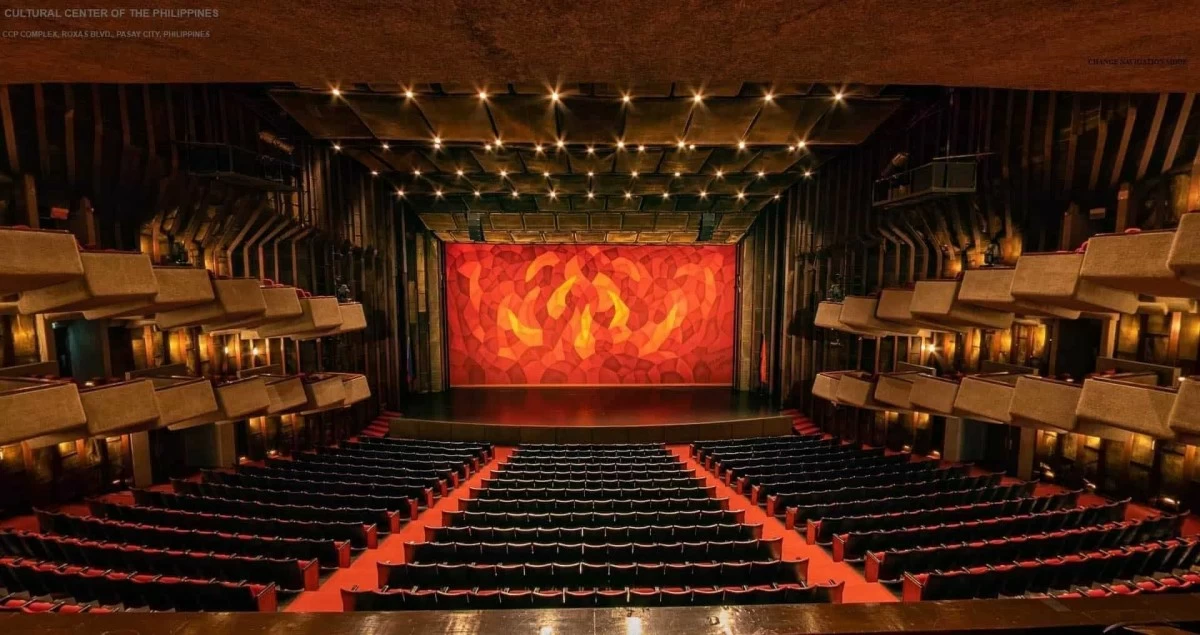
OFFSTAGE DRAMA Inside the CCP’s Tanghalang Nicanor Abelardo, featuring the curtain based on National Artist H. R. Ocampo’s painting ‘Genesis.’ (Photo: CCP)
The end of the Marcos administration in February 1986 ushered in a new political era—and a markedly different climate for the Cultural Center of the Philippines (CCP). With Imelda Marcos away, the CCP, and to some extent the arts, made way for other needs. The CCP, once a flagship institution, entered a period of institutional adjustment.
The Government Service Insurance System (GSIS) called in the loans it had extended to finance CCP’s capital projects, leading to the foreclosure of the Philippine Plaza Hotel, the Coconut Palace, and the extensive parcel of land across Sotto Street from the CCP Main Building. President Corazon Aquino reportedly never set foot inside the CCP during her presidency.
The institution also lost its exemption from civil service regulations, becoming subject to the procedures and constraints of an ordinary bureau. The country’s cultural landscape was also transformed with the establishment of the National Commission for Culture and the Arts (NCCA). Organized on a more participatory model, with decision-making committees composed of artists and cultural practitioners, the NCCA assumed certain functions previously assigned to the CCP and received substantial public funding.
A former CCP officer observed that artistic priorities shifted. It seems that productions tended to distance themselves from association with the Marcos years, turning instead to themes that examined Martial Law abuses and reflected more broadly on the failures of the Marcos years. To some extent, the arts became not only a vehicle for creative expression but also a means of historical reckoning.
The late 1990s brought another period of turbulence as rival factions contested CCP’s leadership. Although the disputes were eventually resolved, they eroded staff morale and tarnished the institution's public standing. Tensions between the CCP and the NCCA also contributed to a prolonged impasse in the conferment of the National Artist awards, delaying the country's highest cultural honors for several years.
As passions cooled, the CCP co-launched programs that have left a lasting mark. Virgin Labfest, launched in 2005, has become the country's premier showcase for new and untried theatrical works. Cinemalaya, established in 2005, revitalized independent Filipino filmmaking. These continue to be among the CCP’s most influential and popular activities.
For much of its history, the CCP Board remained removed from the institution's day-to-day operations. I served briefly as a CCP Trustee in the early 1980s and recall attending only one board meeting. My impression at the time was that trustees were principally engaged in mobilizing financial support for the center's projects.
I lost touch with the CCP over the next decades, but I am told that during those years, CCP functioned largely as a government bureaucracy, with authority concentrated in the president and senior management.
Board meetings served primarily to update trustees on recent activities and secure formal approval for budgets, appointments, and other administrative matters. That was certainly the situation when I returned as a CCP Trustee in 2014.
Notes: (a) Your columnist retired from government service in 1986 as Minister of Education, Culture, and Sports, and went into private professional practice. President Fidel Ramos appointed him chairman of the NCCA, where he served until 2001. He joined the CCP Board as trustee in 2014 and was elected chairman in 2022; and (b) the chairpersons and board members of both the NCCA and the CCP serve on a part-time basis, except for their executive director and president, respectively, who are full-time executives.
Comments are cordially invited, addressed to [email protected].