ADVERTISEMENT

The Philippines' middle-income milestone: Progress, peril, and politics

Published Aug 7, 2026 03:56 pm
The good
For the Philippines, entry into the World Bank’s upper-middle-income club is both a vindication and a warning. After decades in the lower-middle-income category, the country has at last crossed the line. The achievement is real; so is its modesty.
The World Bank’s latest income classification puts the threshold for upper-middle-income status at $4,636 in gross national income per person. The Philippines made it with $4,850—comfortably over the line, but not by much. It remains behind Malaysia, Thailand, Indonesia, and Vietnam. Singapore, as ever, belongs to another category altogether.
The route matters. Vietnam’s ascent has been powered by factories, exports, and industrial upgrading. The Philippines has relied more heavily on remittances from workers abroad. That is a strength, but also an indictment: too many Filipinos must still leave home to raise national income.
A better test of progress is not the label attached to the economy, but the number of Filipinos no longer living in poverty. On that measure, there has been improvement. Poverty incidence fell to 15.5 percent in 2023—about 17.5 million people—down from 18.1 percent in 2021. That means roughly 2.4 million Filipinos escaped poverty in two years.
That is welcome, but it is not fast enough. On current trends—and absent a shock or a bold policy shift—eliminating poverty remains a distant prospect, more likely an achievement for a future administration than for the present one.
Nor does average income say much about distribution. Inequality has eased, with the Gini coefficient falling in the latest official estimates, but the country remains marked by wide gaps in wealth, opportunity, and geography. A higher classification does not make congestion cheaper, rice more affordable, or good jobs more plentiful.
The bad
The price of being promoted to upper-middle-income status is that cheap money becomes scarcer. As an upper-middle-income country, the Philippines will gradually lose some access to concessional official development assistance from multilateral lenders and partner governments. Loans will not disappear; they will simply become less forgiving.
That matters because the country still faces a serious infrastructure gap: roads, railways, ports, power, schools, hospitals, and disaster reconstruction. The Philippines is one of the world’s most disaster-prone economies; resilience is not a luxury, but an annual fiscal requirement. More expensive borrowing will make every weak project harder to justify.
Debt is not yet a crisis. The public debt-to-gross domestic product (GDP) ratio is just above 60 percent—high by pre-pandemic standards, but far below the ratios of the United States, Japan, or the global average. The danger lies less in today’s number than in tomorrow’s arithmetic.
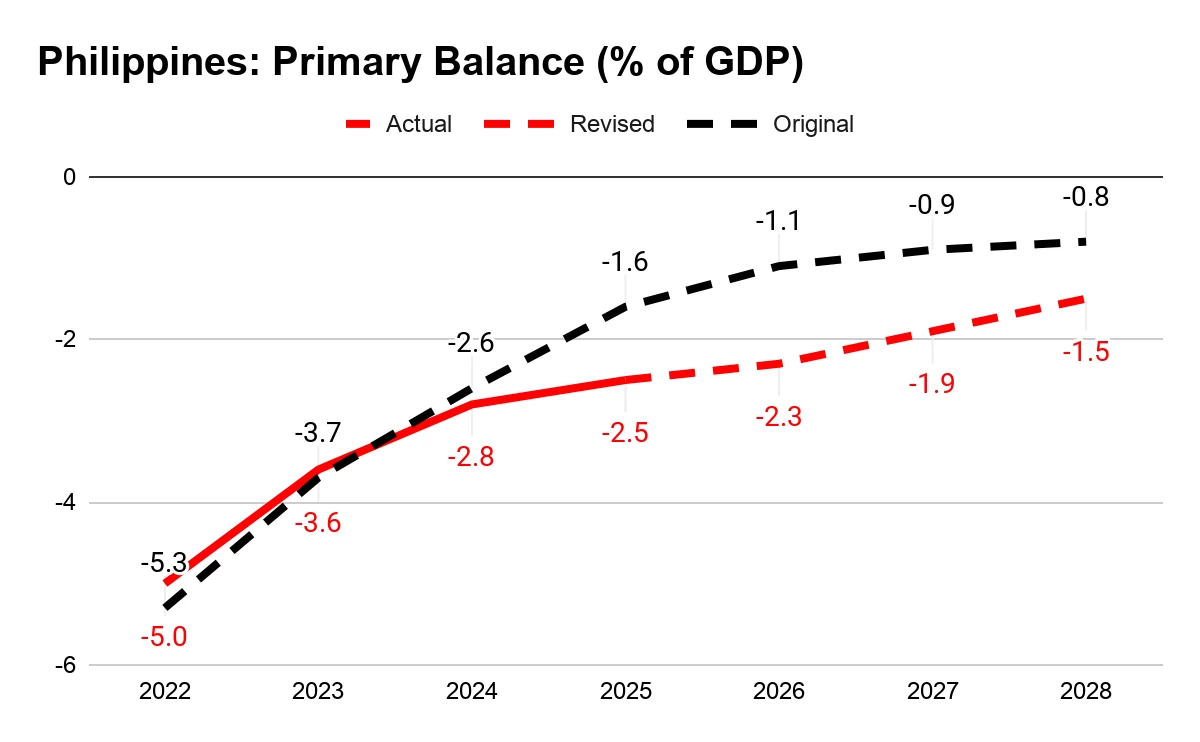
That arithmetic is becoming less friendly. Growth is slowing, borrowing costs are rising, and the primary balance is narrowing. Each trend is manageable on its own, but together they make fiscal consolidation harder.
The rule is simple: debt becomes easier to manage when the economy grows faster than the interest rate on government borrowing. It becomes harder when interest rates exceed growth and the government must run larger primary surpluses merely to keep the debt ratio stable.
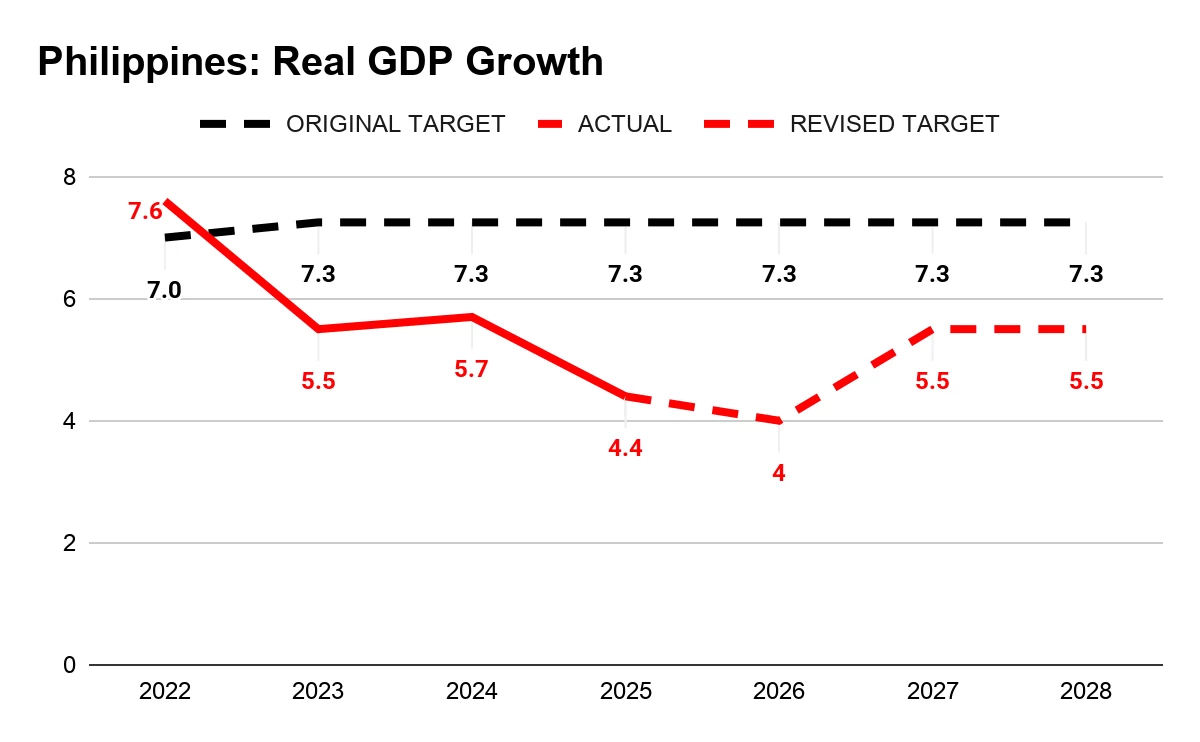
Source: Philippine Statistics Authority; Original targets based on 182nd DBCC Meeting on 08 July 2022; Revised targets based on the 193rd DBCC Meeting on 25 May 2026 and DBCC Ad Referendum approval on 16 June 2026.
Note: The midpoint of the economic growth target was used to represent data points.
Source: Philippine Statistics Authority; Original targets based on 182nd DBCC Meeting on 08 July 2022; Revised targets based on the 193rd DBCC Meeting on 25 May 2026 and DBCC Ad Referendum approval on 16 June 2026. Note: The midpoint of the economic growth target was used to represent data points.
Source: Bureau of the Treasury; Original targets based on the 182nd DBCC Meeting on 08 July 2022; Revised targets based on the 193rd DBCC Meeting on 25 May 2026 and DBCC Ad Referendum approval on 16 June 2026. 
Note: Primary fiscal balance is a government's fiscal balance excluding interest payments on public debt. Figures for 2026 to 2028 were calculated based on interest payments projections in the 2026 Budget of Expenditures and Sources of Financing.
Source: Bureau of the Treasury; Original targets based on the 182nd DBCC Meeting on 08 July 2022; Revised targets based on the 193rd DBCC Meeting on 25 May 2026 and DBCC Ad Referendum approval on 16 June 2026. Note: Primary fiscal balance is a government's fiscal balance excluding interest payments on public debt. Figures for 2026 to 2028 were calculated based on interest payments projections in the 2026 Budget of Expenditures and Sources of Financing.
For the Philippines, the implication is clear: the fiscal room created by growth is shrinking just as the cost of financing development is rising. That is not a reason to stop borrowing; it is a reason to borrow better.
The country should still finance projects whose economic and social returns exceed their costs. But the margin for waste is narrowing. In an upper-middle-income economy, fiscal discipline is no longer merely prudent—it is the cost of credibility.
The ugly
The ugliest risk is political. The spending-and-tax mix appears to be worsening: more transfers, less real infrastructure momentum, and growing pressure for tax cuts without credible offsets. Such policies may be popular, but they are not costless.
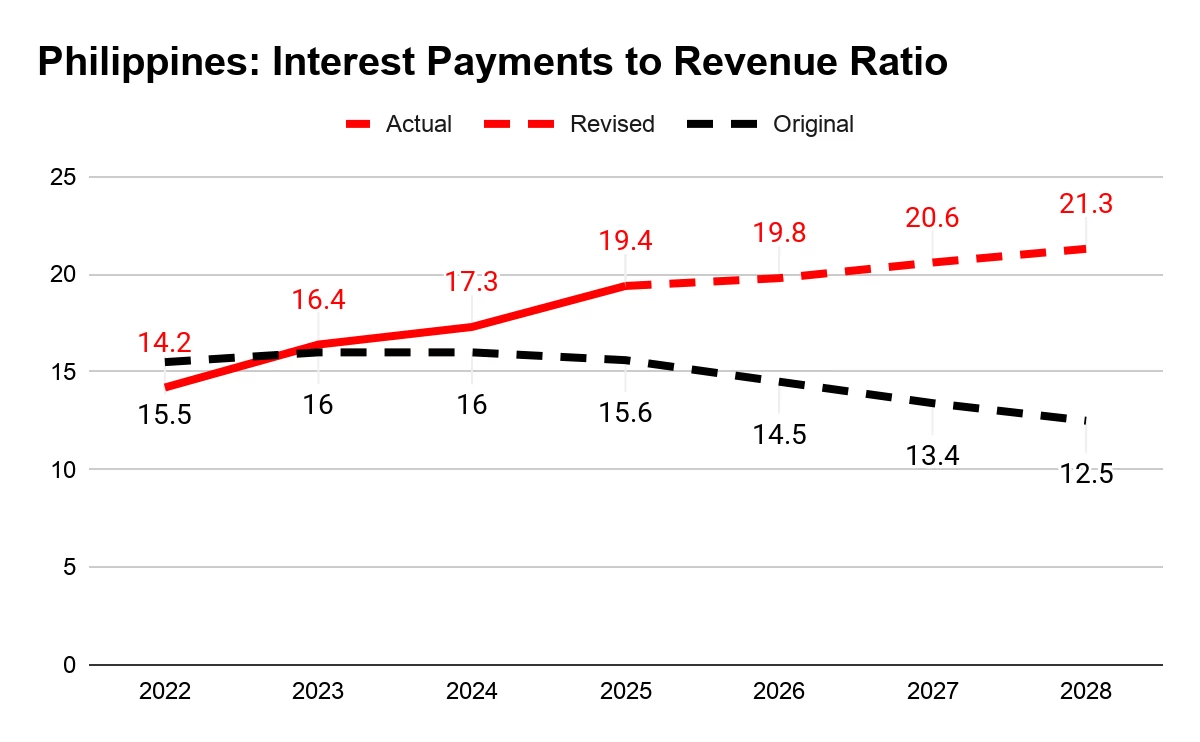
Source: Bureau of the Treasury; Original targets based on 182nd DBCC Meeting on 08 July 2022; Revised targets based on the 193rd DBCC Meeting on 25 May 2026 and DBCC Ad Referendum approval on 16 June 2026. 
Note: Interest Payment figures for 2026 to 2028 were based on projections in the 2026 Budget of Expenditures and Sources of Financing.
Source: Bureau of the Treasury; Original targets based on 182nd DBCC Meeting on 08 July 2022; Revised targets based on the 193rd DBCC Meeting on 25 May 2026 and DBCC Ad Referendum approval on 16 June 2026.  Note: Interest Payment figures for 2026 to 2028 were based on projections in the 2026 Budget of Expenditures and Sources of Financing.
The worry is not simply that concessional finance will fade. It is that foreign-assisted projects will continue to be delayed, politicized, or treated as instruments for electoral advantage rather than national development. A country that borrows at higher rates must execute at higher standards.
Upper-middle-income status should therefore be treated not as a trophy, but as a test. The Philippines has proved that it can grow. It must now prove that it can convert growth into better jobs, lower poverty, narrower inequality, and stronger public institutions. Crossing the line was the easy part; staying on the right side of development will be harder.

Related Tags

Upper middle-income economy World Bank Philippine economy
ADVERTISEMENT
.most-popular .layout-ratio{ padding-bottom: 79.13%; } @media (min-width: 768px) and (max-width: 1024px) { .widget-title { font-size: 15px !important; } }

{{ articles_filter_1561_widget.title }}

.most-popular .layout-ratio{ padding-bottom: 79.13%; } @media (min-width: 768px) and (max-width: 1024px) { .widget-title { font-size: 15px !important; } }

{{ static_articles_1562_widget.title }}

.most-popular .layout-ratio{ padding-bottom: 79.13%; } @media (min-width: 768px) and (max-width: 1024px) { .widget-title { font-size: 15px !important; } }

{{ articles_filter_1563_widget.title }}

{{ articles_filter_1564_widget.title }}

.mb-article-details { position: relative; } .mb-article-details .article-body-preview, .mb-article-details .article-body-summary{ font-size: 17px; line-height: 30px; font-family: "Libre Caslon Text", serif; color: #000; } .mb-article-details .article-body-preview iframe , .mb-article-details .article-body-summary iframe{ width: 100%; margin: auto; } .read-more-background { background: linear-gradient(180deg, color(display-p3 1.000 1.000 1.000 / 0) 13.75%, color(display-p3 1.000 1.000 1.000 / 0.8) 30.79%, color(display-p3 1.000 1.000 1.000) 72.5%); position: absolute; height: 200px; width: 100%; bottom: 0; display: flex; justify-content: center; align-items: center; padding: 0; } .read-more-background a{ color: #000; } .read-more-btn { padding: 17px 45px; font-family: Inter; font-weight: 700; font-size: 18px; line-height: 16px; text-align: center; vertical-align: middle; border: 1px solid black; background-color: white; } .hidden { display: none; }
function initializeAllSwipers() { // Get all hidden inputs with cms_article_id document.querySelectorAll('[id^="cms_article_id_"]').forEach(function (input) { const cmsArticleId = input.value; const articleSelector = '#article-' + cmsArticleId + ' .body_images'; const swiperElement = document.querySelector(articleSelector); if (swiperElement && !swiperElement.classList.contains('swiper-initialized')) { new Swiper(articleSelector, { loop: true, pagination: false, navigation: { nextEl: '#article-' + cmsArticleId + ' .swiper-button-next', prevEl: '#article-' + cmsArticleId + ' .swiper-button-prev', }, }); } }); } setTimeout(initializeAllSwipers, 3000); const intersectionObserver = new IntersectionObserver( (entries) => { entries.forEach((entry) => { if (entry.isIntersecting) { const newUrl = entry.target.getAttribute("data-url"); if (newUrl) { history.pushState(null, null, newUrl); let article = entry.target; // Extract metadata const author = article.querySelector('.author-section').textContent.replace('By', '').trim(); const section = article.querySelector('.section-info ').textContent.replace(' ', ' '); const title = article.querySelector('.article-title h1').textContent; // Parse URL for Chartbeat path format const parsedUrl = new URL(newUrl, window.location.origin); const cleanUrl = parsedUrl.host + parsedUrl.pathname; // Update Chartbeat configuration if (typeof window._sf_async_config !== 'undefined') { window._sf_async_config.path = cleanUrl; window._sf_async_config.sections = section; window._sf_async_config.authors = author; } // Track virtual page view with Chartbeat if (typeof pSUPERFLY !== 'undefined' && typeof pSUPERFLY.virtualPage === 'function') { try { pSUPERFLY.virtualPage({ path: cleanUrl, title: title, sections: section, authors: author }); } catch (error) { console.error('ping error', error); } } // Optional: Update document title if (title && title !== document.title) { document.title = title; } } } }); }, { threshold: 0.1 } ); function showArticleBody(button) { const article = button.closest("article"); const summary = article.querySelector(".article-body-summary"); const body = article.querySelector(".article-body-preview"); const readMoreSection = article.querySelector(".read-more-background"); // Hide summary and read-more section summary.style.display = "none"; readMoreSection.style.display = "none"; // Show the full article body body.classList.remove("hidden"); } document.addEventListener("DOMContentLoaded", () => { let loadCount = 0; // Track how many times articles are loaded const offset = [1, 2, 3, 4, 5, 6, 7, 8, 9, 10]; // Offset values const currentUrl = window.location.pathname.substring(1); let isLoading = false; // Prevent multiple calls if (!currentUrl) { console.log("Current URL is invalid."); return; } const sentinel = document.getElementById("load-more-sentinel"); if (!sentinel) { console.log("Sentinel element not found."); return; } function isSentinelVisible() { const rect = sentinel.getBoundingClientRect(); return ( rect.top < window.innerHeight && rect.bottom >= 0 ); } function onScroll() { if (isLoading) return; if (isSentinelVisible()) { if (loadCount >= offset.length) { console.log("Maximum load attempts reached."); window.removeEventListener("scroll", onScroll); return; } isLoading = true; const currentOffset = offset[loadCount]; window.loadMoreItems().then(() => { let article = document.querySelector('#widget_1690 > div:nth-last-of-type(2) article'); intersectionObserver.observe(article) loadCount++; }).catch(error => { console.error("Error loading more items:", error); }).finally(() => { isLoading = false; }); } } window.addEventListener("scroll", onScroll); });

Sign up by email to receive news.