ADVERTISEMENT

DOE scraps permits, fees for home, business solar panels

Published Aug 6, 2026 03:40 pm
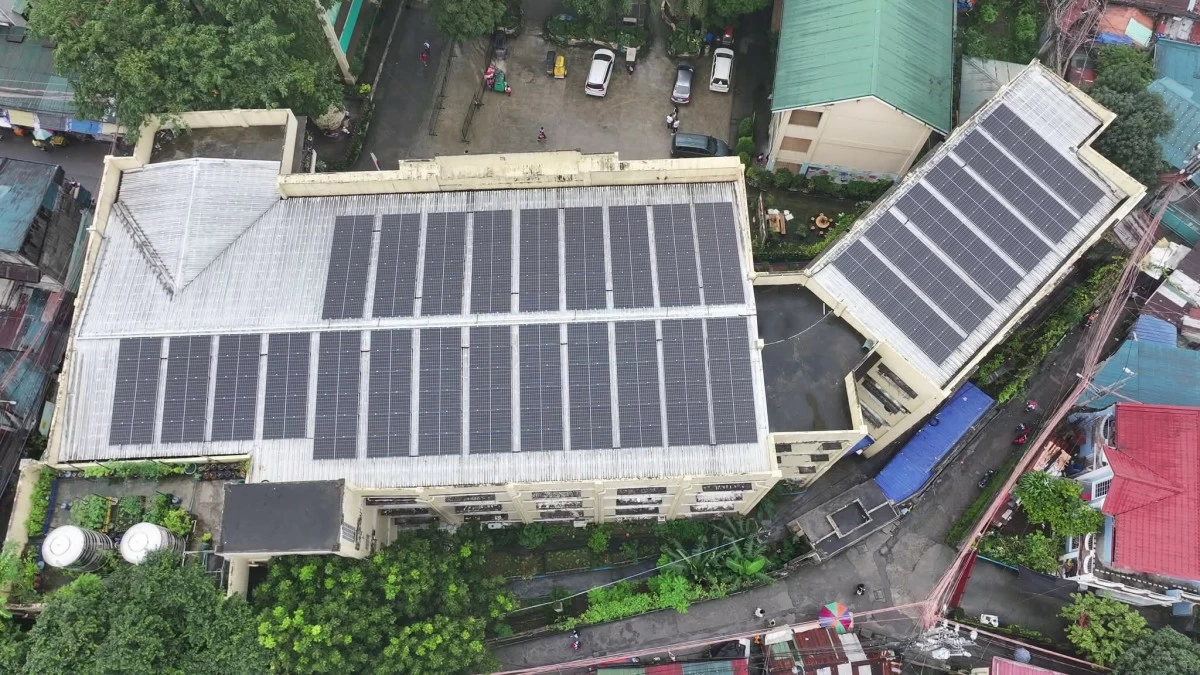
Quezon City Mayor Joy Belmonte leads the ceremonial lighting of the solar power system at San Agustin Elementary School, which has 170 solar panels and is expected to save around P930,000 in electricity costs annually. (Photo courtesy of the Quezon City government)
The government has eliminated administrative and regulatory bottlenecks for households and businesses installing solar panels for self-consumption to accelerate clean energy adoption and lower electricity costs.
Under Department Circular No. DC2026-08-0017, signed by Energy Secretary Sharon S. Garin on July 28, 2026, the Department of Energy (DOE) streamlined rules governing Self-Generating Facility Zero-Export Solar Systems (SGF ZESS) and consumer-grade Micro-Solar Systems (MSS).
DOE said the policy shift directly targets institutional resistance from power distributors while lowering barriers for end-users.
The move forms part of a broader government push to increase renewable energy’s share in the national power generation mix to 35 percent by 2030 and 50 percent by 2040.
By lowering regulatory friction, the DOE said they aim to unlock decentralized rooftop solar capacity across residential and commercial sectors.
Under the new directives, distribution utilities are strictly forbidden from requiring pre-installation clearances, technical permits, or inspection fees before a consumer can install a zero-export solar setup or micro-solar unit.
Power companies are also prohibited from reducing or downgrading an end-user’s assigned transformer or service drop capacity simply because a solar facility has been installed, guaranteeing full grid backup capacity whenever local solar generation experiences downtime.
The circular establishes tiered regulatory standards based on equipment capacity. Micro-Solar Systems—defined as plug-and-play units with direct current capacity up to 1,000 watts (1 kilowatt) and factory-set grid-tied micro-inverters capped at 800 watts (0.8 kilowatts) alternating current—are fully exempt from local government building permits and Certificates of Compliance from the Energy Regulatory Commission.
Consumers installing these plug-and-play models need only issue a written post-installation notice to their host utility.
For larger grid-connected zero-export solar installations, requirements remain limited to written utility notification, a standard building permit, and an ERC Certificate of Compliance.
However, the rule explicitly exempts residential households, clinics, hospitals, and medical facilities from obtaining the compliance certificate. Off-grid, standalone zero-export installations carry no utility notification obligation whatsoever.
While utilities may still conduct Distribution Impact Studies for long-term grid management, the circular mandates that distributors absorb all financial costs and technical responsibility.
Such studies cannot delay or block installation and operational rollout. Power distributors have 30 days from the circular’s effective date to amend internal operating protocols and Citizens’ Charters.
To expand adoption in urban environments, the DOE will partner with the Department of Human Settlements and Urban Development to allow solar installations on residential balconies, windows, rooftops, and exterior building walls.
Further inter-agency efforts with the Department of Trade and Industry and the Department of the Interior and Local Government will focus on equipment standardization and streamlined local permitting.
The ERC has been given 90 days to release comprehensive technical, commercial, and single-transaction licensing frameworks to complete the implementation.

Related Tags

Department of Energy (DOE) Energy Regulatory Commission (ERC) solar panels
ADVERTISEMENT
.most-popular .layout-ratio{ padding-bottom: 79.13%; } @media (min-width: 768px) and (max-width: 1024px) { .widget-title { font-size: 15px !important; } }

{{ articles_filter_1561_widget.title }}

.most-popular .layout-ratio{ padding-bottom: 79.13%; } @media (min-width: 768px) and (max-width: 1024px) { .widget-title { font-size: 15px !important; } }

{{ static_articles_1562_widget.title }}

.most-popular .layout-ratio{ padding-bottom: 79.13%; } @media (min-width: 768px) and (max-width: 1024px) { .widget-title { font-size: 15px !important; } }

{{ articles_filter_1563_widget.title }}

{{ articles_filter_1564_widget.title }}

.mb-article-details { position: relative; } .mb-article-details .article-body-preview, .mb-article-details .article-body-summary{ font-size: 17px; line-height: 30px; font-family: "Libre Caslon Text", serif; color: #000; } .mb-article-details .article-body-preview iframe , .mb-article-details .article-body-summary iframe{ width: 100%; margin: auto; } .read-more-background { background: linear-gradient(180deg, color(display-p3 1.000 1.000 1.000 / 0) 13.75%, color(display-p3 1.000 1.000 1.000 / 0.8) 30.79%, color(display-p3 1.000 1.000 1.000) 72.5%); position: absolute; height: 200px; width: 100%; bottom: 0; display: flex; justify-content: center; align-items: center; padding: 0; } .read-more-background a{ color: #000; } .read-more-btn { padding: 17px 45px; font-family: Inter; font-weight: 700; font-size: 18px; line-height: 16px; text-align: center; vertical-align: middle; border: 1px solid black; background-color: white; } .hidden { display: none; }
function initializeAllSwipers() { // Get all hidden inputs with cms_article_id document.querySelectorAll('[id^="cms_article_id_"]').forEach(function (input) { const cmsArticleId = input.value; const articleSelector = '#article-' + cmsArticleId + ' .body_images'; const swiperElement = document.querySelector(articleSelector); if (swiperElement && !swiperElement.classList.contains('swiper-initialized')) { new Swiper(articleSelector, { loop: true, pagination: false, navigation: { nextEl: '#article-' + cmsArticleId + ' .swiper-button-next', prevEl: '#article-' + cmsArticleId + ' .swiper-button-prev', }, }); } }); } setTimeout(initializeAllSwipers, 3000); const intersectionObserver = new IntersectionObserver( (entries) => { entries.forEach((entry) => { if (entry.isIntersecting) { const newUrl = entry.target.getAttribute("data-url"); if (newUrl) { history.pushState(null, null, newUrl); let article = entry.target; // Extract metadata const author = article.querySelector('.author-section').textContent.replace('By', '').trim(); const section = article.querySelector('.section-info ').textContent.replace(' ', ' '); const title = article.querySelector('.article-title h1').textContent; // Parse URL for Chartbeat path format const parsedUrl = new URL(newUrl, window.location.origin); const cleanUrl = parsedUrl.host + parsedUrl.pathname; // Update Chartbeat configuration if (typeof window._sf_async_config !== 'undefined') { window._sf_async_config.path = cleanUrl; window._sf_async_config.sections = section; window._sf_async_config.authors = author; } // Track virtual page view with Chartbeat if (typeof pSUPERFLY !== 'undefined' && typeof pSUPERFLY.virtualPage === 'function') { try { pSUPERFLY.virtualPage({ path: cleanUrl, title: title, sections: section, authors: author }); } catch (error) { console.error('ping error', error); } } // Optional: Update document title if (title && title !== document.title) { document.title = title; } } } }); }, { threshold: 0.1 } ); function showArticleBody(button) { const article = button.closest("article"); const summary = article.querySelector(".article-body-summary"); const body = article.querySelector(".article-body-preview"); const readMoreSection = article.querySelector(".read-more-background"); // Hide summary and read-more section summary.style.display = "none"; readMoreSection.style.display = "none"; // Show the full article body body.classList.remove("hidden"); } document.addEventListener("DOMContentLoaded", () => { let loadCount = 0; // Track how many times articles are loaded const offset = [1, 2, 3, 4, 5, 6, 7, 8, 9, 10]; // Offset values const currentUrl = window.location.pathname.substring(1); let isLoading = false; // Prevent multiple calls if (!currentUrl) { console.log("Current URL is invalid."); return; } const sentinel = document.getElementById("load-more-sentinel"); if (!sentinel) { console.log("Sentinel element not found."); return; } function isSentinelVisible() { const rect = sentinel.getBoundingClientRect(); return ( rect.top < window.innerHeight && rect.bottom >= 0 ); } function onScroll() { if (isLoading) return; if (isSentinelVisible()) { if (loadCount >= offset.length) { console.log("Maximum load attempts reached."); window.removeEventListener("scroll", onScroll); return; } isLoading = true; const currentOffset = offset[loadCount]; window.loadMoreItems().then(() => { let article = document.querySelector('#widget_1690 > div:nth-last-of-type(2) article'); intersectionObserver.observe(article) loadCount++; }).catch(error => { console.error("Error loading more items:", error); }).finally(() => { isLoading = false; }); } } window.addEventListener("scroll", onScroll); });

Sign up by email to receive news.