







Plan vs. reality: Commitment lost
The President and Congress have lost their commitment to fiscal consolidation
Published Aug 4, 2026 12:13 pm



Within days of assuming office on July 1, 2022, the Marcos Jr. administration unveiled an ambitious fiscal consolidation plan: the Medium-Term Fiscal Framework 2022–2028 (MTFF 2022–28). This plan was unprecedented in two respects: it was the first framework of its kind in Philippine history and the first to be fully endorsed by both Houses of Congress through a joint resolution. The MTFF 2022–28 became the new administration’s North Star.
The MTFF 2022–28 established clear, specific targets. By the end of 2028, the economy was projected to grow by 6.5 percent to 8.0 percent, the public debt-to-gross domestic product (GDP) ratio was to decline from 61.8 percent to 51.1 percent, and the fiscal deficit was to narrow from 7.6 percent of GDP to 3.0 percent. However, with less than two years left in the current administration’s term, these objectives now appear well beyond reach.
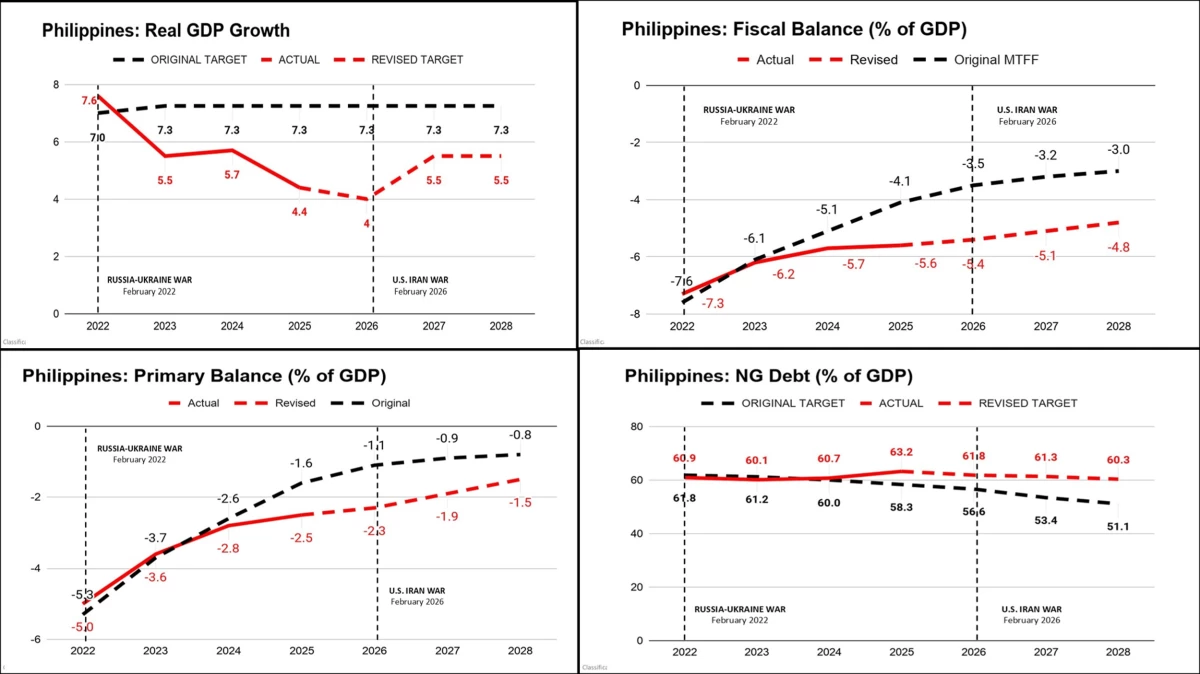
Source: Bureau of the Treasury for fiscal indicators; Philippine Statistics Authority for economic growth. Original targets based on 182nd DBCC Meeting on 08 July 2022; Revised targets based on the 193rd DBCC Meeting on 25 May 2026 and DBCC Ad Referendum approval on 16 June 2026. Debt revised targets are based on MTFF 2022-2030 Midterm Update (October 2025).
Note: The midpoint of the economic growth target was used to represent datapoints.
Growth has fallen behind plan
The economic slowdown has persisted. Growth in 2026 is expected to be weaker than in the preceding year. First-quarter GDP growth came in at a modest 2.8 percent, and the second quarter offers little promise. Socioeconomic Planning Secretary Arsenio Balisacan has projected full-year growth of just 3.5 percent to 4.5 percent—far short of the MTFF target of 6.5 percent to 8.0 percent.
Several factors account for this weakness:
- Weaker household consumption, driven by high inflation, eroding consumer confidence, slowing economic activity, and rising joblessness, all of which weigh on domestic demand;
- Declining foreign direct investment; and
- Slowing remittances, strained by challenges in overseas Filipino worker deployment, ongoing conflict in the Middle East, and a sluggish global economy.
For the final two years of the Marcos Jr. administration, the Development Budget Coordination Committee (DBCC) revised its GDP growth forecast down to 5.0 percent to 6.0 percent, marking a significant departure from the original MTFF target of 6.5 percent to 8.0 percent.
Policymakers lose commitment to fiscal discipline
The Covid-19 crisis left a deep mark on the economy, causing a sharp contraction and driving up the national debt-to-GDP ratio. Fiscal consolidation was the appropriate and necessary response. The MTFF 2022–28 set two anchor objectives: reduce the national government debt-to-GDP ratio from 61.8 percent in 2022 to 51.1 percent by 2028, and narrow the fiscal deficit from 7.6 percent of GDP to 3.0 percent over the same period.
As of the end of June 2026, the national government’s outstanding debt reached a record high of ₱19.1 trillion (approximately $311.4 billion).
It is worth noting that there is no universal threshold at which a debt-to-GDP ratio becomes inherently dangerous. Therefore, a debt-to-GDP ratio around 61.8 percent is not an immediate cause for alarm; in fact, it remains enviable compared to many international peers. For instance, the European Union's Maastricht convergence criteria set a debt-to-GDP ceiling of 60 percent. Global debt-to-GDP averages around 95 percent, while the United States exceeds 120 percent and Japan surpasses 250 percent. Prior to the pandemic, the Philippines maintained a debt-to-GDP ratio of 39.6 percent.
Similarly, while the 3.0 percent fiscal deficit target is not sacrosanct, it has long served as a standard benchmark among economists and policymakers. For a developing country like the Philippines—facing an unusually large school-age population and a massive public infrastructure gap—a 3.0 percent deficit-to-GDP ratio represented a balanced and prudent target.
Fiscal responsibility requires the government to gradually and credibly reduce its deficit to preserve fiscal buffer space for future economic shocks and keep debt trajectories sustainable. Under the MTFF, the deficit was meant to narrow steadily from 7.6 percent of GDP in 2022 to 3.0 percent in 2028. Instead, after a temporary drop to 7.3 percent in 2022, momentum stalled. In 2024 and 2025, the actual deficit repeatedly breached planned targets, a trend expected to persist through 2028.
The implications for debt sustainability are concerning. The primary balance—the fiscal balance net of interest payments expressed as a share of GDP—tells a similar story. The original MTFF targeted a steady improvement from -5.0 percent of GDP in 2022 to -0.8 percent by 2028. Under the revised framework, the projected 2028 primary balance stands at -1.5 percent, pointing to a structurally weaker trajectory.
Ultimately, the Executive and Legislative branches appear to have abandoned their commitment to fiscal consolidation. The revised MTFF now plans for a much slower deficit reduction, aiming for 4.8 percent of GDP by 2028 instead of the original 3.0 percent. This 1.8-percentage-point difference is substantial, representing an estimated loss of ₱1.5 trillion in fiscal consolidation between 2026 and 2028.
Regrettably, this retreat from fiscal discipline threatens to undermine the country's long-term debt sustainability.