






 Business
The Economy
'Misleading': BSP chief says record-low peso reflects strong US dollar
Business
The Economy
'Misleading': BSP chief says record-low peso reflects strong US dollar
'Misleading': BSP chief says record-low peso reflects strong US dollar
By Derco Rosal


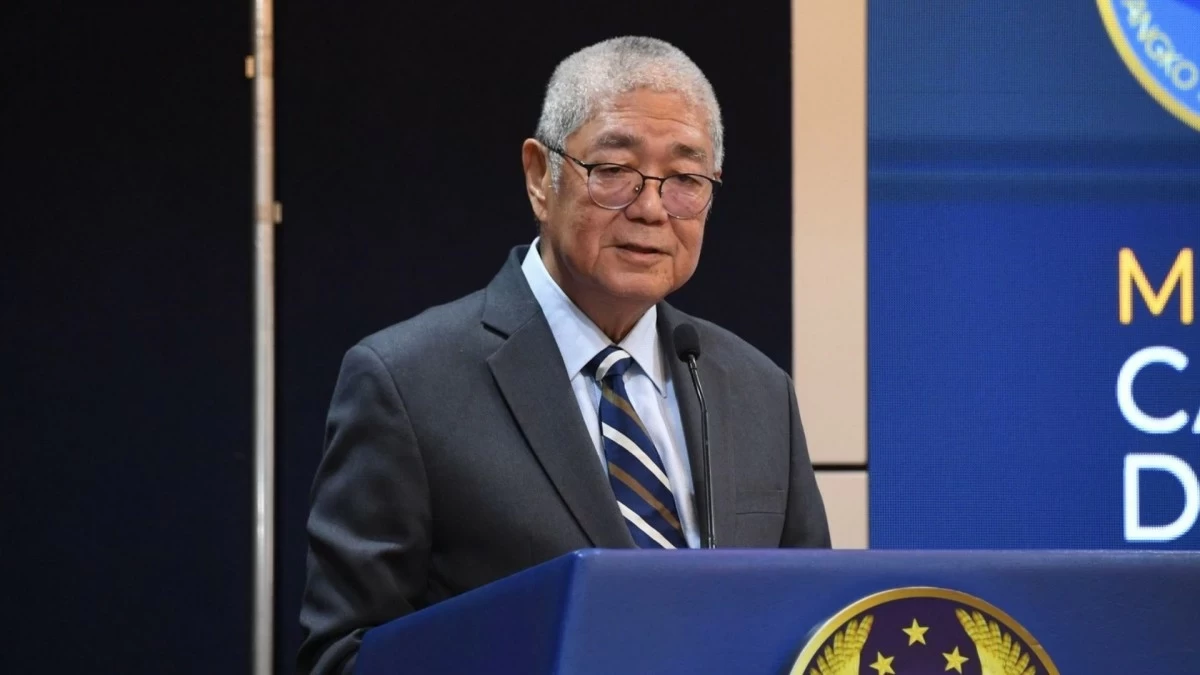
Bangko Sentral ng Pilipinas (BSP) Governor Eli M. Remolona Jr. said the Philippine peso’s recent fall to its weakest level on record was “misleading,” citing the tremendous strength of the United States (US) dollar against major currencies.
Last Friday, July 24, the peso sank to a fresh record low of ₱61.847 against the greenback, weighed down by escalating import burdens, global energy cost pressures, and persistent demand for foreign currency.
“That’s a misleading number because exchange rates were moving,” Remolona told reporters on the sidelines of the first knowledge-sharing event hosted by the BSP and Philippine Economic Society (PES) on Tuesday, July 28.
“You’re looking only at the peso-dollar [rate movement], but the rest of the world, the currencies have been weakening against the US dollar,” Remolona noted, explaining that the BSP is monitoring the US Dollar Index (DXY), which tracks the dollar’s strength relative to the world’s six major currencies, including the euro, British pound, and Japanese yen.
“If you look at that index, the dollar was really strong last week,” Remolona pointed out, suggesting the local currency’s experience is not so much an outlier as something that moves in line with foreign exchange movements globally.
As a matter of practice, the BSP only intervenes in the foreign exchange (forex) market to the extent necessary to prevent disorderly swings in the local currency.
“If we intervene against a strong dollar, we’re simply helping the rest of the world obtain dollars. We’d just be giving them our dollars. We can’t compete with that. We’d only end up depleting our own dollar [reserves],” Remolona said.
While peso depreciation appears not to be a grave concern for the BSP, the governor believes it “could” push inflation higher for imported goods.
To tame the inflationary pressures stemming from the falling peso, the BSP could implement an interest rate hike.
Other pressures that the BSP factors into its model include the re-escalation of US-Iran tensions, the record-high ₱85 wage hike in Metro Manila, and the looming tax measures President Ferdinand R. Marcos Jr. announced during his fourth State of the Nation Address (SONA).
According to Remolona, “there is a chance” that the policy-setting Monetary Board (MB) would launch more aggressive policy tightening amid a convergence of risks. While he did not rule out the possibility of a more hawkish policy move, he clarified that the likelihood is “low.”
Remolona said the central bank is still calibrating its model because the existing tool does not account for the uncertainty. He added that while price indices are consistently monitored, “the associated effect on confidence still needs to be factored in.”
While the domestic economy has been gasping for air amid a series of pressures from governance, geopolitics, and weather, Remolona believes gross domestic product (GDP) growth could still regain its upward momentum, particularly with a rebound in the second half of 2026.
Recall that Philippine economic growth continued to slow to 2.8 percent in the first quarter of 2026, its weakest pace since the height of the Covid-19 pandemic. It revived the narrative about the country being the “sick man of Asia” and also prompted private-sector watchers to flag the heightened risk of stagflation amid overheating inflation.
Inflation peaked at 7.2 percent in April and eased to 6.8 percent in May before slowing further to 6.4 percent in June. Much of the elevated inflation was tied to surging oil prices caused by the blockage of the Strait of Hormuz.
During the June policy meeting, the BSP revised upward its inflation forecasts for 2026 and 2027 to 6.4 percent and 4.5 percent, respectively, from 6.3 percent and 4.3 percent previously—both of which exceed the four-percent target ceiling.
Remolona said in his speech that an inflation print of 10 percent is considered “too high” and poses a threat to output expansion.
“High inflation means that there is much greater demand for the items in [a] consumer basket. It means there’s more demand than the economy can produce. This causes prices to rise sharply.
“In that situation, the BSP needs to act in a way that reduces demand and thus lowers inflation,” the governor explained.
Since the US-Iran war erupted in late February, the BSP has already raised key borrowing costs twice to 4.75 percent. The MB is scheduled to hold its fourth policy meeting on Aug. 27, with the remaining two meetings set for Oct. 22 and Dec. 17.