







Philippine stocks miss AI-driven market rally—DBS


Philippine stocks remain among Asia’s weakest performers as investors continue to favor markets benefiting from the artificial intelligence (AI) boom, while concerns over domestic economic, investment, and policy conditions weigh on sentiment, according to Singapore-based DBS Bank Ltd.
In a commentary last Monday, June 8, DBS Group Research global chief economist Taimur Baig said the Philippine stock market, alongside those of India and Indonesia, has failed to benefit from the strong rally that has lifted technology-driven markets in the United States (US) and parts of Asia.
“India, Indonesia, and the Philippines’ markets are soft owing to policy issues and less AI exposure,” the report said.
DBS noted that while AI-related demand has boosted valuations in technology-heavy markets such as China’s Shenzhen, South Korea, and Taiwan, equities in the Philippines, India, as well as Indonesia have been among the region’s laggards, posting negative returns this year.
The report said markets that are not deeply integrated into East and North Asia’s AI-driven electronics supply chains have struggled to benefit from the technology boom that has fueled gains elsewhere in the region.
DBS’ chart showed the Philippines as the only market in its regional comparison whose price-to-earnings (PE) ratio declined consistently from 2022 to 2026.
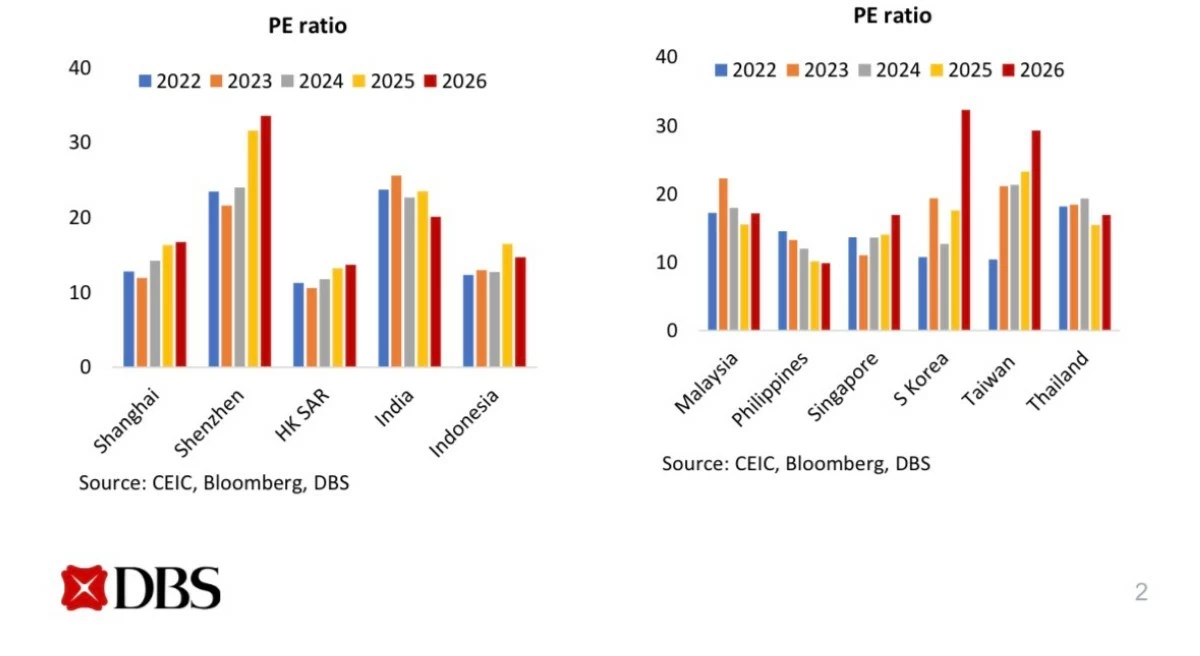
Based on the chart, the Philippine market’s valuation fell from nearly 15 times earnings in 2022 to less than 10 times in 2026, reflecting steadily weakening investor sentiment over the five-year period.
DBS said India’s market, despite losing ground in recent months, still commands a relatively high valuation premium compared with other regional markets, a distinction not shared by the Philippines and Indonesia.
“No such silver lining for the beleaguered markets of Indonesia and the Philippines. Volatile policy making, middling exports performance, soft domestic demand, and a flat or worsening investment environment have kept investors unenthusiastic about the prospects of these two markets,” the report said.
By contrast, DBS said Shenzhen, South Korea, and Taiwan have recorded significant valuation gains as companies supplying key AI-related electronics products benefited from surging global demand. Hong Kong, Shanghai, and Singapore have likewise posted strong performances, supported by robust export growth.
The report noted that Malaysia and Thailand have also lagged the region’s top performers despite solid electronics exports, although neither market has generated negative returns this year. Domestic political issues and weak performance in non-electronics sectors have limited gains in the Malaysian and Thai markets, it added.
In the US, AI enthusiasm has driven a sharp increase in stock valuations, with the technology-heavy Nasdaq-100’s PE ratio rising to 33.7 at present from 20.3 at end-2022, while the S&P 500’s multiple climbed to 25.1 from 17.1 over the same period, DBS noted.
“The varying performances of regional markets reflect their cyclical strengths and offer important lessons for their respective policy makers,” DBS said, adding that markets that have fallen out of favor need measures to revive investor interest.