

ADVERTISEMENT

Philippines, Vietnam reaffirm support for 2016 South China Sea arbitral ruling

Published Jun 1, 2026 04:31 pm

At A Glance

  • The Philippines and Vietnam backed the 2016 arbitral ruling and called for self-restraint in the South China Sea
  • Both countries upgraded ties to an Enhanced Strategic Partnership focused on defense, maritime, and economic cooperation
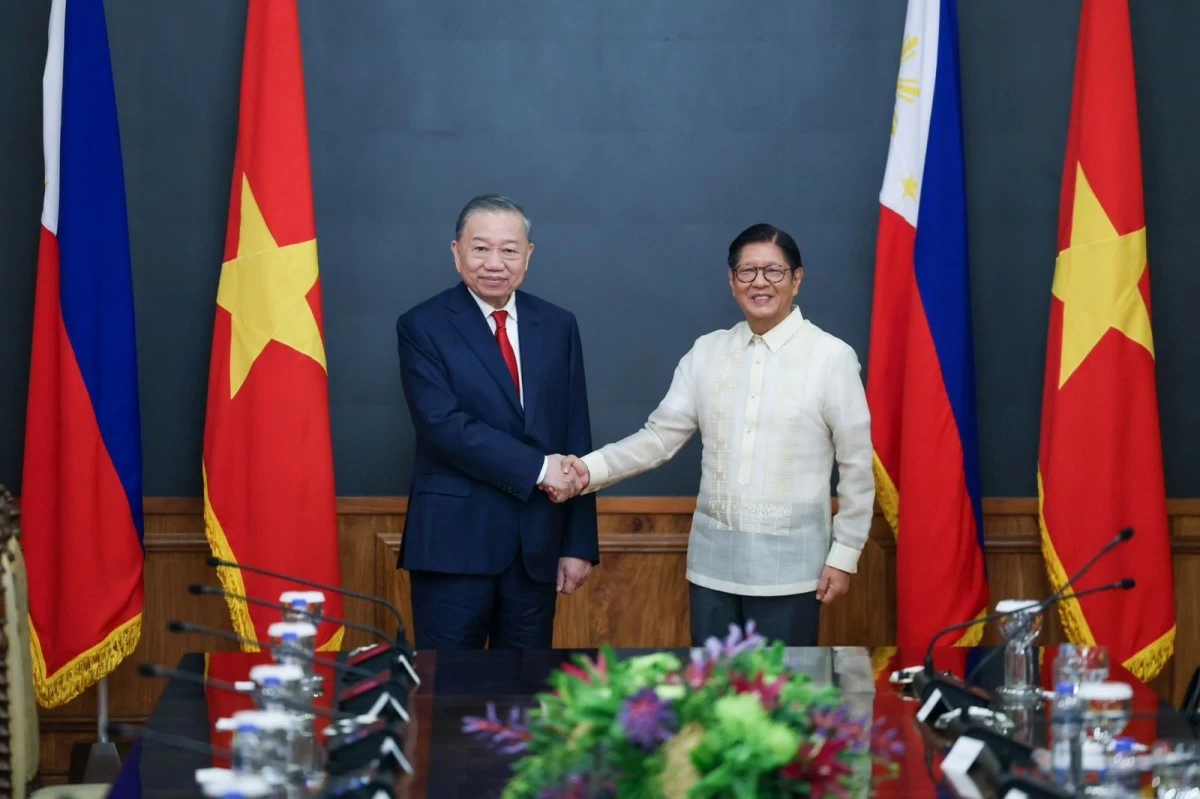
President Ferdinand R. Marcos Jr. (right) and Vietnamese President and Communist Party leader Tô Lâm (left) hold a bilateral meeting at Malacañan Palace in Manila on June 1, 2026. (Noel B. Pabalate / PPA Pool)
The Philippines and Vietnam reaffirmed their support for the 2016 South China Sea arbitral ruling, emphasizing the need to uphold international law and exercise self-restraint to maintain peace and stability in maritime disputes.
In a joint statement released by the Department of Foreign Affairs (DFA) on Monday, June 1, following Vietnamese President and Communist Party leader Tô Lâm’s state visit to Manila, both sides underscored the importance of maintaining peace, stability, and freedom of navigation in the South China Sea.
Both countries reiterated their commitment to the United Nations Convention on the Law of the Sea (UNCLOS) and the peaceful settlement of disputes, rejecting threats or the use of force.
According to the joint statement, the two leaders “reaffirmed their positions” on the 2016 Award by the Tribunal in the South China Sea Arbitration and “further reaffirmed the importance for all parties to exercise self-restraint in the conduct of activities that could escalate tensions, which in turn could affect peace and stability in the South China Sea.”
The arbitral ruling invalidated China’s sweeping South China Sea claims and supported the Philippines’ UNCLOS-based position.
The Philippines and Vietnam called on all parties to avoid actions that could escalate tensions in disputed waters, reiterating the need for self-restraint as emphasized in their joint statement.
Both sides stressed the importance of fully implementing the 2002 ASEAN-China Declaration on the Conduct of Parties in the South China Sea and pursuing the early conclusion of a substantive Code of Conduct.
The reaffirmation comes as regional tensions continue over competing territorial claims and maritime activities in the South China Sea.
Enhanced Strategic Partnership
The two leaders upgraded bilateral ties to an Enhanced Strategic Partnership, marking closer collaboration between the two countries.
READ: 
https://mb.com.ph/2026/06/01/philippines-vietnam-elevate-ties-to-enhanced-strategic-partnership
The partnership signals deeper cooperation on security, trade, and maritime concerns amid regional tensions.
According to the joint statement, the upgraded partnership reflects an “enduring friendship and cooperation” as both countries mark 50 years of diplomatic relations and a decade of Strategic Partnership.
The leaders reaffirmed their commitment to multilateralism, international law, and regional stability, especially in the South China Sea, where both countries have overlapping maritime interests.
“Their discussions laid the foundation for an Enhanced Strategic Partnership that is vigorous, resilient, and mutually beneficial for the security, prosperity, and well-being of the two peoples,” the joint statement read.
The leaders agreed to expand cooperation in political-security, maritime safety, defense, trade, agriculture, tourism, education, and cultural exchanges.
They also agreed to strengthen dialogue mechanisms, including defense and maritime consultations, and tasked their foreign ministries with drafting a new Plan of Action.
The development comes amid growing regional focus on the South China Sea, where ASEAN member states continue to push for peaceful dispute resolution in line with international law.
Boosting maritime and defense cooperation
Marcos and Lâm agreed to deepen maritime and defense collaboration to better coordinate regional security efforts.
As stated in the joint statement, the two countries committed to enhancing existing maritime mechanisms, including coast guard cooperation, maritime consultations, and hotline communications between maritime authorities.
Both sides also pledged to peacefully resolve maritime incidents in accordance with international law.
The agreement includes expanding cooperation in marine research, environmental protection, connectivity, hydrography, and the preservation of maritime commons.
On defense cooperation, the two countries agreed to sustain high-level military exchanges, strengthen strategic dialogues, and increase training and personnel interactions between their armed forces and maritime agencies.
The Philippines and Vietnam also committed to broader cooperation in defense trade, military medicine, search and rescue operations, humanitarian assistance and disaster response, maritime and aviation security, counterterrorism, and peacekeeping.
Both countries likewise reiterated support for ASEAN centrality and regional cooperation as Manila prepares to assume the ASEAN chairmanship in 2026. 
RELATED STORY: 
https://mb.com.ph/2026/06/01/philippines-vietnam-sign-four-agreements

Related Tags

South China Sea Philippines Vietnam West Philippine Sea UNCLOS ASEAN
ADVERTISEMENT
.most-popular .layout-ratio{ padding-bottom: 79.13%; } @media (min-width: 768px) and (max-width: 1024px) { .widget-title { font-size: 15px !important; } }

{{ articles_filter_1561_widget.title }}

.most-popular .layout-ratio{ padding-bottom: 79.13%; } @media (min-width: 768px) and (max-width: 1024px) { .widget-title { font-size: 15px !important; } }

{{ articles_filter_1562_widget.title }}

.most-popular .layout-ratio{ padding-bottom: 79.13%; } @media (min-width: 768px) and (max-width: 1024px) { .widget-title { font-size: 15px !important; } }

{{ articles_filter_1563_widget.title }}

{{ articles_filter_1564_widget.title }}

.mb-article-details { position: relative; } .mb-article-details .article-body-preview, .mb-article-details .article-body-summary{ font-size: 17px; line-height: 30px; font-family: "Libre Caslon Text", serif; color: #000; } .mb-article-details .article-body-preview iframe , .mb-article-details .article-body-summary iframe{ width: 100%; margin: auto; } .read-more-background { background: linear-gradient(180deg, color(display-p3 1.000 1.000 1.000 / 0) 13.75%, color(display-p3 1.000 1.000 1.000 / 0.8) 30.79%, color(display-p3 1.000 1.000 1.000) 72.5%); position: absolute; height: 200px; width: 100%; bottom: 0; display: flex; justify-content: center; align-items: center; padding: 0; } .read-more-background a{ color: #000; } .read-more-btn { padding: 17px 45px; font-family: Inter; font-weight: 700; font-size: 18px; line-height: 16px; text-align: center; vertical-align: middle; border: 1px solid black; background-color: white; } .hidden { display: none; }
function initializeAllSwipers() { // Get all hidden inputs with cms_article_id document.querySelectorAll('[id^="cms_article_id_"]').forEach(function (input) { const cmsArticleId = input.value; const articleSelector = '#article-' + cmsArticleId + ' .body_images'; const swiperElement = document.querySelector(articleSelector); if (swiperElement && !swiperElement.classList.contains('swiper-initialized')) { new Swiper(articleSelector, { loop: true, pagination: false, navigation: { nextEl: '#article-' + cmsArticleId + ' .swiper-button-next', prevEl: '#article-' + cmsArticleId + ' .swiper-button-prev', }, }); } }); } setTimeout(initializeAllSwipers, 3000); const intersectionObserver = new IntersectionObserver( (entries) => { entries.forEach((entry) => { if (entry.isIntersecting) { const newUrl = entry.target.getAttribute("data-url"); if (newUrl) { history.pushState(null, null, newUrl); let article = entry.target; // Extract metadata const author = article.querySelector('.author-section').textContent.replace('By', '').trim(); const section = article.querySelector('.section-info ').textContent.replace(' ', ' '); const title = article.querySelector('.article-title h1').textContent; // Parse URL for Chartbeat path format const parsedUrl = new URL(newUrl, window.location.origin); const cleanUrl = parsedUrl.host + parsedUrl.pathname; // Update Chartbeat configuration if (typeof window._sf_async_config !== 'undefined') { window._sf_async_config.path = cleanUrl; window._sf_async_config.sections = section; window._sf_async_config.authors = author; } // Track virtual page view with Chartbeat if (typeof pSUPERFLY !== 'undefined' && typeof pSUPERFLY.virtualPage === 'function') { try { pSUPERFLY.virtualPage({ path: cleanUrl, title: title, sections: section, authors: author }); } catch (error) { console.error('ping error', error); } } // Optional: Update document title if (title && title !== document.title) { document.title = title; } } } }); }, { threshold: 0.1 } ); function showArticleBody(button) { const article = button.closest("article"); const summary = article.querySelector(".article-body-summary"); const body = article.querySelector(".article-body-preview"); const readMoreSection = article.querySelector(".read-more-background"); // Hide summary and read-more section summary.style.display = "none"; readMoreSection.style.display = "none"; // Show the full article body body.classList.remove("hidden"); } document.addEventListener("DOMContentLoaded", () => { let loadCount = 0; // Track how many times articles are loaded const offset = [1, 2, 3, 4, 5, 6, 7, 8, 9, 10]; // Offset values const currentUrl = window.location.pathname.substring(1); let isLoading = false; // Prevent multiple calls if (!currentUrl) { console.log("Current URL is invalid."); return; } const sentinel = document.getElementById("load-more-sentinel"); if (!sentinel) { console.log("Sentinel element not found."); return; } function isSentinelVisible() { const rect = sentinel.getBoundingClientRect(); return ( rect.top < window.innerHeight && rect.bottom >= 0 ); } function onScroll() { if (isLoading) return; if (isSentinelVisible()) { if (loadCount >= offset.length) { console.log("Maximum load attempts reached."); window.removeEventListener("scroll", onScroll); return; } isLoading = true; const currentOffset = offset[loadCount]; window.loadMoreItems().then(() => { let article = document.querySelector('#widget_1690 > div:nth-last-of-type(2) article'); intersectionObserver.observe(article) loadCount++; }).catch(error => { console.error("Error loading more items:", error); }).finally(() => { isLoading = false; }); } } window.addEventListener("scroll", onScroll); });

Sign up by email to receive news.