ADVERTISEMENT

Satellite data shows NO2 concentration in Metro Manila down to pre-fire levels for two consecutive days

Published Apr 30, 2026 09:50 am
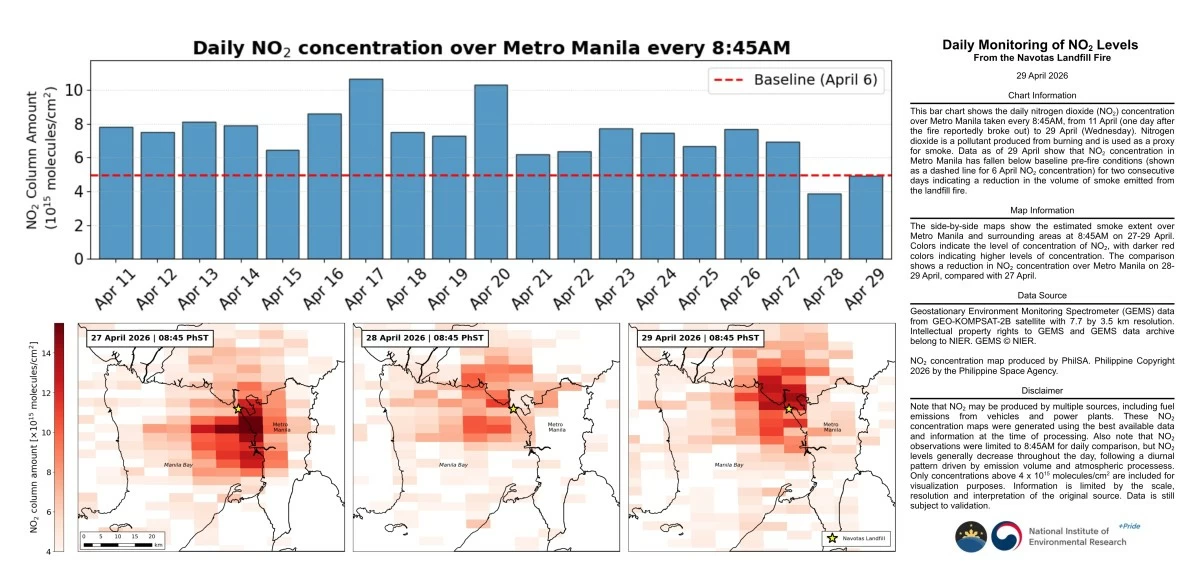
The Philippine Space Agency (PhilSA) has done daily monitoring of satellite data since the Navotas landfill fire reportedly broke out on 10 April 2026. Coinciding with reports on Tuesday (28 April) that significant progress has been made in suppressing the fire, satellite data shows that nitrogen dioxide (NO2) concentration in Metro Manila has fallen below 6 April (pre-fire) levels for two consecutive days. Nitrogen dioxide is a pollutant produced from burning and is a component of smoke, and lower NO2 concentrations indicate a reduction in the volume of smoke emitted from the landfill fire. Observations are consistent with measurements on the ground by EMB NCR and Central Luzon that particulate matter or PM over Metro Manila has improved on Tuesday (28 April) and Wednesday (29 April). PhilSA will continue monitoring of NO2 to assist in quantifying the impact of ground interventions. Please follow local and national health agencies for the latest advisories.
The side-by-side maps compare the estimated smoke extent over Metro Manila at 8:45AM on 27-29 April. Colors indicate the level of concentration of NO2, with darker red colors indicating higher levels of concentration. Data show a reduction in NO2 concentration levels over Metro Manila on 28-29 April, compared to 27 April and previous days. This is also supported by the time-lapse video showing daily snapshots at 8:45AM from 11 April (one day after the fire reportedly broke out) to 29 April (Wednesday).
NO₂ may be produced by multiple sources, including fuel emissions from vehicles and power plants. Please note that NO2 observations were limited to 8:45AM for daily comparison, but NO2 levels generally decrease throughout the day, following a diurnal pattern driven by emission volume and atmospheric processes.
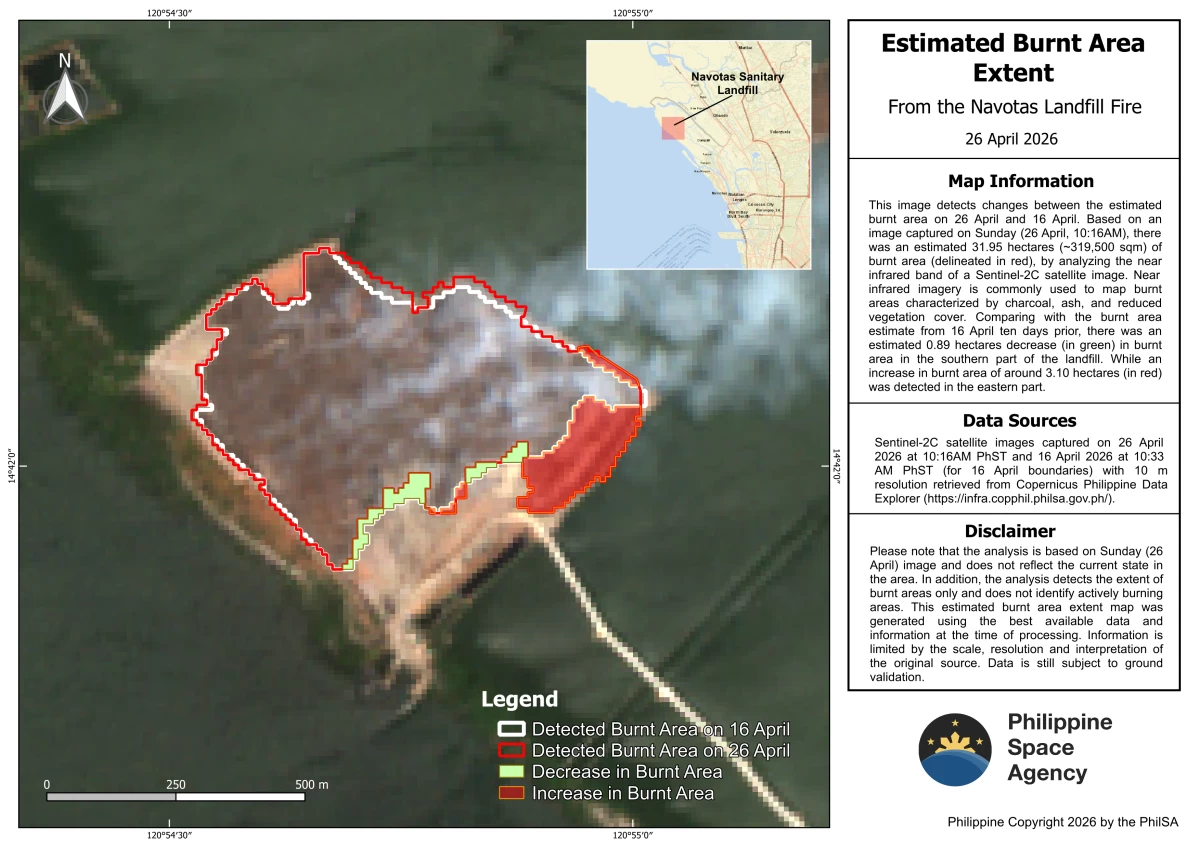
PhilSA has also been monitoring the estimated burnt area extent at the Navotas landfill by analyzing the near infrared band of Sentinel-2C satellite images. Near infrared imagery is commonly used to map burnt areas characterized by charcoal, ash, and reduced vegetation cover. Based on a satellite image captured on Sunday (26 April, 10:16AM), there was an estimated 31.95 hectares (~319,500 sqm) of burnt area (delineated in red). Comparing with the burnt area estimate from 16 April, there was an estimated 0.89 hectares decrease (in green) in burnt area in the southern part of the landfill while an increase of around 3.10 hectares (in red) was detected in the eastern part. Please note that the analysis is based on Sunday (26 April) image and does not reflect the current state in the area. In addition, the analysis detects the extent of burnt areas only and does not identify actively burning areas (ang mga lugar na sunog na, hindi ang mga lugar na nasusunog). A version of this map has been provided to the NDRRMC.
PhilSA’s support through the analysis of satellite data provides wide-area coverage that assists the NDRRMC in monitoring the situation and prioritizing areas for response. By making space data accessible to stakeholders, PhilSA enables informed decision-making and strengthens disaster response.

Related Tags

PhilSA Navotas landfill fire Philippine Space Agency
ADVERTISEMENT
.most-popular .layout-ratio{ padding-bottom: 79.13%; } @media (min-width: 768px) and (max-width: 1024px) { .widget-title { font-size: 15px !important; } }

{{ articles_filter_1561_widget.title }}

.most-popular .layout-ratio{ padding-bottom: 79.13%; } @media (min-width: 768px) and (max-width: 1024px) { .widget-title { font-size: 15px !important; } }

{{ articles_filter_1562_widget.title }}

.most-popular .layout-ratio{ padding-bottom: 79.13%; } @media (min-width: 768px) and (max-width: 1024px) { .widget-title { font-size: 15px !important; } }

{{ articles_filter_1563_widget.title }}

{{ articles_filter_1564_widget.title }}

.mb-article-details { position: relative; } .mb-article-details .article-body-preview, .mb-article-details .article-body-summary{ font-size: 17px; line-height: 30px; font-family: "Libre Caslon Text", serif; color: #000; } .mb-article-details .article-body-preview iframe , .mb-article-details .article-body-summary iframe{ width: 100%; margin: auto; } .read-more-background { background: linear-gradient(180deg, color(display-p3 1.000 1.000 1.000 / 0) 13.75%, color(display-p3 1.000 1.000 1.000 / 0.8) 30.79%, color(display-p3 1.000 1.000 1.000) 72.5%); position: absolute; height: 200px; width: 100%; bottom: 0; display: flex; justify-content: center; align-items: center; padding: 0; } .read-more-background a{ color: #000; } .read-more-btn { padding: 17px 45px; font-family: Inter; font-weight: 700; font-size: 18px; line-height: 16px; text-align: center; vertical-align: middle; border: 1px solid black; background-color: white; } .hidden { display: none; }
function initializeAllSwipers() { // Get all hidden inputs with cms_article_id document.querySelectorAll('[id^="cms_article_id_"]').forEach(function (input) { const cmsArticleId = input.value; const articleSelector = '#article-' + cmsArticleId + ' .body_images'; const swiperElement = document.querySelector(articleSelector); if (swiperElement && !swiperElement.classList.contains('swiper-initialized')) { new Swiper(articleSelector, { loop: true, pagination: false, navigation: { nextEl: '#article-' + cmsArticleId + ' .swiper-button-next', prevEl: '#article-' + cmsArticleId + ' .swiper-button-prev', }, }); } }); } setTimeout(initializeAllSwipers, 3000); const intersectionObserver = new IntersectionObserver( (entries) => { entries.forEach((entry) => { if (entry.isIntersecting) { const newUrl = entry.target.getAttribute("data-url"); if (newUrl) { history.pushState(null, null, newUrl); let article = entry.target; // Extract metadata const author = article.querySelector('.author-section').textContent.replace('By', '').trim(); const section = article.querySelector('.section-info ').textContent.replace(' ', ' '); const title = article.querySelector('.article-title h1').textContent; // Parse URL for Chartbeat path format const parsedUrl = new URL(newUrl, window.location.origin); const cleanUrl = parsedUrl.host + parsedUrl.pathname; // Update Chartbeat configuration if (typeof window._sf_async_config !== 'undefined') { window._sf_async_config.path = cleanUrl; window._sf_async_config.sections = section; window._sf_async_config.authors = author; } // Track virtual page view with Chartbeat if (typeof pSUPERFLY !== 'undefined' && typeof pSUPERFLY.virtualPage === 'function') { try { pSUPERFLY.virtualPage({ path: cleanUrl, title: title, sections: section, authors: author }); } catch (error) { console.error('ping error', error); } } // Optional: Update document title if (title && title !== document.title) { document.title = title; } } } }); }, { threshold: 0.1 } ); function showArticleBody(button) { const article = button.closest("article"); const summary = article.querySelector(".article-body-summary"); const body = article.querySelector(".article-body-preview"); const readMoreSection = article.querySelector(".read-more-background"); // Hide summary and read-more section summary.style.display = "none"; readMoreSection.style.display = "none"; // Show the full article body body.classList.remove("hidden"); } document.addEventListener("DOMContentLoaded", () => { let loadCount = 0; // Track how many times articles are loaded const offset = [1, 2, 3, 4, 5, 6, 7, 8, 9, 10]; // Offset values const currentUrl = window.location.pathname.substring(1); let isLoading = false; // Prevent multiple calls if (!currentUrl) { console.log("Current URL is invalid."); return; } const sentinel = document.getElementById("load-more-sentinel"); if (!sentinel) { console.log("Sentinel element not found."); return; } function isSentinelVisible() { const rect = sentinel.getBoundingClientRect(); return ( rect.top < window.innerHeight && rect.bottom >= 0 ); } function onScroll() { if (isLoading) return; if (isSentinelVisible()) { if (loadCount >= offset.length) { console.log("Maximum load attempts reached."); window.removeEventListener("scroll", onScroll); return; } isLoading = true; const currentOffset = offset[loadCount]; window.loadMoreItems().then(() => { let article = document.querySelector('#widget_1690 > div:nth-last-of-type(2) article'); intersectionObserver.observe(article) loadCount++; }).catch(error => { console.error("Error loading more items:", error); }).finally(() => { isLoading = false; }); } } window.addEventListener("scroll", onScroll); });

Sign up by email to receive news.