ADVERTISEMENT

Oil crisis batters poor Filipinos, threatens inflation, growth

Published Mar 27, 2026 01:56 pm
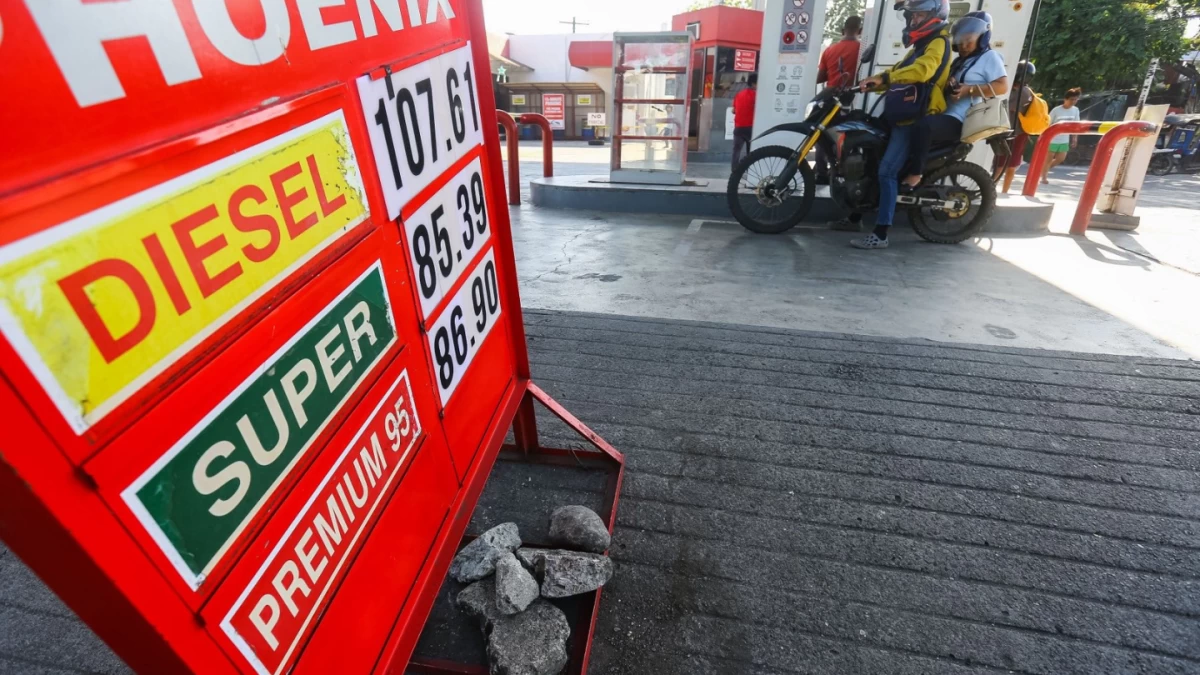
Fuel prices at a gas station in Davao City show a significant jump on Tuesday, March 17. Local motorists are feeling the pinch as oil companies implement a "big-time" price hike across the board. (Photo by Keith Bacongco I MB)
The global oil shock triggered by escalating conflict in the Middle East is hitting the Philippines’ poorest households the hardest, as surging fuel costs spill over into food prices and erode purchasing power.
A March 26 position paper by state-run policy think tank Philippine Institute for Development Studies (PIDS) said the crisis is not just a broad economic shock but one that disproportionately affects low-income groups.
“Since the ongoing oil shock is not merely a macroeconomic disturbance but a disproportionate burden on the poor, there is a strong case for a distributional policy response,” said PIDS senior research fellow Adoracion M. Navarro.
Navarro said focusing only on aggregate indicators like economic growth and inflation risks missing the deeper issue.
“Focusing on these could obscure the unequal burden,” she said, noting that “the poorest households, with their high food expenditure shares and limited income flexibility, bear the brunt of second-round inflation effects,” while higher-income groups are “relatively insulated.”
According to PIDS, the transmission of the oil shock is largely through food prices, as higher fuel costs raise transport, logistics, and production expenses.
“The primary transmission channel is through domestic prices,” Navarro said, explaining that fuel-driven increases cascade into food costs, which dominate household spending—especially among the poor.
Data cited by PIDS showed that the poorest households allocate 64.1 percent of their spending to food, compared to 30.9 percent for the richest, making food inflation inherently regressive.
Navarro emphasized that the policy response should be targeted rather than broad-based.
“The appropriate policy response must move toward targeted distributional intervention,” she said, citing the need for “direct income or consumption support,” as well as “targeted subsidies for transport workers, farmers, and fisherfolk” and “food supply stabilization measures.”
She added that the key issue is not simply fuel prices.
“The central policy problem is not pump prices per se… The central policy problem is how to address distributional asymmetry to mitigate the socioeconomic impacts of the crisis,” Navarro said.
Beyond its uneven impact on households, the oil shock is also expected to weigh heavily on the broader economy.
Navarro said rising energy prices could dampen consumption, raise costs for firms, and heighten risks for micro, small, and medium enterprises (MSMEs), particularly in transport and retail.
She also flagged external risks, including pressure on the country’s current account, exchange rate, and remittance flows from overseas Filipino workers (OFWs) in the Middle East.
These vulnerabilities were echoed in a March 26 report by Capital Economics chief emerging markets (EMs) economist Jason Tuvey.
The report noted that President Ferdinand R. Marcos Jr. this week declared a state of national energy emergency due to the “imminent danger posed upon the availability and stability of the country’s energy supply.”
While the emergency powers allow the government to secure fuel and manage distribution, Capital Economics said the move “won’t prevent an economic shock.”
The think tank highlighted the Philippines’ structural vulnerability as a net energy importer, equivalent to 4.2 percent of gross domestic product (GDP), with nearly all oil and petroleum products sourced from abroad—much of it from the Middle East.
This exposure has already translated into sharply higher domestic fuel prices, with gasoline rising by about 50 percent and diesel by around 80 percent since the conflict began, the report noted.
Tuvey said these increases are expected to feed directly into inflation.
“Fuel prices are likely to push up inflation by a total of 0.8 percentage point (ppt) over the coming months,” he said, with inflation projected to peak at “a touch over four percent.”
External accounts are also at risk, with the current account deficit seen widening to more than five percent of GDP, while remittances—equivalent to 0.8 percent of GDP from OFWs in the Gulf—could decline if regional economies weaken.
The Philippine peso has also come under pressure, with the report noting it has been one of the worst-performing currencies in Asia since the conflict escalated, although strong foreign exchange (forex) reserves provide some buffer.
Amid these developments, the Bangko Sentral ng Pilipinas (BSP) held an off-cycle meeting on Thursday, March 26, and kept interest rates unchanged at 4.25 percent, choosing to monitor second-round inflation effects rather than respond aggressively to supply-driven price pressures.
As Manila Bulletin earlier reported, Capital Economics also downgraded its growth outlook for the Philippines, cutting its forecast for 2026 GDP expansion to 3.8 percent from 4.5 percent previously.

Related Tags

Philippine Institute for Development Studies (PIDS) Capital Economics Middle East war gross domestic product (GDP) growth inflation rate
ADVERTISEMENT
.most-popular .layout-ratio{ padding-bottom: 79.13%; } @media (min-width: 768px) and (max-width: 1024px) { .widget-title { font-size: 15px !important; } }

{{ articles_filter_1561_widget.title }}

.most-popular .layout-ratio{ padding-bottom: 79.13%; } @media (min-width: 768px) and (max-width: 1024px) { .widget-title { font-size: 15px !important; } }

{{ articles_filter_1562_widget.title }}

.most-popular .layout-ratio{ padding-bottom: 79.13%; } @media (min-width: 768px) and (max-width: 1024px) { .widget-title { font-size: 15px !important; } }

{{ articles_filter_1563_widget.title }}

{{ articles_filter_1564_widget.title }}

.mb-article-details { position: relative; } .mb-article-details .article-body-preview, .mb-article-details .article-body-summary{ font-size: 17px; line-height: 30px; font-family: "Libre Caslon Text", serif; color: #000; } .mb-article-details .article-body-preview iframe , .mb-article-details .article-body-summary iframe{ width: 100%; margin: auto; } .read-more-background { background: linear-gradient(180deg, color(display-p3 1.000 1.000 1.000 / 0) 13.75%, color(display-p3 1.000 1.000 1.000 / 0.8) 30.79%, color(display-p3 1.000 1.000 1.000) 72.5%); position: absolute; height: 200px; width: 100%; bottom: 0; display: flex; justify-content: center; align-items: center; padding: 0; } .read-more-background a{ color: #000; } .read-more-btn { padding: 17px 45px; font-family: Inter; font-weight: 700; font-size: 18px; line-height: 16px; text-align: center; vertical-align: middle; border: 1px solid black; background-color: white; } .hidden { display: none; }
function initializeAllSwipers() { // Get all hidden inputs with cms_article_id document.querySelectorAll('[id^="cms_article_id_"]').forEach(function (input) { const cmsArticleId = input.value; const articleSelector = '#article-' + cmsArticleId + ' .body_images'; const swiperElement = document.querySelector(articleSelector); if (swiperElement && !swiperElement.classList.contains('swiper-initialized')) { new Swiper(articleSelector, { loop: true, pagination: false, navigation: { nextEl: '#article-' + cmsArticleId + ' .swiper-button-next', prevEl: '#article-' + cmsArticleId + ' .swiper-button-prev', }, }); } }); } setTimeout(initializeAllSwipers, 3000); const intersectionObserver = new IntersectionObserver( (entries) => { entries.forEach((entry) => { if (entry.isIntersecting) { const newUrl = entry.target.getAttribute("data-url"); if (newUrl) { history.pushState(null, null, newUrl); let article = entry.target; // Extract metadata const author = article.querySelector('.author-section').textContent.replace('By', '').trim(); const section = article.querySelector('.section-info ').textContent.replace(' ', ' '); const title = article.querySelector('.article-title h1').textContent; // Parse URL for Chartbeat path format const parsedUrl = new URL(newUrl, window.location.origin); const cleanUrl = parsedUrl.host + parsedUrl.pathname; // Update Chartbeat configuration if (typeof window._sf_async_config !== 'undefined') { window._sf_async_config.path = cleanUrl; window._sf_async_config.sections = section; window._sf_async_config.authors = author; } // Track virtual page view with Chartbeat if (typeof pSUPERFLY !== 'undefined' && typeof pSUPERFLY.virtualPage === 'function') { try { pSUPERFLY.virtualPage({ path: cleanUrl, title: title, sections: section, authors: author }); } catch (error) { console.error('ping error', error); } } // Optional: Update document title if (title && title !== document.title) { document.title = title; } } } }); }, { threshold: 0.1 } ); function showArticleBody(button) { const article = button.closest("article"); const summary = article.querySelector(".article-body-summary"); const body = article.querySelector(".article-body-preview"); const readMoreSection = article.querySelector(".read-more-background"); // Hide summary and read-more section summary.style.display = "none"; readMoreSection.style.display = "none"; // Show the full article body body.classList.remove("hidden"); } document.addEventListener("DOMContentLoaded", () => { let loadCount = 0; // Track how many times articles are loaded const offset = [1, 2, 3, 4, 5, 6, 7, 8, 9, 10]; // Offset values const currentUrl = window.location.pathname.substring(1); let isLoading = false; // Prevent multiple calls if (!currentUrl) { console.log("Current URL is invalid."); return; } const sentinel = document.getElementById("load-more-sentinel"); if (!sentinel) { console.log("Sentinel element not found."); return; } function isSentinelVisible() { const rect = sentinel.getBoundingClientRect(); return ( rect.top < window.innerHeight && rect.bottom >= 0 ); } function onScroll() { if (isLoading) return; if (isSentinelVisible()) { if (loadCount >= offset.length) { console.log("Maximum load attempts reached."); window.removeEventListener("scroll", onScroll); return; } isLoading = true; const currentOffset = offset[loadCount]; window.loadMoreItems().then(() => { let article = document.querySelector('#widget_1690 > div:nth-last-of-type(2) article'); intersectionObserver.observe(article) loadCount++; }).catch(error => { console.error("Error loading more items:", error); }).finally(() => { isLoading = false; }); } } window.addEventListener("scroll", onScroll); });

Sign up by email to receive news.