






Manila Bulletin
 Philippines
National
EXPLAINER: Understanding DepEd's new three-term school calendar
Philippines
National
EXPLAINER: Understanding DepEd's new three-term school calendar
Philippines
National
EXPLAINER: Understanding DepEd's new three-term school calendar
EXPLAINER: Understanding DepEd's new three-term school calendar
Reform targets learning gaps and time management issues by protecting instructional time, reducing disruptions, and easing teacher workload
Published Mar 26, 2026 12:40 pm
|
Updated Mar 26, 2026 03:25 pm


At A Glance
- DepEd is introducing a three-term school calendar this SY 2026-2027 to address learning gaps, improve time management, and reduce teacher workload
- The reform aims to protect instructional time by separating teaching from administrative tasks and adding buffer periods to absorb class disruptions
- It also aims to benefit both learners and teachers through better lesson pacing, structured remediation, and reduced workload overlap

The Department of Education (DepEd) is set to introduce a three-term school calendar to improve instructional time and reduce disruptions. (MB Visual Content Group)
The Department of Education (DepEd) is pushing a major shift in how the Philippine school year is structured, introducing what it calls a “Three-Term School Calendar”—a reform aimed at addressing long-standing issues in instructional time, teacher workload, and learning recovery.
In a briefer obtained by the Manila Bulletin, DepEd explained that its three-term school calendar is not a trimester system like those used in colleges and universities.
Instead, it is a reorganization of the basic education calendar designed to improve how time is used in schools.
DepEd Secretary Sonny Angara explained that the redesigned calendar aims to streamline teachers’ workload—particularly by clearly separating instructional time from administrative responsibilities such as grading and report preparation.
He added that this structure allows educators to focus more on effective lesson delivery rather than managing multiple tasks simultaneously.
Why DepEd is changing the school calendar
The reform comes in response to a persistent problem: frequent disruptions to classes.
Schools across the country regularly face interruptions due to typhoons, heat waves, local events, and other unforeseen circumstances. According to the Second Congressional Commission on Education (EDCOM II) Year 1 Report, as many as 53 of 180 school days can be disrupted.
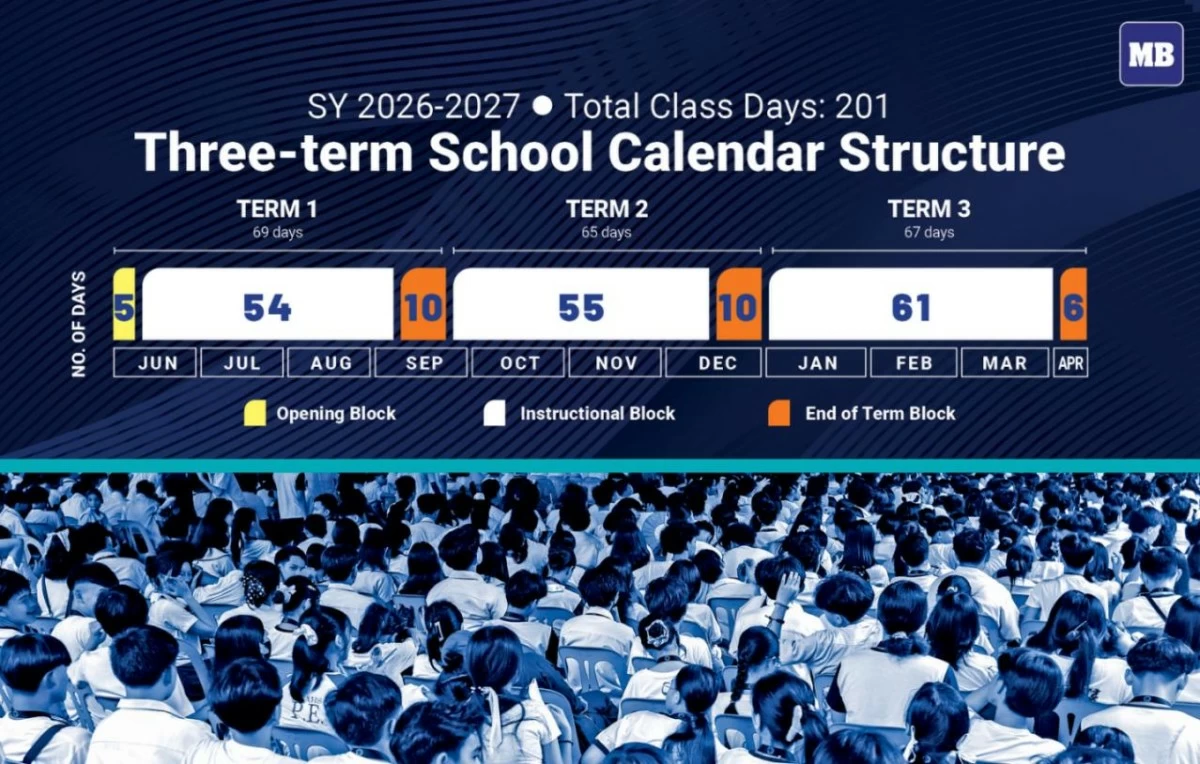
DepEd clarifies that the three-term school calendar for basic education is not like the college trimester system — it is a restructuring designed to protect instructional time and improve learning outcomes. (MB Visual Content Group)
These lost days do not reduce curriculum requirements. Instead, DepEd said lessons are compressed into shorter periods, creating a domino effect: students get less time to fully understand lessons; opportunities for remediation become limited; and teachers struggle to complete both teaching and administrative tasks.
This compression, DepEd explained, has been undermining learning quality and increasing teacher burnout.
How the three-term calendar works
The proposed calendar divides the school year into three structured terms, each with clearly defined blocks: Opening Block—for beginning-of-school-year activities; Instructional Block—for teaching and learning; and End-of-Term Block—for assessments, remediation, training, and school activities.
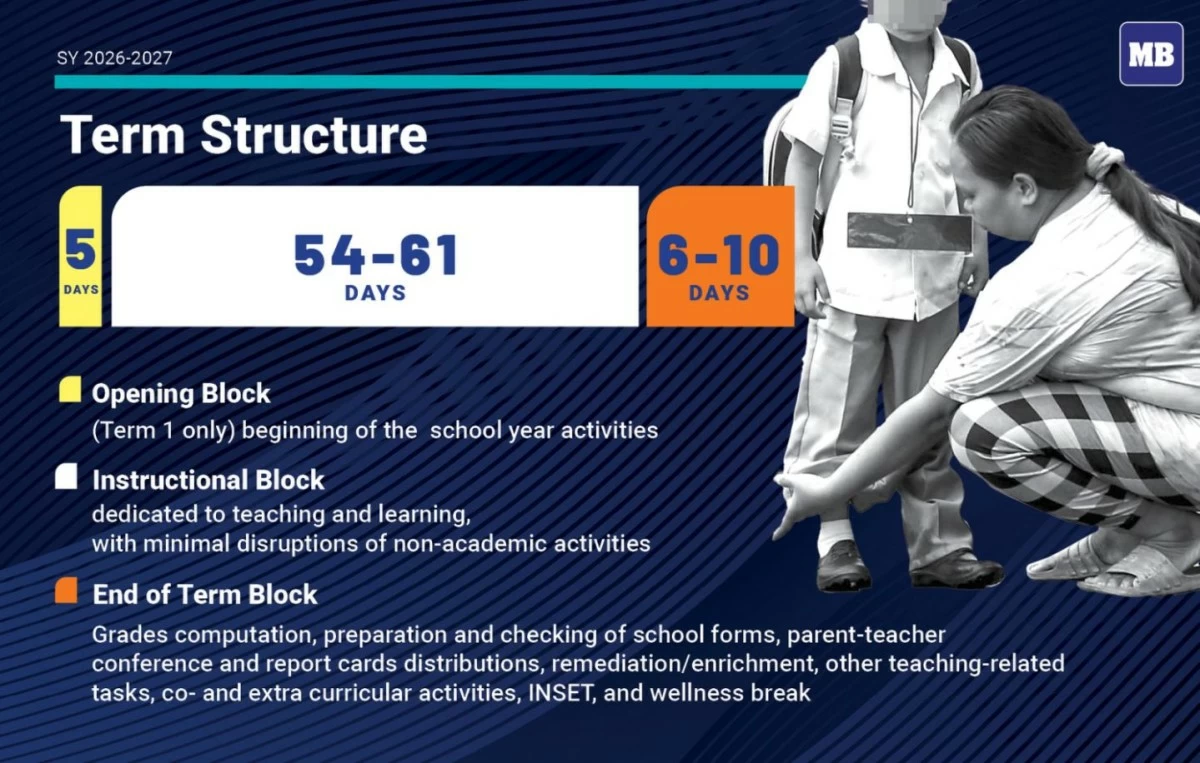
The three-term system includes dedicated blocks for instruction, assessment, and remediation. (MB Visual Content Group)
This design, DepEd explained, separates teaching time from administrative and co-curricular responsibilities—something that is often blurred in the current system.
Importantly, DepEd stressed that the instructional block is protected, ensuring that teaching time is not constantly interrupted.
Key problems it aims to solve
DepEd’s reform directly targets several systemic issues.
One is learning compression. As explained by DepEd, when classes are canceled, lessons are rushed. The new system introduces buffer periods that can “absorb disruptions” without sacrificing learning time.
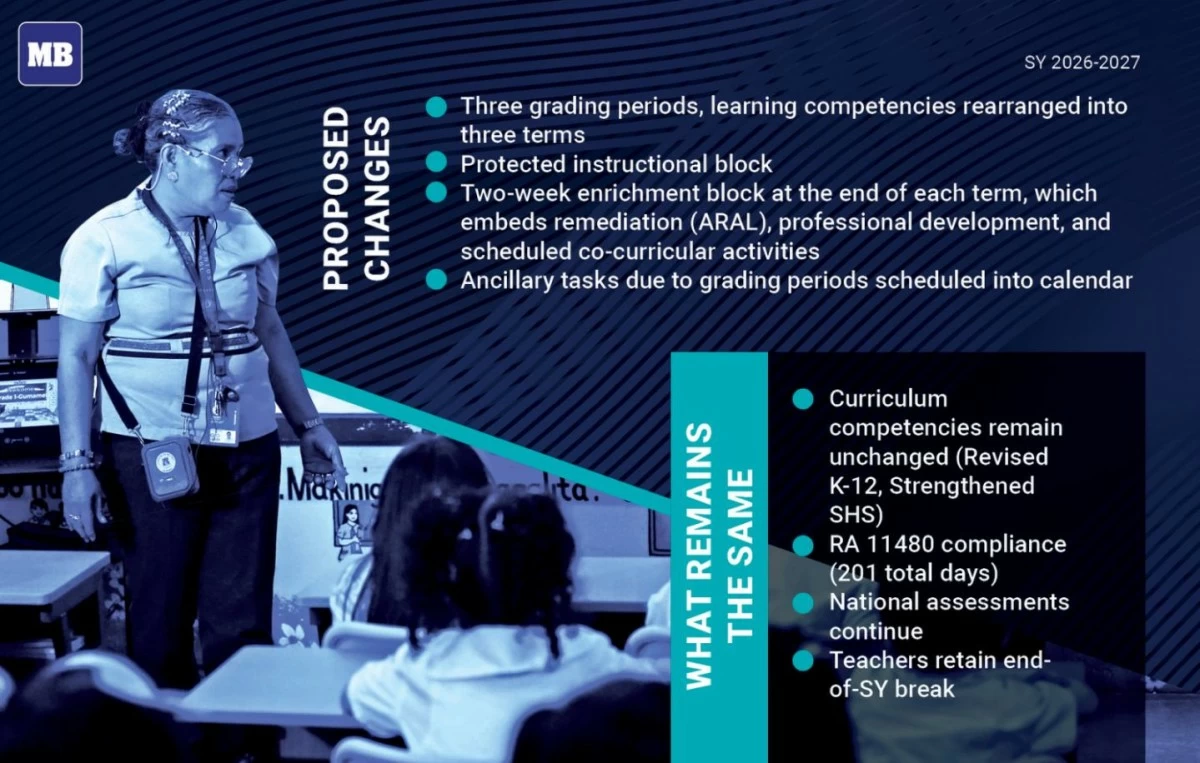
The reform separates teaching time from administrative tasks to enhance classroom focus. (MB Visual Content Group)
The new school calendar framework also aims to resolve limited remediation. DepEd said that students who fall behind often lack structured support. Under the new calendar, remediation sessions are built into both instructional and end-of-term blocks.
Moreover, DepEd said the three-term calendar is being eyed to reduce teacher workload. In the current four-grading system, teachers juggle grading, reports, and teaching simultaneously. The reform creates dedicated periods for administrative tasks, thus reducing after-hours work.
Benefits for learners and teachers
At the core of the school calendar reform is the goal of benefiting both teachers and learners.

DepEd said the new school calendar gives teachers dedicated time for grading, reporting, and professional development, reducing workload overlap and burnout while allowing greater focus on teaching. (DepEd file photo)
For learners, DepEd outlined clear advantages of the three-term school calendar, including more stable lesson pacing, longer time to master competencies, regular structured academic recovery sessions, and built-in buffers during disruptions.
For teachers, the reform ensures dedicated time for grading and reports, scheduled professional development, wellness breaks to reduce burnout, and less overlap between teaching and administrative work.
Part of a broader education reform
DepEd stressed that the three-term calendar is “not a standalone change” but part of a wider reform package that includes curriculum streamlining, assessment alignment, teacher workload rationalization, and flexible learning programs such as the Open High School, Night High School, and Homeschooling, among others.
The three-term school calendar also aligns with recommendations from the EDCOM II, which called for protecting instructional time and minimizing non-teaching burdens, DepEd said.
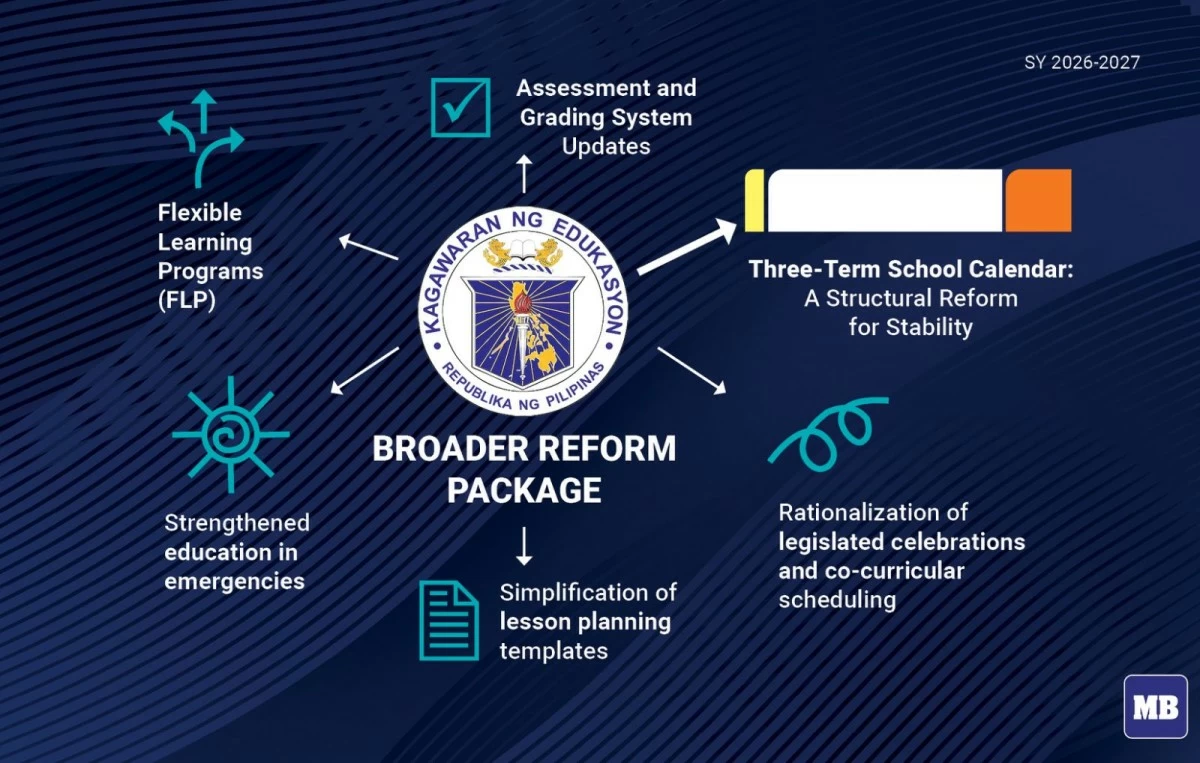
The proposed calendar aims to address learning gaps and ease teacher workload across Philippine schools. (MB Visual Content Group)
Moreover, DepEd said the proposal supports the intent of House Resolution No. 1805, which prioritizes foundational literacy, learning recovery, and structured assessments.
The three-term structure, DepEd said, helps operationalize these goals by ensuring dedicated time for both instruction and remediation.
DepEd said the reform also complies with Republic Act 11480, which mandates no more than 220 class days, including teacher breaks.
How will it be rolled out?
After securing the President’s approval, DepEd is preparing to implement the new calendar this incoming School Year (SY) 2026–2027, set to open in June.
READ:
According to DepEd, implementation of the three-term school calendar will follow a phased orientation process: Central Office to Regional Offices; Regional Offices to Schools Division Offices; and Division Offices to school heads and teachers.
DepEd said it will also use information campaigns such as official memoranda, school websites, social media, and community meetings and assemblies.
Private schools will be given flexibility, depending on their context and participation in consultations, DepEd said.
Countdown to implementation
Following regional consultations and national surveys, DepEd aims to finalize the draft of the policy before the end of this month.
The target issuance of the policy is in April. School Year 2026–2027 is scheduled to start in June, which is also the planned initial implementation of DepEd’s three-term school calendar.
In the following years, DepEd said there will be annual reviews and a comprehensive evaluation after five years. Stakeholder feedback will continue to shape the final policy.
Mixed reactions
Stakeholders, including teachers’ groups, on March 23, have expressed concerns about the shift to a three-term school calendar in basic education.
For the Teachers’ Dignity Coalition (TDC), the proposed three-grading period system is a possible solution to school calendar challenges, including lost days, unfinished lessons, and the need for balanced academic and co-curricular activities.
While it may ease teachers’ workloads and provide regular breaks, TDC stressed that its success depends on thorough pilot testing, genuine consultations, efficient digital school forms, and adequate learning materials.
TDC stressed that any reform must be backed by clear planning, strong support, and meaningful participation, while safeguarding teachers’ rights and dignity.
“TDC remains committed to constructive engagement to ensure policies are responsive to the realities of our education system,” the group said.
READ:
The Alliance of Concerned Teachers (ACT) Philippines, meanwhile, denounced the Marcos administration for “railroading” the approval of a three-term school calendar beginning SY 2026–2027.
The group called the three-term school calendar a “superficial reform” that ignores the worsening education crisis marked by shortages in classrooms, teachers, and learning resources.
ACT warned that the policy will only add burdens to already overworked teachers, forcing them to recalibrate curricula and assessments without adequate support, while diverting attention from urgent demands such as higher salaries, expanded benefits, and increased education budgets.
The group also urged the government to “stop experimenting” with ill-conceived policies and instead deliver genuine solutions to the deepening education and economic crises.
READ:
Support from parents, other teachers, and school heads
Meanwhile, DepEd reported growing support for the new school calendar among education stakeholders.
In a statement issued on March 25, DepEd said several parents, teachers, and school leaders have “expressed support” for the shift to a three-term school calendar, noting that the reform could “help improve” the flow of instruction and give teachers more time to focus on teaching.
Reden Juego, a teacher from Ramon Magsaysay Cubao High School, pointed out that the three-term system could lessen the overlap between instructional and administrative duties.
“On the part of the teachers, administrative tasks such as checking summative test papers, computing grades, distributing report cards, and similar duties will be reduced,” he said.
Rather than compressing tasks like exam checking, grade computation, and report card distribution into already tight schedules, these responsibilities can be spread more evenly throughout the school year.
“This entails more time for teachers to focus on the actual planning and execution of lessons,” he added.
Edwin Fuego, school head of Alveola Integrated School Annex in Butuan City, said a more organized academic calendar enables educators to ensure that learning competencies are not just covered but fully mastered.
“With a more structured distribution of the school year, educators can devote sufficient time to ensure that learning competencies are thoroughly taught and mastered,” Fuego said.
Miriam Illescas, a parent whose child studies at Malolos Marine Fishery School and Laboratory in Bulacan, said the revised calendar could help reduce disruptions caused by frequent school activities or unforeseen interruptions.
“The three-term school calendar by DepEd offers a structured yet flexible framework for learning,” she said. “With proper planning, it can improve student achievement, minimize fatigue, and provide timely support for struggling learners,” she added.
What it is and what it’s not
Concerns have been raised about the proposed shift to a three-term school calendar, with some fearing that fewer grading periods could lower academic standards, increase teacher workload, and eliminate meaningful breaks due to remediation activities.
Others worry that struggling learners may fall further behind and that the reform does not address recurring disruptions such as typhoons.
However, DepEd said these misconceptions are countered by several key design features of the policy.
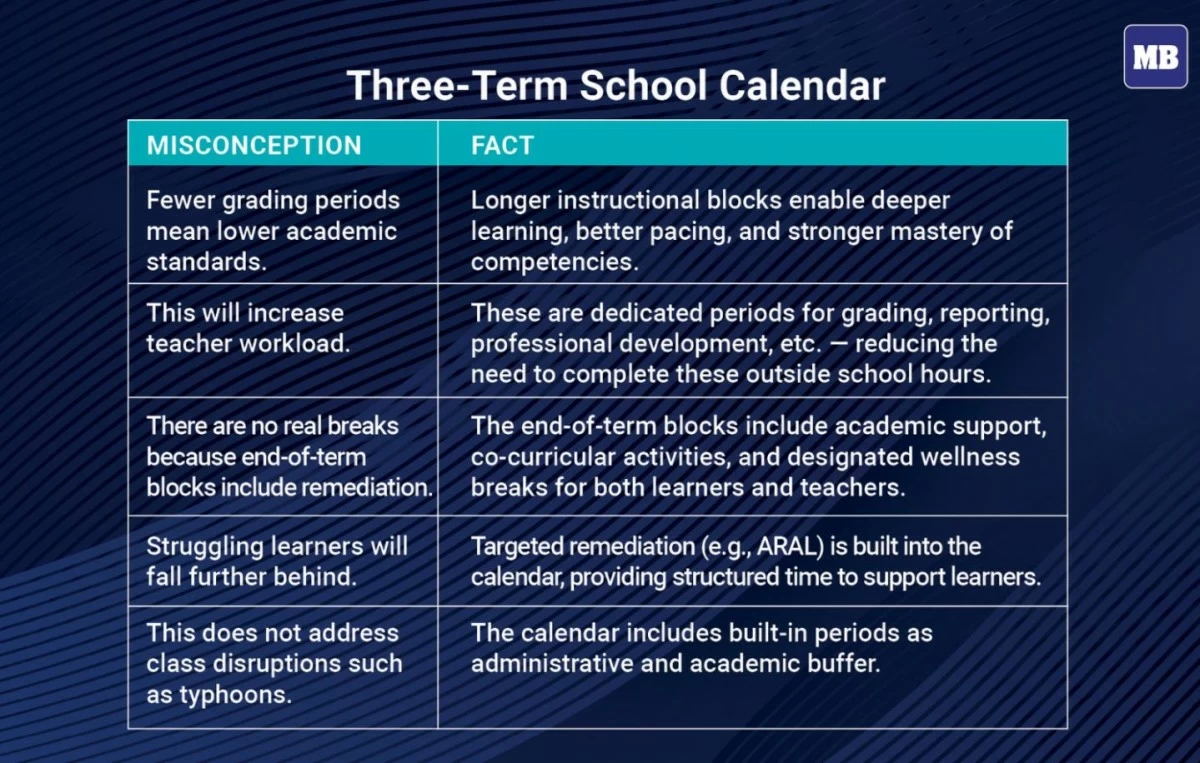
Despite concerns, DepEd assured that the new school calendar includes built-in remediation, buffer periods, and dedicated breaks to support both students and teachers. (MB Visual Content Group)
Longer instructional blocks are intended to support deeper learning, improved pacing, and stronger mastery of competencies. Dedicated periods for grading, reporting, and professional development are embedded in the calendar, reducing the need for teachers to complete these tasks outside school hours.
The end-of-term blocks are structured to include academic support, co-curricular activities, and wellness breaks for both learners and teachers, while targeted remediation programs such as ARAL are built into the system to provide structured support for struggling students.
Additionally, the calendar incorporates administrative and academic buffer periods to better manage disruptions.
DepEd said the proposed changes include reorganizing learning competencies into three grading periods, implementing protected instructional blocks, and introducing a two-week enrichment block at the end of each term that integrates remediation, professional development, and co-curricular activities.
Ancillary grading tasks are also scheduled in the calendar to streamline teacher workload.
Despite these adjustments, several key elements remain unchanged: curriculum competencies under the revised K–12 and strengthened Senior High School programs will stay the same, compliance with Republic Act 11480’s required 201 school days will be maintained, national assessments will continue, and teachers will retain their end-of-school-year break.
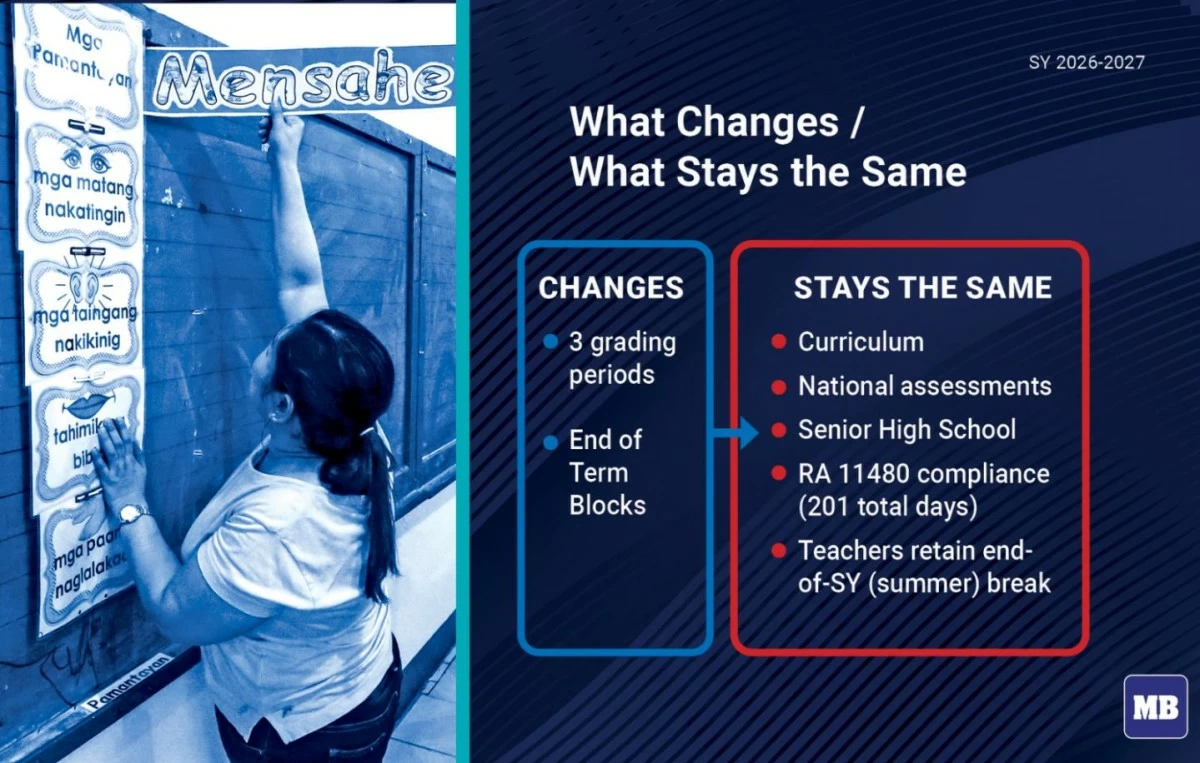
DepEd prepares for the rollout of the new academic calendar in School Year 2026–2027. (MB Visual Content Group)
While risks such as increased teacher workload and potential over-scheduling of co- and extra-curricular activities are acknowledged, DepEd said mitigation measures are being developed.
These include simplifying lesson plan templates, aligning curriculum delivery plans with the three-term structure, and consulting with regional offices, local government units, and private school associations to safeguard instructional time.
Co-creation workshops with regional and division offices are also planned to maximize the effectiveness of enrichment blocks and ensure smooth implementation, DepEd said.
Strengthen learning continuity despite disruptions
DepEd explained that the proposed three-term school calendar is designed to fix how time is used in schools, not to change what is taught.
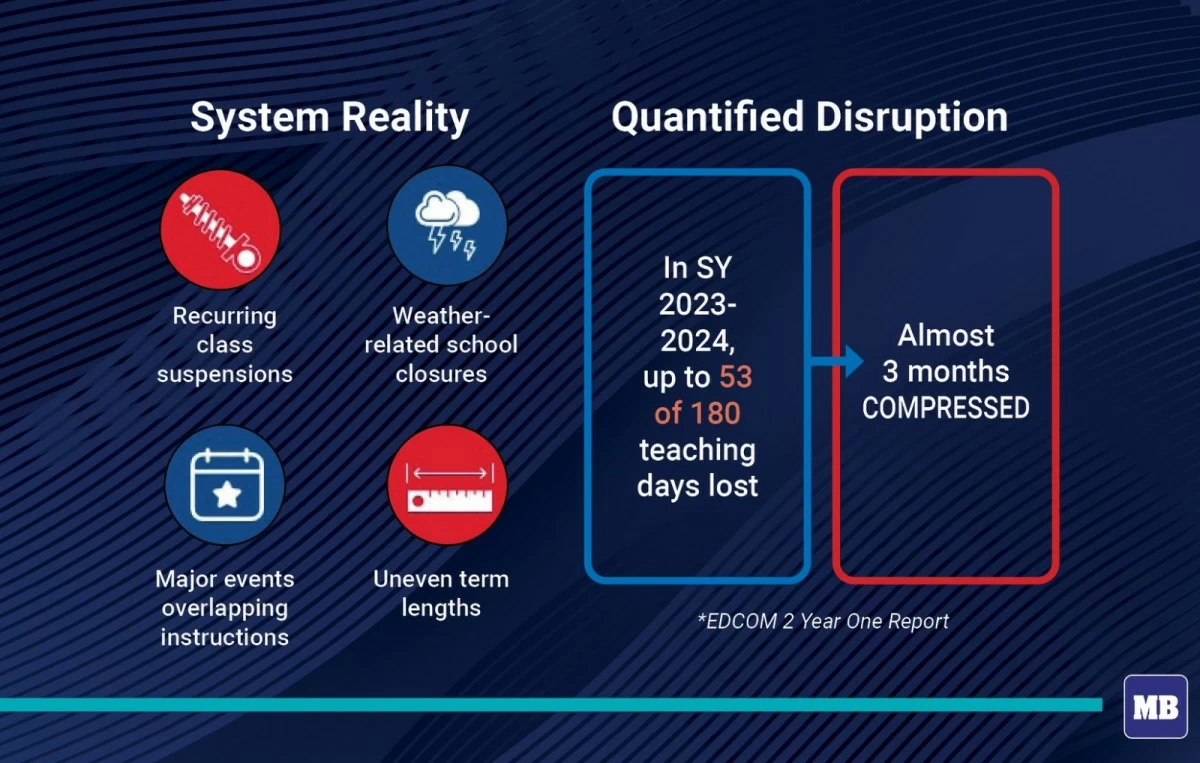
DepEd said the new calendar will help absorb class disruptions caused by typhoons and other events. (MB Visual Content Group)
By separating instruction from administrative and co-curricular demands, DepEd aims to protect learning time, improve student mastery, and reduce teacher burnout.
As consultations continue, the success of the reform will largely depend on how effectively it is implemented—and how well it addresses the realities faced by schools on the ground.
READ: