







Marcos declares state of national energy emergency
Published Mar 24, 2026 07:46 pm


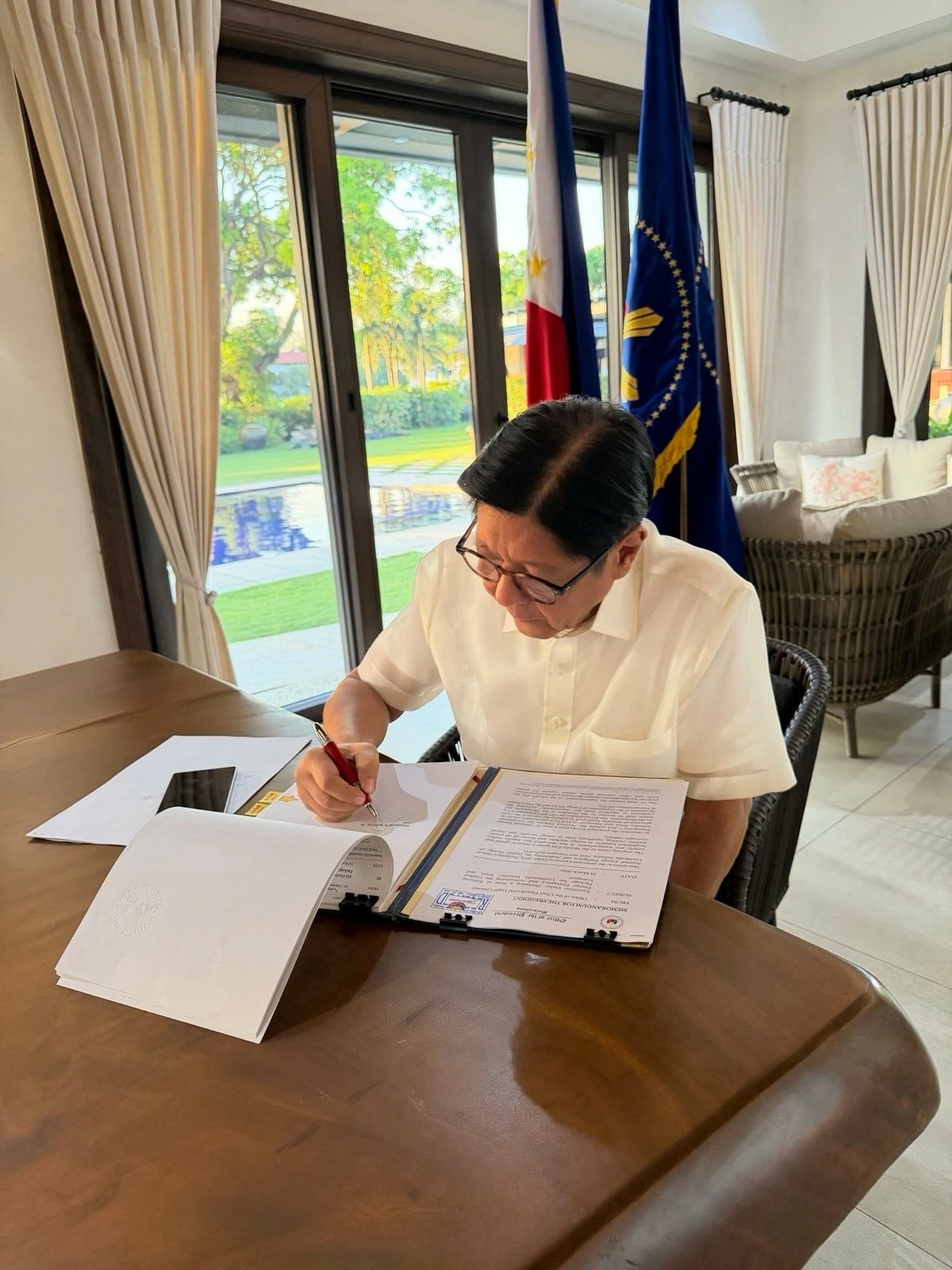
President Ferdinand R. Marcos Jr. signs Executive Order No. 110 declaring a State of National Energy Emergency and adopting the Unified Package for Livelihoods, Industry, Food, and Transport (UPLIFT), activating a whole-of-government response to ensure energy supply stability, support key sectors such as transport, agriculture, and MSMEs, and protect Filipinos amid global oil supply disruptions. (Photo courtesy of Malacañang)
The Philippines is now under a state of national energy emergency.
President Marcos has signed Executive Order No. 110, declaring a state of national energy emergency in light of the ongoing conflict in the Middle East which has impacted the "availability and stability" of the country's energy supply.
The Executive Order signed on Tuesday, March 24, places the country under a state of energy emergency for one year.
In declaring a state of energy emergency, Marcos cited the "imminent danger" the ongoing Middle East conflict poses to the country's energy supply.
"[U]rgent measures are necessary to ensure the stability and adequacy of the country's energy supply," the EO stated.
The declaration of a state of national energy emergency, according to the EO, will enable the government to implement responsive and coordinated measures to address the risks posed by disruptions in the global energy supply and domestic economy.
UPLIFT Committee
Aside from the declaration, the EO also authorizes Unified Package for Livelihoods, Industry, Food, and Transport (UPLIFT) and creates the UPLIFT Committee.
Under the EO, UPLIFT Committee will be the government's coordinated response, consisting of energy supply management measures by the Department of Energy and its attached agencies.
The committee aims to safeguard national interest by ensuring stability of domestic energy supply, the uninterrupted delivery of essential services, the continuity of economic activities, and welfare of citizens, particularly the vulnerable sectors.
It will also mitigate the impact of the ongoing conflict in the Middle East.
The committee will be chaired by Marcos. Its members include the Executive Secretary and secretaries of Departments of Energy (DOE), Transportation (DOTr), Social Welfare and Development (DSWD), Agriculture (DA), Finance (DOF), Economy, Planning, and Development (DEPDev), and Budget and Management (DBM).
Among the functions UPLIFT will perform include monitoring and ensuring the continued and orderly supply, distribution, and availability of food, medicines, agricultural products, and other essential goods.
They shall also ensure that the operation of public transportation and services will carry on.
The committee is also tasked to formulate longer-term demand-side solutions and strategies to decrease consumption of petroleum products across residential, commercial, industrial, and public utility sectors.
Under the EO, Marcos highlighted that "the recent hostilities in the Middle East involving the United States of America, Israel, and Iran have heightened geopolitical tensions in the region that plays a critical role in global oil production and transportation, creating uncertainty in global energy markets, severe disruptions in supply chains, and significant volatility and upward pressure on international oil prices, thereby posing a threat to the country's energy security."
He also cited that the closure of the Strait of Hormuz, a critical energy corridor for global oil shipments, "disrupts the flow of petroleum products to international markets and constrains global fuel supply, with corresponding implications on the stability and adequacy of our domestic energy supply."
He stressed that the Philippines remains highly dependent on external sources of fuel supply and is therefore vulnerable to disruptions in global oil production and transportation, which may affect the availability and timely delivery of petroleum products necessary to sustain domestic energy requirements.