

ADVERTISEMENT

Katrina Cuenca and the art of becoming

From paint and metal to luminous glass, the Filipino artist's evolving practice reflects a shared journey with the Manila Bulletin as it marks its 126th year

Published Jan 30, 2026 06:48 pm
As the Manila Bulletin marks its 126th year, the milestone offers an opportunity to reflect on the artists whose journeys have unfolded alongside our paper’s own history of chronicling culture, creativity, and change. One of them is Katrina Cuenca, a Filipino contemporary artist whose practice has steadily evolved—from painting, to metal sculpture, and now, to glass—guided by a persistent fascination with light, movement, and transformation.
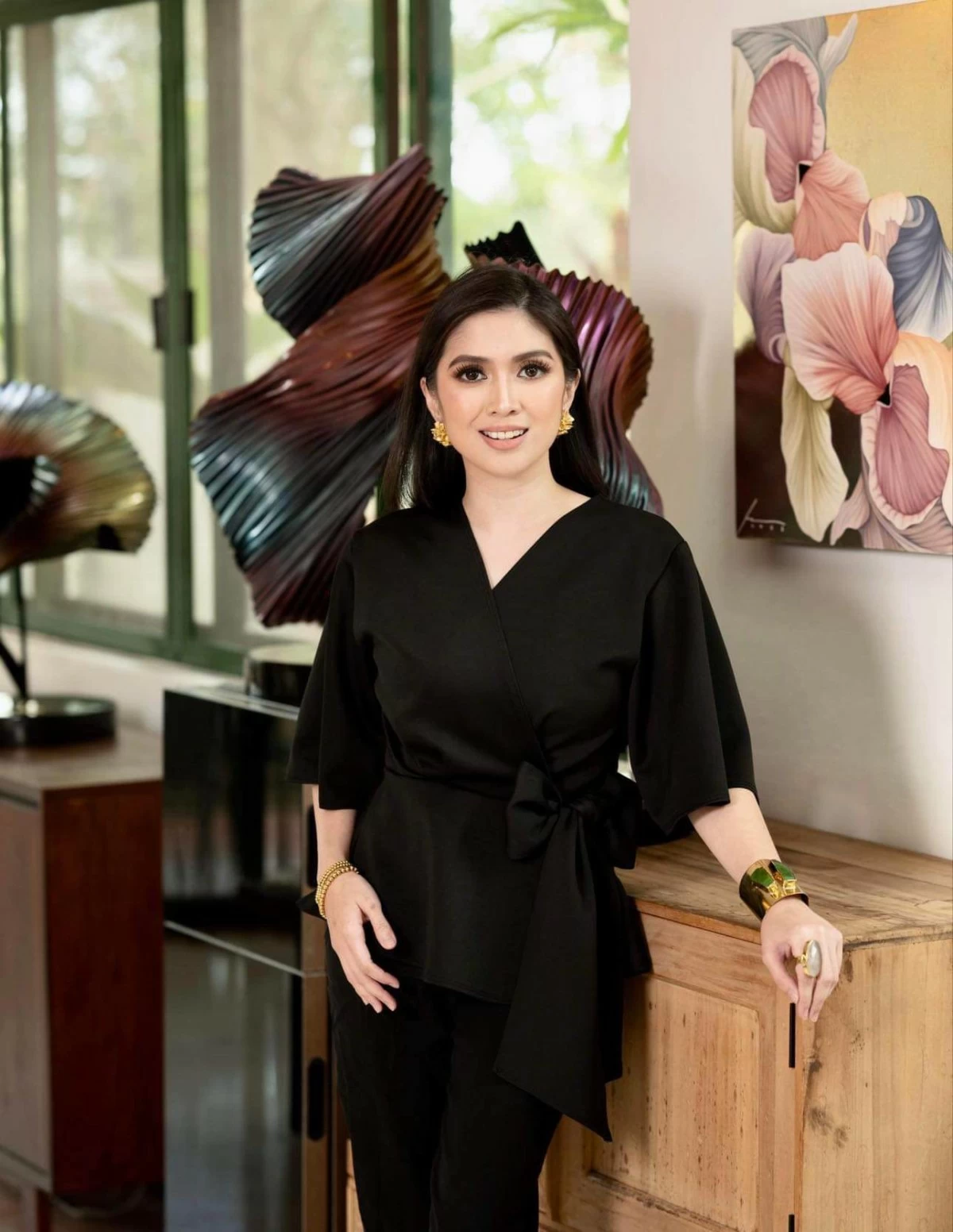
IN MOTION Katrina Cuenca surrounded by her brass sculptures and paintings, where fluid forms first took shape across canvas and metal.
Katrina’s relationship with the Manila Bulletin goes beyond coverage. In 2023, she was commissioned to create the trophy for the Manila Bulletin Uplift Awards, translating her signature flowing forms into a sculptural object that embodied ascent, resilience, and hope. The piece, executed in metal and finished in vivid blue, became a physical symbol of shared values. Looking back, it now reads as a marker in her artistic timeline—a moment when her language of movement and light intersected with Manila Bulletin’s mission to recognize progress and possibility.
At the time, Katrina was already moving fluidly between painting and sculpture. She first gained recognition for abstract canvases defined by organic, rippling forms, often built through layered surfaces and unconventional materials. That sensibility carried naturally into sculpture. By the time she began working in brass and metal, Katrina’s forms had fully entered three dimensions. Ribbon-like structures twisted and rose from their bases, reflective surfaces catching ambient light and shifting with the viewer’s movement. It was only a matter of time before light moved from being reflected to being contained.
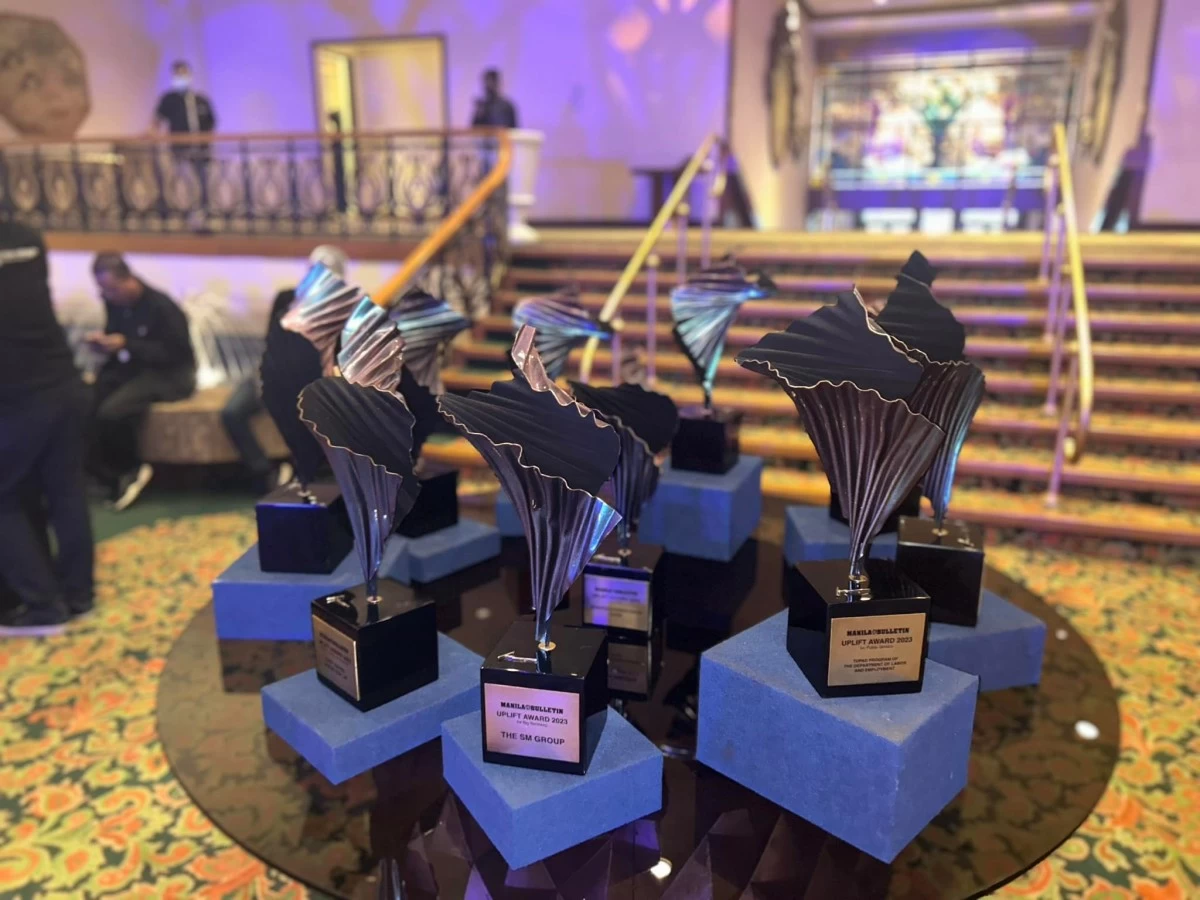
RISING FORM The Manila Bulletin Uplift trophy, designed by Katrina Cuenca in 2023, translating her signature flowing forms into a sculptural symbol of ascent, resilience, and shared purpose.
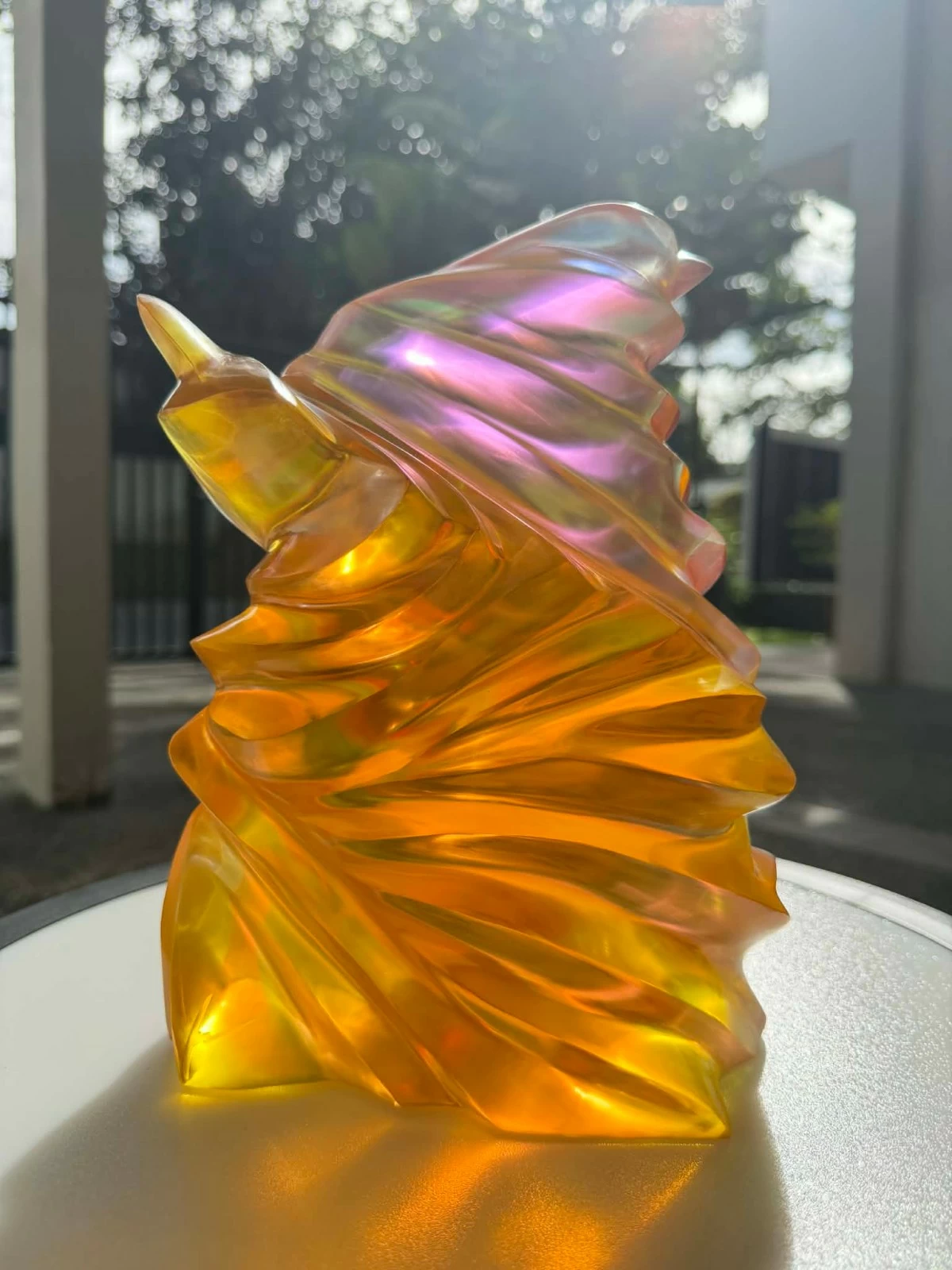
“Yes, in early 2025 I released my first glass sculptures,” Katrina says. “Glass was always like a dream medium for me to tackle. I finally dove in 2024 and committed to learn. It is always important for me to experiment with my work and to bring my figures to different mediums and forms. It was important for me to really use glass because light was always an external medium for my work and glass is perfect to play with and capture light.”
The shift to glass marked a significant turning point in her practice. Unlike metal, which resists and reflects, glass demands a different kind of engagement—one that balances precision with surrender. Katrina describes the transition as both technically and emotionally challenging.
Glass introduced risk at every stage of the process. A single slip could fracture a piece, undoing hours or days of work. Learning to manage that uncertainty became part of the discipline.
“It’s very exciting because glass is very beautiful on its own as a material,” she says. “It is both fragile and tough. Anything can go wrong during the process of creating the piece. But it makes me appreciate the finished pieces even more.”
IN MOTION Katrina Cuenca surrounded by her brass sculptures and paintings, where fluid forms first took shape across canvas and metal.
The finished works reveal that tension. Katrina’s glass sculptures emerge solid and sturdy, yet visually soft, their contours fluid and almost weightless. In her newer iridescent pieces, light refracts within the form itself, creating an effect that feels atmospheric.
Her approach to the medium has been deliberately incremental. Katrina began with the most forgiving type of glass available, using it as a training ground to understand hardness, cutting behavior, and structural limits.
As her confidence grew, so did the complexity of her materials. She now adheres different types of glass—including crystal and iridescent sheets—before carving them into form, a process that demands patience and precision.
For Katrina, the decision to commit to glass was not simply a technical evolution, but a personal one.
“I’m very happy I challenged myself to take on this medium,” she says. “The whole experience wasn’t just an evolution of my work. I think it also changed me as an artist.”
From the perspective of the Manila Bulletin, that progression carries particular resonance. Katrina is an artist the paper has followed, collaborated with, and supported—from feature stories to the creation of the Uplift trophy. Watching her move from paint to brass to glass is not just witnessing a change in materials, but an expansion of vision.

Related Tags

MB126 Arts and Culture Katrina Cuenca
ADVERTISEMENT
.most-popular .layout-ratio{ padding-bottom: 79.13%; } @media (min-width: 768px) and (max-width: 1024px) { .widget-title { font-size: 15px !important; } }

{{ articles_filter_1561_widget.title }}

.most-popular .layout-ratio{ padding-bottom: 79.13%; } @media (min-width: 768px) and (max-width: 1024px) { .widget-title { font-size: 15px !important; } }

{{ articles_filter_1562_widget.title }}

.most-popular .layout-ratio{ padding-bottom: 79.13%; } @media (min-width: 768px) and (max-width: 1024px) { .widget-title { font-size: 15px !important; } }

{{ articles_filter_1563_widget.title }}

{{ articles_filter_1564_widget.title }}

.mb-article-details { position: relative; } .mb-article-details .article-body-preview, .mb-article-details .article-body-summary{ font-size: 17px; line-height: 30px; font-family: "Libre Caslon Text", serif; color: #000; } .mb-article-details .article-body-preview iframe , .mb-article-details .article-body-summary iframe{ width: 100%; margin: auto; } .read-more-background { background: linear-gradient(180deg, color(display-p3 1.000 1.000 1.000 / 0) 13.75%, color(display-p3 1.000 1.000 1.000 / 0.8) 30.79%, color(display-p3 1.000 1.000 1.000) 72.5%); position: absolute; height: 200px; width: 100%; bottom: 0; display: flex; justify-content: center; align-items: center; padding: 0; } .read-more-background a{ color: #000; } .read-more-btn { padding: 17px 45px; font-family: Inter; font-weight: 700; font-size: 18px; line-height: 16px; text-align: center; vertical-align: middle; border: 1px solid black; background-color: white; } .hidden { display: none; }
function initializeAllSwipers() { // Get all hidden inputs with cms_article_id document.querySelectorAll('[id^="cms_article_id_"]').forEach(function (input) { const cmsArticleId = input.value; const articleSelector = '#article-' + cmsArticleId + ' .body_images'; const swiperElement = document.querySelector(articleSelector); if (swiperElement && !swiperElement.classList.contains('swiper-initialized')) { new Swiper(articleSelector, { loop: true, pagination: false, navigation: { nextEl: '#article-' + cmsArticleId + ' .swiper-button-next', prevEl: '#article-' + cmsArticleId + ' .swiper-button-prev', }, }); } }); } setTimeout(initializeAllSwipers, 3000); const intersectionObserver = new IntersectionObserver( (entries) => { entries.forEach((entry) => { if (entry.isIntersecting) { const newUrl = entry.target.getAttribute("data-url"); if (newUrl) { history.pushState(null, null, newUrl); let article = entry.target; // Extract metadata const author = article.querySelector('.author-section').textContent.replace('By', '').trim(); const section = article.querySelector('.section-info ').textContent.replace(' ', ' '); const title = article.querySelector('.article-title h1').textContent; // Parse URL for Chartbeat path format const parsedUrl = new URL(newUrl, window.location.origin); const cleanUrl = parsedUrl.host + parsedUrl.pathname; // Update Chartbeat configuration if (typeof window._sf_async_config !== 'undefined') { window._sf_async_config.path = cleanUrl; window._sf_async_config.sections = section; window._sf_async_config.authors = author; } // Track virtual page view with Chartbeat if (typeof pSUPERFLY !== 'undefined' && typeof pSUPERFLY.virtualPage === 'function') { try { pSUPERFLY.virtualPage({ path: cleanUrl, title: title, sections: section, authors: author }); } catch (error) { console.error('ping error', error); } } // Optional: Update document title if (title && title !== document.title) { document.title = title; } } } }); }, { threshold: 0.1 } ); function showArticleBody(button) { const article = button.closest("article"); const summary = article.querySelector(".article-body-summary"); const body = article.querySelector(".article-body-preview"); const readMoreSection = article.querySelector(".read-more-background"); // Hide summary and read-more section summary.style.display = "none"; readMoreSection.style.display = "none"; // Show the full article body body.classList.remove("hidden"); } document.addEventListener("DOMContentLoaded", () => { let loadCount = 0; // Track how many times articles are loaded const offset = [1, 2, 3, 4, 5, 6, 7, 8, 9, 10]; // Offset values const currentUrl = window.location.pathname.substring(1); let isLoading = false; // Prevent multiple calls if (!currentUrl) { console.log("Current URL is invalid."); return; } const sentinel = document.getElementById("load-more-sentinel"); if (!sentinel) { console.log("Sentinel element not found."); return; } function isSentinelVisible() { const rect = sentinel.getBoundingClientRect(); return ( rect.top < window.innerHeight && rect.bottom >= 0 ); } function onScroll() { if (isLoading) return; if (isSentinelVisible()) { if (loadCount >= offset.length) { console.log("Maximum load attempts reached."); window.removeEventListener("scroll", onScroll); return; } isLoading = true; const currentOffset = offset[loadCount]; window.loadMoreItems().then(() => { let article = document.querySelector('#widget_1690 > div:nth-last-of-type(2) article'); intersectionObserver.observe(article) loadCount++; }).catch(error => { console.error("Error loading more items:", error); }).finally(() => { isLoading = false; }); } } window.addEventListener("scroll", onScroll); });

Sign up by email to receive news.