







The living mythology of Pueblo and Yamagata
Two unique styles shine in "Myth/Making"
By S.C. Fojas
Published Jan 24, 2026 09:41 am


At A Glance
- Though their aesthetics differ, Mervy's being illustrative and narrative, Atsuko's being abstract and textural, the two artists find common ground in their sincerity.
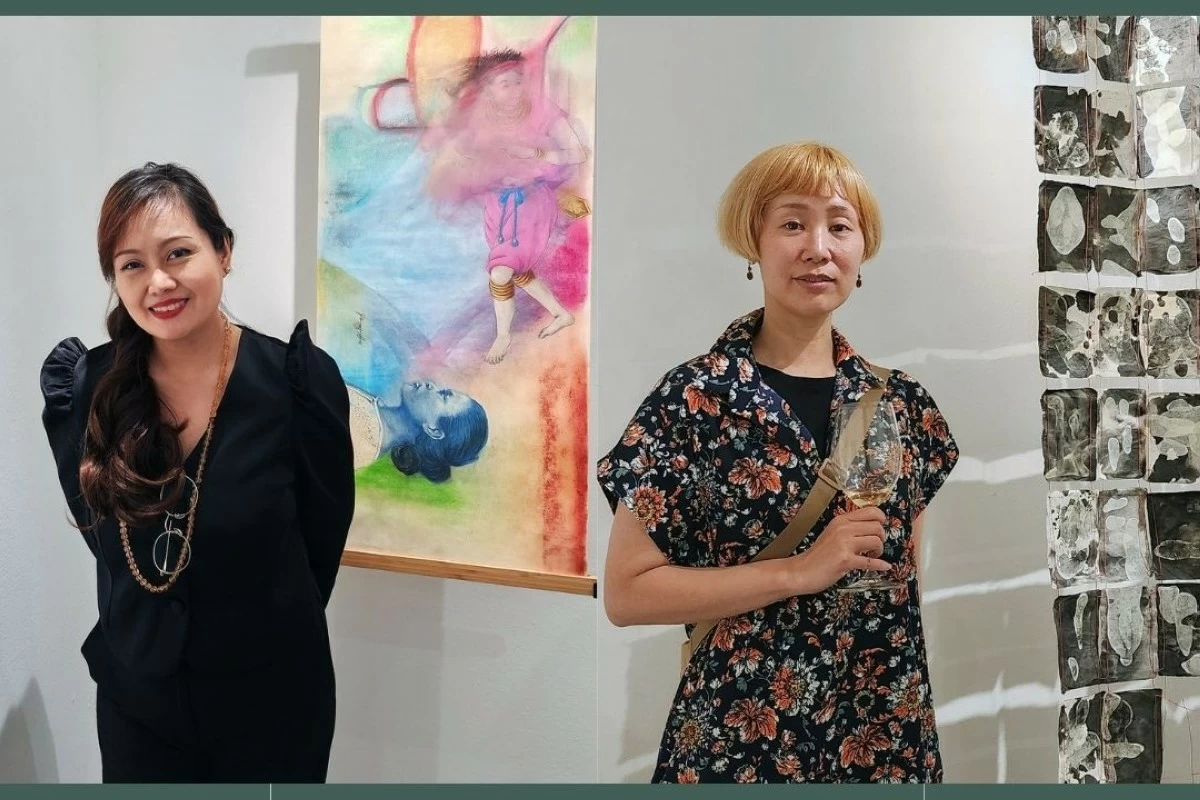
MEET THE ARTISTS Mervy Pueblo and Atsuko Yamagata
When Mervy Pueblo and Atsuko Yamagata met in Japan in 2019, they found a common language that transcended their different styles. “We both respond to life,” says Mervy. Their exhibit “Myth/Making” is a homecoming of sorts—not to a physical place, but to the stories that define them and us. Utilizing materials that bridge the Philippines and Japan, such as the handmade papers of Asao Shimura, the duo explores what Mervy calls the “outsider’s gaze,” and Atsuko describes as the “blood line of stories.”
While Mervy’s works confront the sharp, often jagged edges of systemic failure, Atsuko’s pieces offer a meditative, tactile exploration of memory and the spirits of the soil. Together, they demonstrate that myths are not merely relics of the past but a living collaboration in the construction of the present.
Mervy Pueblo: The horror of everyday
Mervy adopts what she calls “the outsider’s gaze,” utilizing the visual lexicon of the 16th-century Boxer Codex to critique the modern Filipino experience. Her work is a reaction to the “cross capitalist operations” and bureaucratic demons that haunt the nation.
In the striking “The Demonization of Power,” she uses watercolor that transforms into a monstrous, scaled entity (representing a corrupt official) literally devouring documents while exhaling a smoke screen of deception. Beside him, a laughing minion catches bags of gold, indifferent to the background scenes where a mother and child struggle against ink-washed waves.
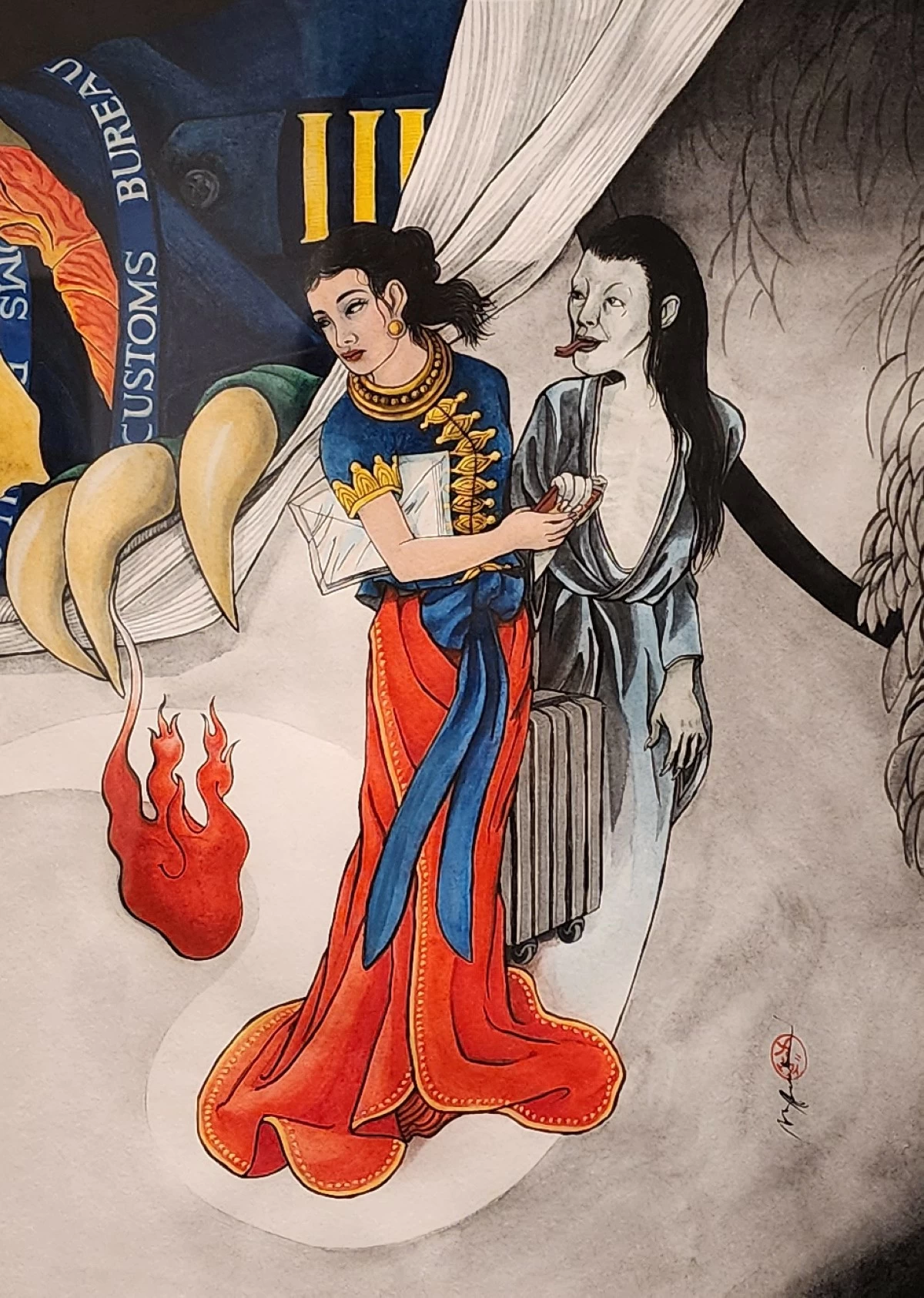
'DEMONS AND THE BUREAUCRACY OF FLIGHT I' 14x10 inches, watercolor on paper, 2026
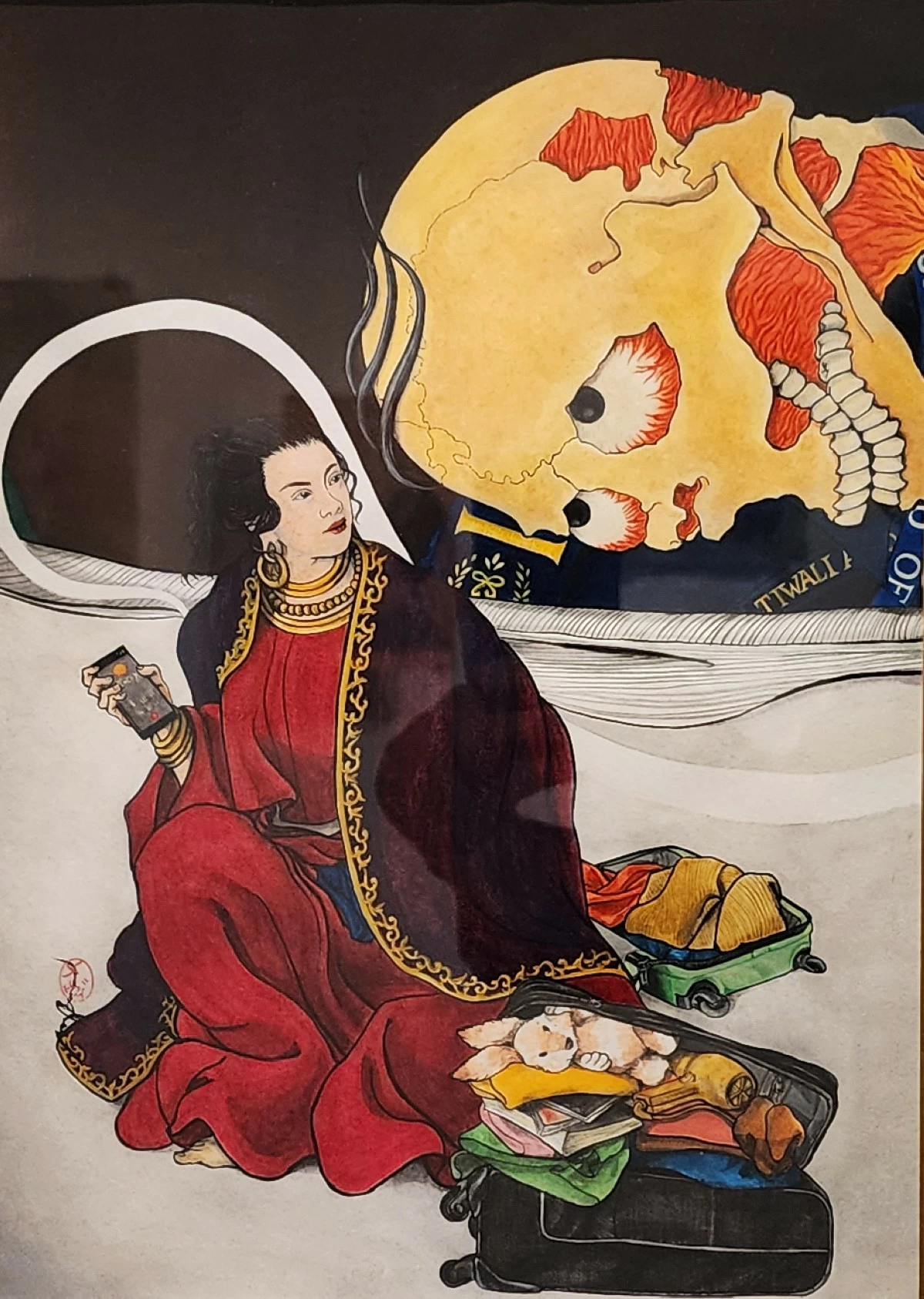
'DEMONS AND THE BUREAUCRACY OF FLIGHT II' 14x10 inches, watercolor on paper, 2026
Her “Demons and the Bureaucracy of Flight (I and II)” illustrate the darker machinery of migration. In I, a woman in traditional-meets-modern attire clutches her documents while a gaunt, tongue-flicking demon looms behind her, a personification of illegal recruitment and passport confiscation. The imagery of suitcases filled with stuffed toys and hair dryers in II emphasizes the heartbreaking domestic reality of those caught in the “bureaucracy of flight.”
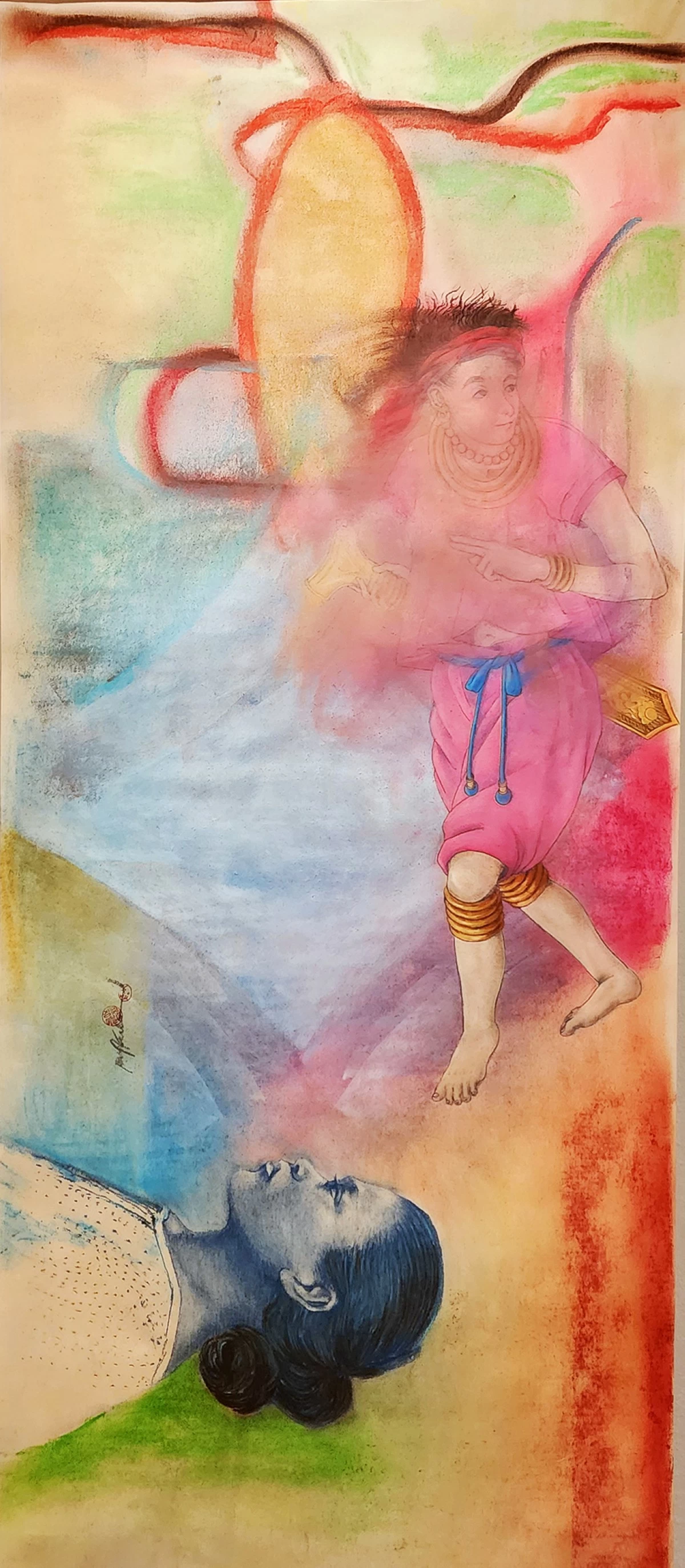
'SYSTEMIC ERASURE' 44x20 inches, chalk pastel on paper, 2026
Meanwhile, “Systemic Erasure” is a large chalk pastel piece that is the most haunting. By depicting an erased face of the ancient Filipino, Mervy asks what remains of a national identity when its pre-colonial foundations are deliberately obscured.
Mervy, who balances her practice with other responsibilities, admits the process wasn’t without its hurdles. “It would have been great to be a full-time visual artist. However, that is not afforded to me.” Despite this, her work feels urgent and fully realized, designed for the audience to see some part of themselves in the art.
Atsuko Yamagata: The red thread of memory
In contrast to Mervy’s sharp social critique, Atsuko Yamagata’s “Threads of Memory” offers a gentler, more intimate revival of folklore from Nakanojo, Japan. Her medium—embroidery and collage on handmade washi paper—is as significant as the imagery itself.
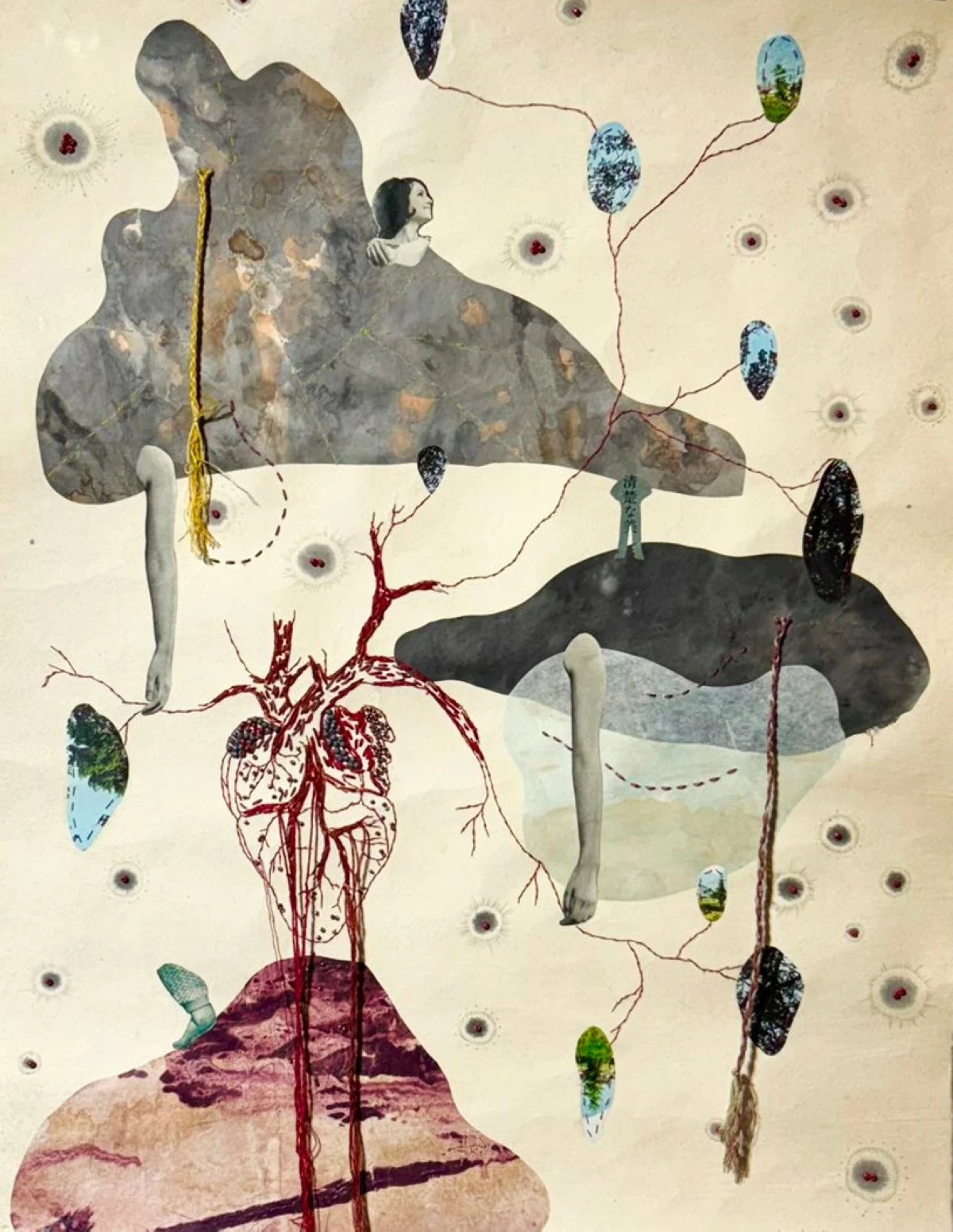
'BLOOD LINE OF STORIES' 24x18 inches, mixed media on handmade paper, 2026
In her “Blood Line of Stories,” a central, anatomical heart is rendered in red thread, its vessels extending like branches across the paper. “Folklore is alive,” Atsuko says, “and stories connect to other stories. We can trace the story, and there must be a heart somewhere.”
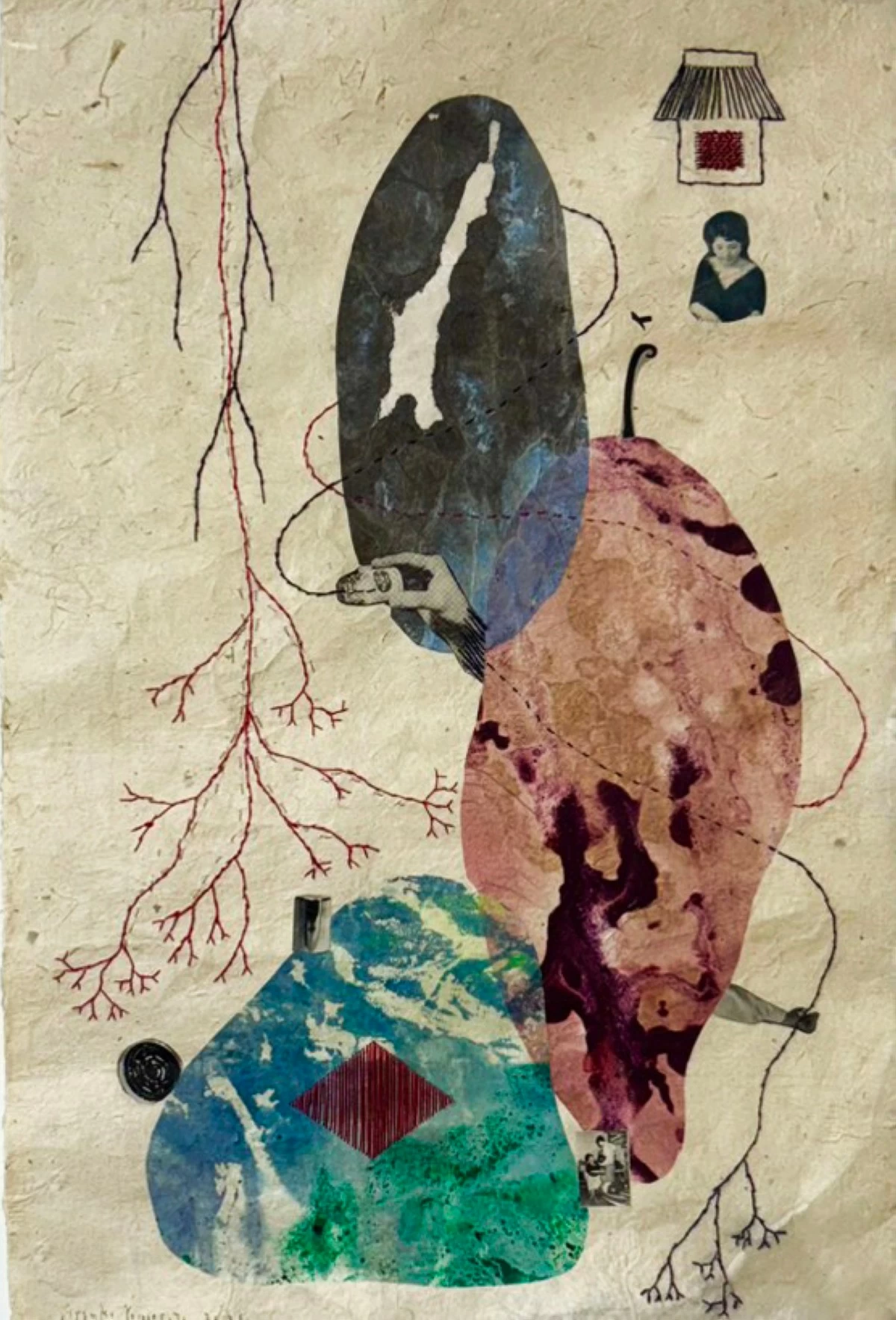
'THE TALKING ROCK SPEAKS TO THE MAN IN THE MIDDLE OF THE NIGHT,' 16x10 inches, mixed media on handmade paper, 2026
Her “The Talking Rock Speaks to the Man in the Middle of the Night” made use of organic, stone-like shapes and delicate red-stitching. Atsuko constructs the legend of a stone that aided a man seeking justice, only to be silenced by a samurai’s blade.
Atsuko’s choice of paper is a bridge between her two homes. “All of my works are made using Asao Shamura’s handmade paper, which is made from Philippine plants and is crafted using traditional Japanese papermaking techniques,” she explains. “These papers have always symbolized my shifting identity as a result of my migration.”
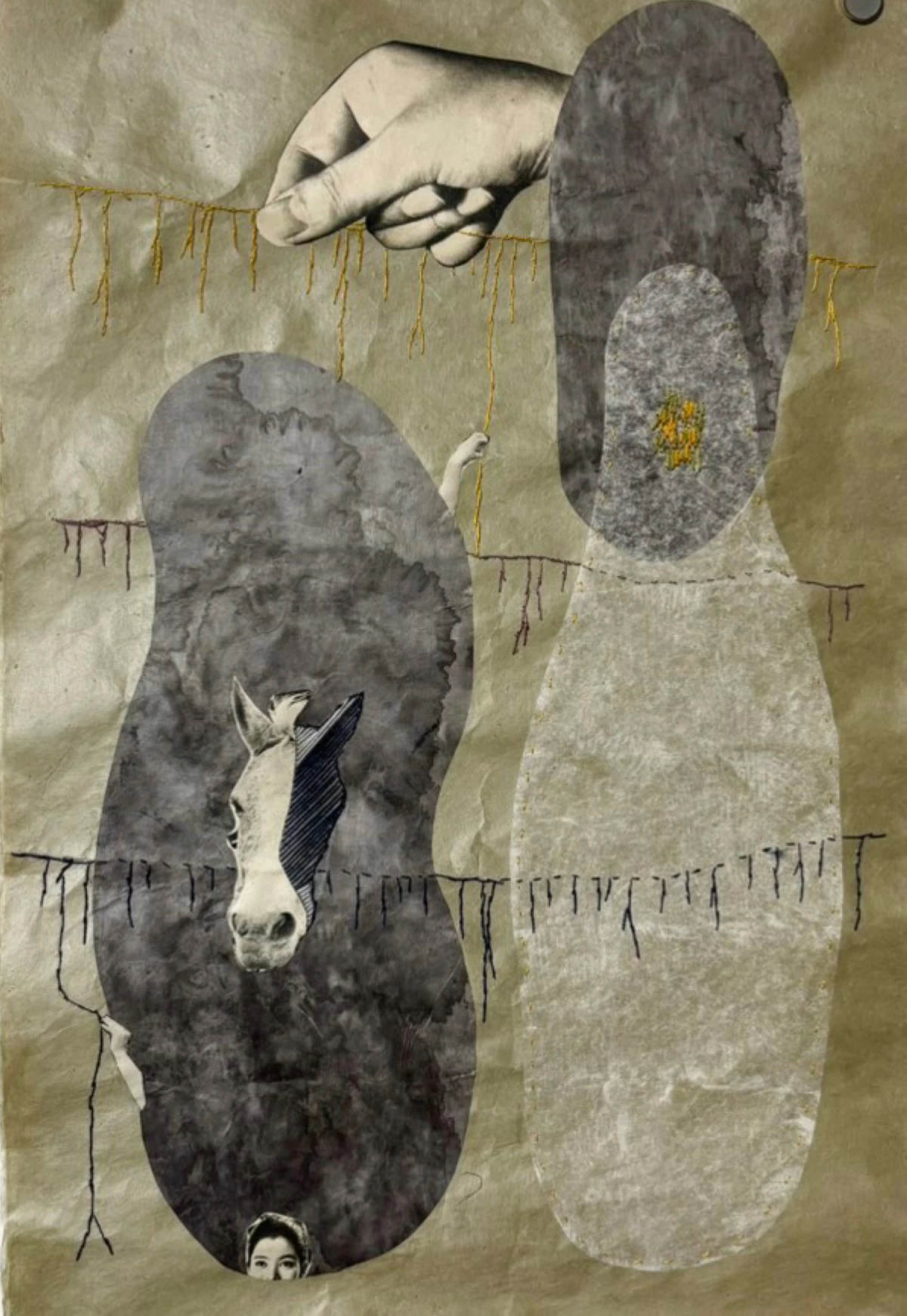
'LEADING A HORSE, BEING LED BY A HORSE' 16x10 inches, mixed media on handmade paper, 2025
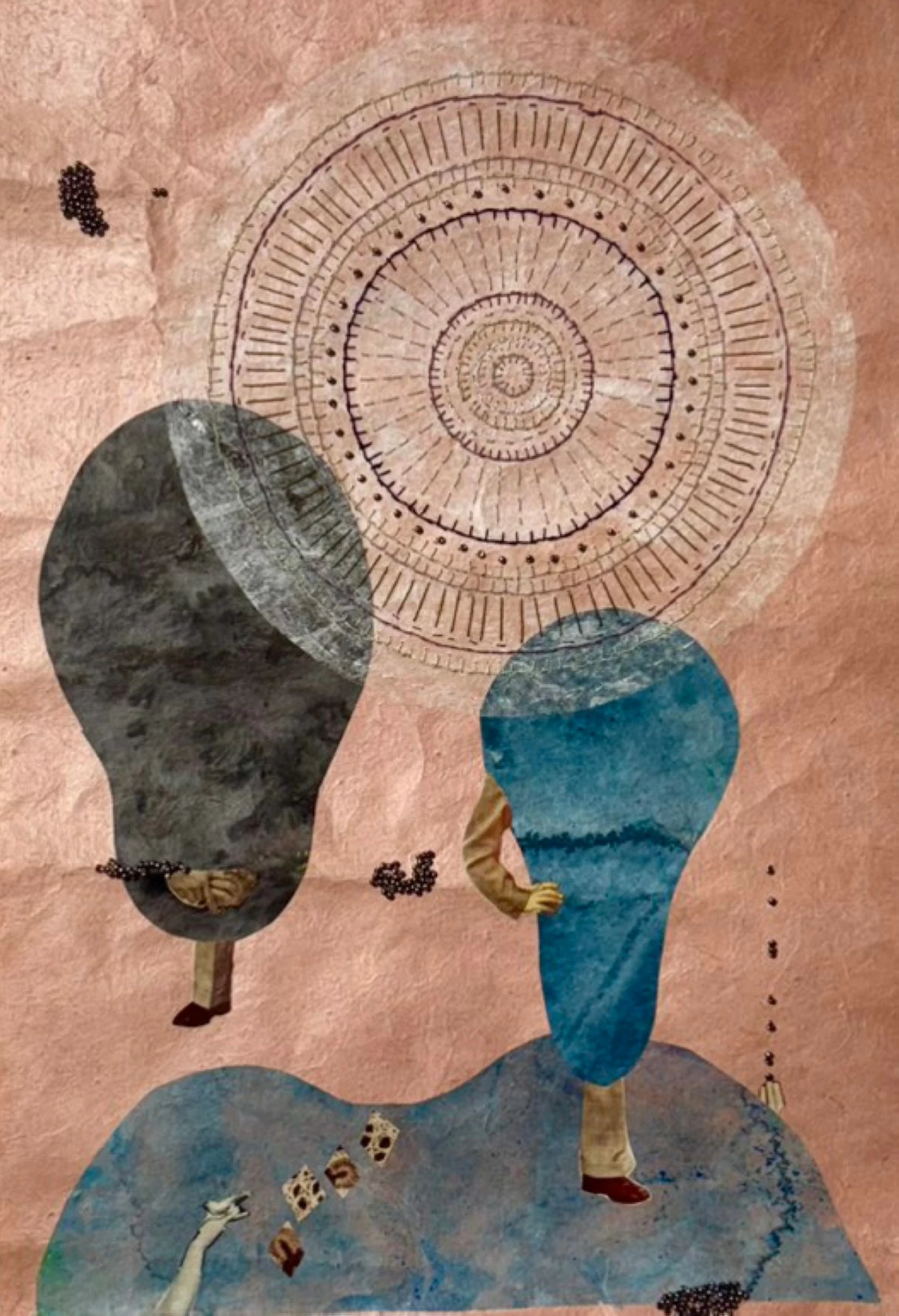
'SUN, MOUNTAINS, AND FAITH' 16x10 inches, mixed media on handmade paper, 2025
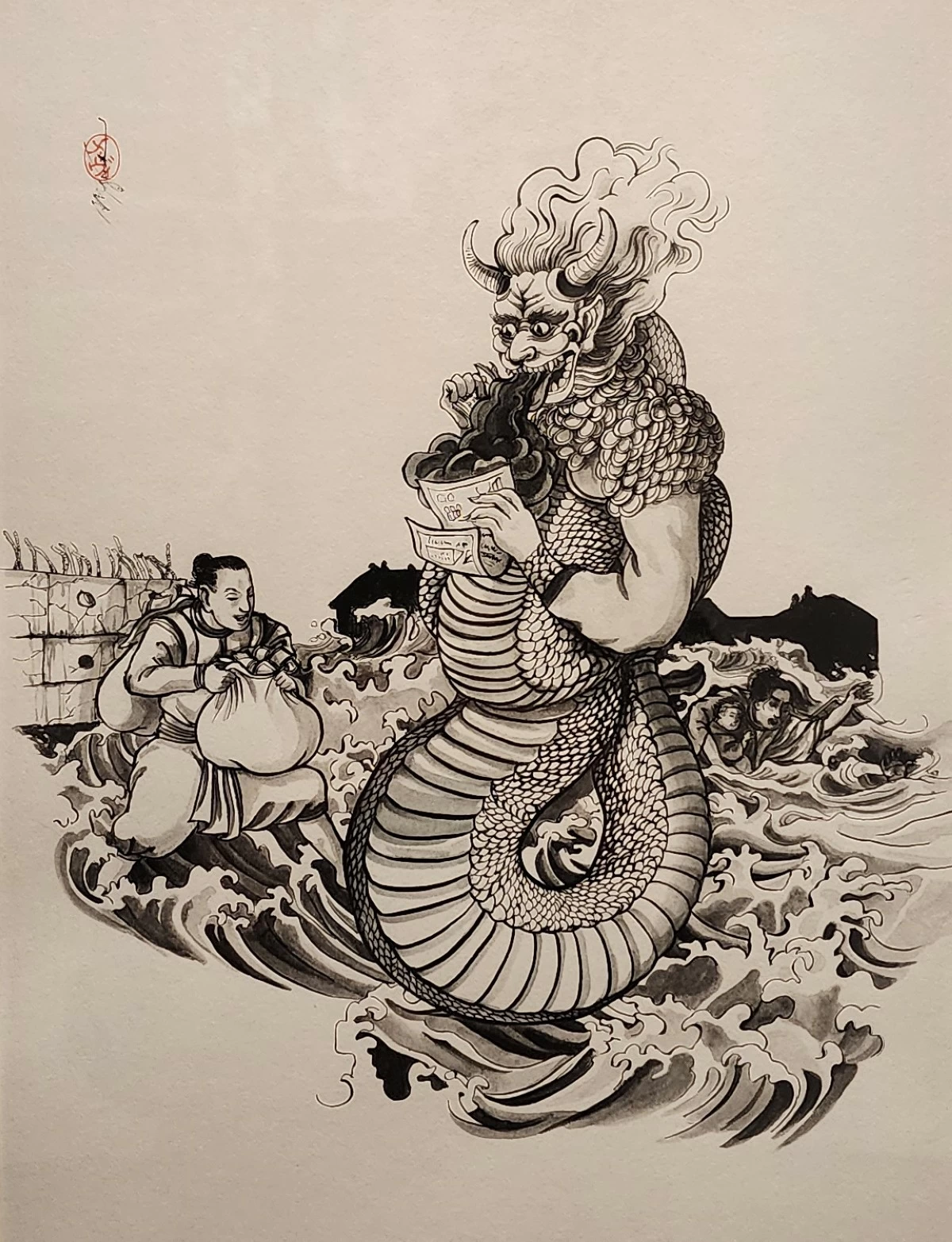
'THE DEMONIZATION OF POWER' 14x10 inches, watercolor on paper, 2026
A shared response to life
Though their aesthetics differ, Mervy’s being illustrative and narrative, Atsuko’s being abstract and textural, the two artists find common ground in their sincerity.
“I think we both work outside obsession on style,” Mervy says of their connection. “To me, we both respond to life.”
“Myth/Making” runs until Feb. 11 at Art Informal, Gallery 3, The Alley at Karrivin Chino Roces Ext. Makati.