






Manila Bulletin
 Philippines
National
Filipino students' proficiency plummets to near zero by Senior High School, study finds
Philippines
National
Filipino students' proficiency plummets to near zero by Senior High School, study finds
Philippines
National
Filipino students' proficiency plummets to near zero by Senior High School, study finds
Filipino students' proficiency plummets to near zero by Senior High School, study finds
EDCOM 2 flags proficiency cliff as students slide from early promise to minimal mastery
Published Jan 16, 2026 09:05 pm


At A Glance
- Filipino students' proficiency drops sharply from early grades to Senior High School, falling from 30.52% in Grade 3 to just 0.47% by Grade 12, EDCOM 2 found
- Only about four out of every 1,000 senior high school students meet expected learning standards
- Most students fail to master basic literacy and numeracy in elementary school, causing steep declines in high school
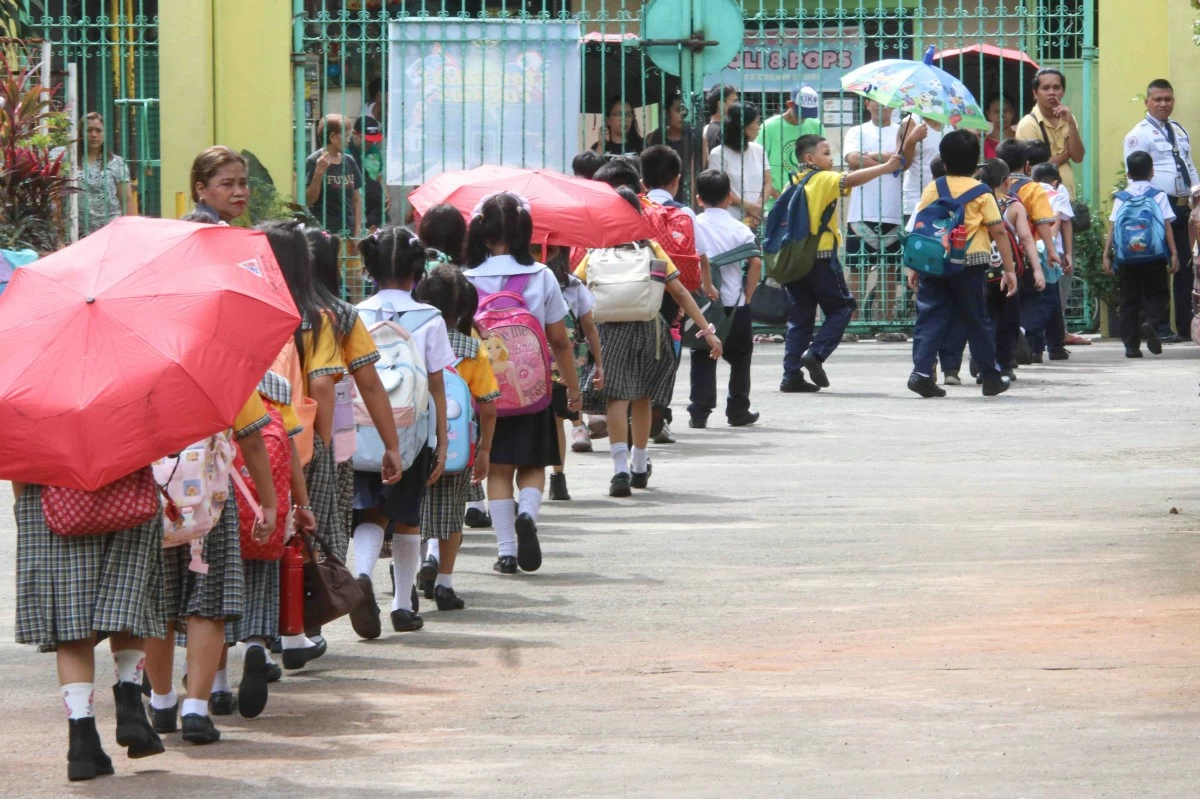
EDCOM 2 data shows a steep drop of proficiency rates among Filipino students from 30 percent in Grade 3 to under one percent by Grade 12. (Manila Bulletin / file photo)
At Grade 3, nearly one in three Filipino children can read, count, and solve problems at a level deemed “proficient” but by the time that same cohort reaches the end of high school, that number has all but vanished.
In a statement issued Friday, January 16, the Second Congressional Commission on Education (EDCOM 2) presented a stark picture: proficiency rates plunge from 30.52 percent in Grade 3 to just 0.47 percent by Grade 12.
In practical terms, only four out of every 1,000 senior high school students demonstrate the skills expected of them after more than a decade in the classroom, EDCOM 2 said.
Set to be included in its Final Report on January 26, the findings draw from standardized assessments administered by the Department of Education (DepEd) between 2023 and 2025.
Together, they traced a troubling trajectory of learning loss that begins early and compounds relentlessly as students move through the system.
A ‘fragile’ foundation
EDCOM 2 noted that under DepEd Order No. 55, series of 2016, national and system-level assessments—such as the Early Language, Literacy, and Numeracy Assessment (ELLNA) and the National Achievement Test (NAT)—are designed to measure whether learners meet curriculum standards at key stages.
Students scoring at least 75 percent are classified as “Proficient” or “Highly Proficient,” while those below 50 percent are considered “Low” or “Not Proficient.”
Even by this strict standard, EDCOM 2 said the system struggles early on. The Commission pointed out that ELLNA results from 2024 show that while 30.52 percent of Grade 3 learners reach proficiency, about 70 percent do not.
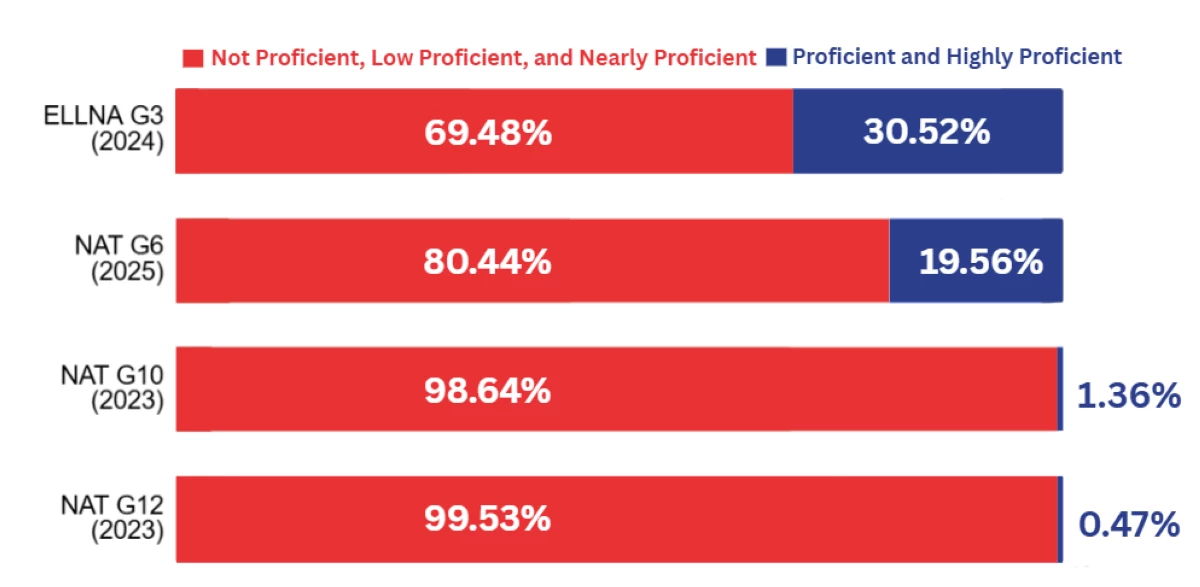
Data shows the distribution of learners by proficiency level across the National Key Stage Assessments, including ELLNA Grade 3 and NAT Grades 6, 10, and 12 (Photo credit: EDCOM 2 / Source: DepEd - Bureau of Education Assessment as of September 2025)
Many still struggle with basic tasks—recognizing letters and sounds, reading common words, understanding short passages, or performing simple numerical operations, the study revealed.
By Grade 6, the gap widens. EDCOM 2 highlighted that the 2024 NAT shows proficiency dropping to 19.56 percent, meaning only one in five learners can meet expected standards at the end of elementary school.
The steep fall through high school
The most dramatic decline, EDCOM 2 stressed, occurs in secondary education.
In Grade 10, only 1.36 percent of students reach at least the proficient level, and by Grade 12, the figure slips further to about 0.4 percent.
At this stage, proficiency is no longer about basic decoding or arithmetic. It reflects higher-order skills—problem-solving, managing and communicating information, and analyzing data to generate ideas.
EDCOM 2’s analysis suggests that by Senior High School (SHS), these competencies are out of reach for the vast majority of learners.
Not new, but a ‘sobering’ wake-up call
EDCOM 2 Executive Director Dr. Karol Mark Yee said these findings are “not new.”
“In fact, for years now, we have seen the low performance of our students in National Achievement Tests, and recently, it has also been confirmed by international assessments at Grades 4, 5, and 10,” Yee said, noting that many years of neglect have “led us to this.”
With less than one percent of Grade 10 and 12 students reaching proficiency, EDCOM 2 Co-Chair Sen. Bam Aquino said the data should serve as a “sobering wake-up call.”
“We cannot fix what we do not acknowledge, and this transparency is the first step toward prioritizing and securing resources—from textbooks to classrooms—that our learners have gone without for too long,” he added.
A learning gap that hardens over time
The sharp decline is rooted in the failure to master foundational skills in the earliest years of schooling according to EDCOM 2.
Nearly half of learners are not reading at grade level by the end of Grade 3. By age 15, this disadvantage translates into a “learning gap” of 5.5 years.
EDCOM 2 noted that because literacy underpins numeracy and all other subjects, students who fall behind early face mounting difficulty as lessons grow more complex.
International studies reinforce this pattern. UNICEF and World Bank data indicate that 91 percent of Filipino children of late primary age cannot read and understand a simple story.
Regional and global assessments echo the same warning. Citing the Southeast Asia Primary Learning Metrics (SEA-PLM), only 14 percent of Filipino Grade 5 learners reached the highest proficiency bands in reading.
By Grade 10, the Programme for International Student Assessment (PISA) found that 76 percent of Filipino students scored below the minimum proficiency level in reading.
Inequality deepens the crisis
EDCOM 2 noted that the crisis is most severe among the country’s most vulnerable learners.
In Geographically Isolated and Disadvantaged Areas (GIDA) and Last Mile Schools, for instance, only 0.13 percent of Grade 12 students reached proficiency in the most recent assessments, with none classified as highly proficient.
These schools often face overcrowded classrooms, shortages of specialized teachers, and limited learning resources, EDCOM 2 stressed.
While the NAT does not track the same students over time, EDCOM 2 emphasized that these snapshots reveal system-wide gaps that demand urgent attention, particularly where disadvantage is entrenched.
Rethinking what ‘proficient’ means
EDCOM 2 also highlighted a structural issue in how proficiency is defined.
A study by the Philippine Institute for Development Studies (PIDS), commissioned by EDCOM 2, suggested that the current 75 percent cut-off may be unrealistically high.
When alternative standard-setting methods are applied, more students qualify as proficient, raising questions about whether current benchmarks accurately reflect achievable learning standards.
Still, even with adjusted thresholds, the Commission said the overall pattern of decline remains alarming.
Indicators of response, future challenges
In response to mounting evidence of a learning crisis, EDCOM 2 cited several DepEd interventions.
These include decongesting the curriculum through the Revised K to 10 framework to refocus on foundational skills, ramping up textbook procurement by 289 percent compared with the previous decade, and expanding literacy remediation programs such as ARAL under Republic Act 12028.
Yee also noted that by making assessment data public through initiatives like DepEd’s Project BUKAS, parents, local governments, universities, and civil society groups can better understand specific challenges in their communities—and act on them.
“DepEd now enables each one of us—LGUs, parents, universities, civil society groups—to work closely with our schools, knowing exactly the unique challenges faced by our respective communities and how we can help reverse this crisis,” he added.
EDCOM 2, created under RA 11899, is tasked with assessing the state of Philippine education and recommending laws to tackle the country’s education crisis.