

ADVERTISEMENT

IMF lowers Philippine growth forecasts for 2025, 2026

Published Oct 1, 2025 05:47 pm
Citing weaker-than-expected economic growth in the first semester of 2025, the International Monetary Fund (IMF) has lowered its 2025 and 2026 gross domestic product (GDP) forecasts, with next year’s outlook seen to fall short of the downscaled growth goal.
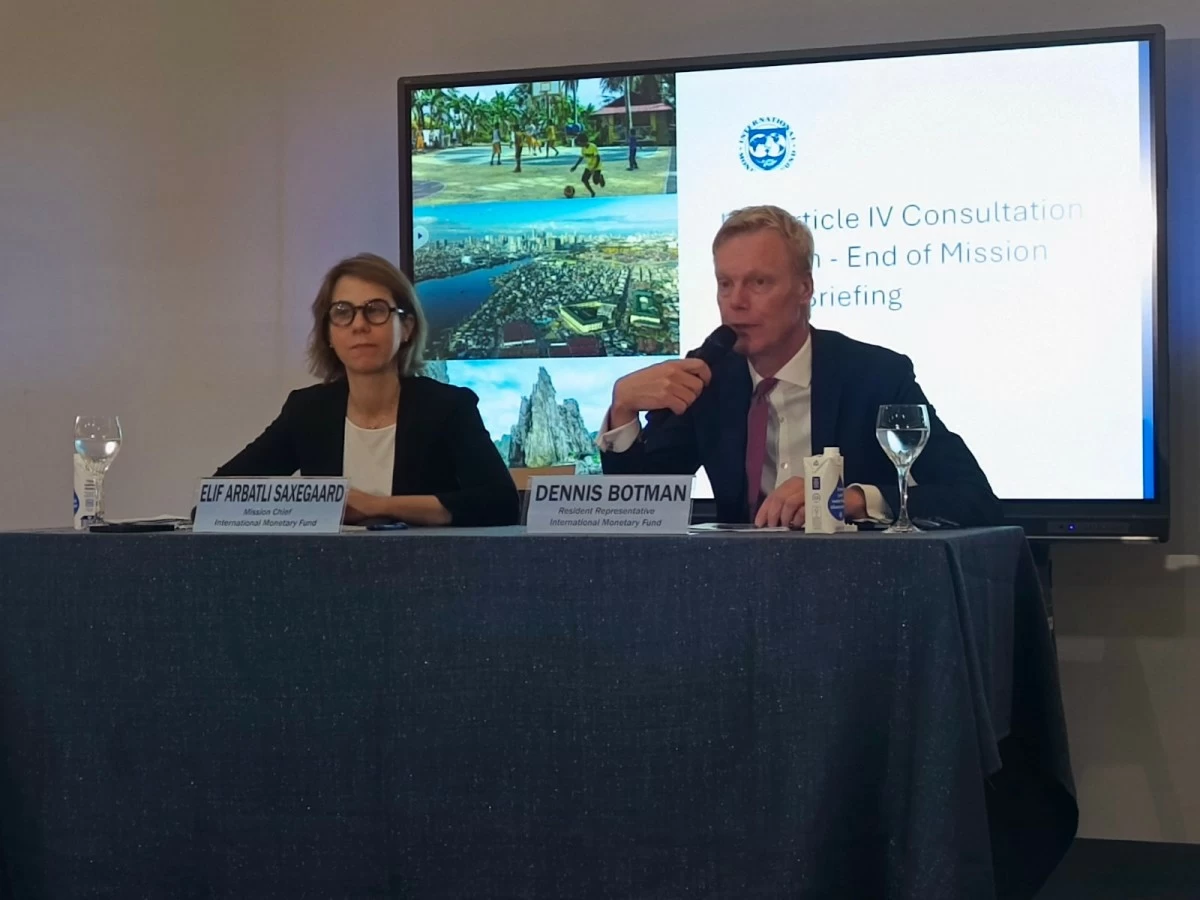
IMF Mission Chief Elif Arbatli Saxegaard, who led the two-week consultation mission in Manila, told a press briefing on Wednesday, Oct. 1, that the intergovernmental organization expects growth to ease to 5.4 percent in 2025, one-tenth of a percentage point (ppt) lower than its July forecast of 5.5 percent.
This remains below the government’s revised target of 5.5 percent to 6.5 percent. Data from the Philippine Statistics Authority (PSA) showed the economy expanded by 5.4 percent in the first six months.
For 2026, the IMF expects a slower pace of 5.7 percent, compared with its earlier projection of 5.9 percent. Both the previous and updated forecasts fall short of the narrowed goal of six percent to seven percent for 2026 through 2028.
Saxegaard said the downgrade “reflects factors related to the first-half performance, which was weaker than expected.”
She said the main drivers affecting growth include “the higher tariffs which are imposed on Philippine exports to the US. It will weigh on exports and investment. While the envisioned decline in government expenditure to meet the deficit target is expected to more than offset an increase in private consumption.”
External risks stem from prolonged global trade policy uncertainty, geopolitical conflicts, and sudden financial market corrections. Domestically, “more frequent and intense climate shocks would cause notable macroeconomic losses.”
The national government’s fiscal deficit widened by 24.7 percent to ₱869.2 billion in the first eight months of the year from ₱697 billion in the same period last year.
The deficit stood at ₱1.48 trillion in 2024, equivalent to 5.6 percent of GDP. The government aims to narrow this to 5.3 percent in 2025, 4.7 percent in 2026, and 4.1 percent in 2027.
“Over the medium term, the authorities should continue implementing gradual fiscal consolidation, in line with their targets, to replenish fiscal buffers and support external balance,” the IMF said.
Meanwhile, it expects inflation to average 1.6 percent this year, lower than the previous 1.8-percent forecast and below the 2 to 4 percent target band. The 2026 projection of 2.5 percent would fall at the midpoint of the band.
Saxegaard urged local authorities to “consider implementing concrete and durable tax measures to limit the need for restraint in priority spending, which tends to have a larger impact on growth and disproportionately impacts the vulnerable.”
On monetary policy, she said the BSP still “has room for a slightly more accommodative stance to help bring inflation back to the target faster and reduce economic slack amid elevated downside risks to growth.” However, she declined to give specific guidance.
“Policy will need to remain data dependent amidst prevailing uncertainties around the output gap and the neutral rate, and two-sided risks to inflation,” she said. The IMF expects the negative output gap to close around 2027, aligning with the BSP’s earlier projection.

Related Tags

International Monetary Fund (IMF) economic growth gross domestic product (GDP)
ADVERTISEMENT
.most-popular .layout-ratio{ padding-bottom: 79.13%; } @media (min-width: 768px) and (max-width: 1024px) { .widget-title { font-size: 15px !important; } }

{{ articles_filter_1561_widget.title }}

.most-popular .layout-ratio{ padding-bottom: 79.13%; } @media (min-width: 768px) and (max-width: 1024px) { .widget-title { font-size: 15px !important; } }

{{ articles_filter_1562_widget.title }}

.most-popular .layout-ratio{ padding-bottom: 79.13%; } @media (min-width: 768px) and (max-width: 1024px) { .widget-title { font-size: 15px !important; } }

{{ articles_filter_1563_widget.title }}

{{ articles_filter_1564_widget.title }}

.mb-article-details { position: relative; } .mb-article-details .article-body-preview, .mb-article-details .article-body-summary{ font-size: 17px; line-height: 30px; font-family: "Libre Caslon Text", serif; color: #000; } .mb-article-details .article-body-preview iframe , .mb-article-details .article-body-summary iframe{ width: 100%; margin: auto; } .read-more-background { background: linear-gradient(180deg, color(display-p3 1.000 1.000 1.000 / 0) 13.75%, color(display-p3 1.000 1.000 1.000 / 0.8) 30.79%, color(display-p3 1.000 1.000 1.000) 72.5%); position: absolute; height: 200px; width: 100%; bottom: 0; display: flex; justify-content: center; align-items: center; padding: 0; } .read-more-background a{ color: #000; } .read-more-btn { padding: 17px 45px; font-family: Inter; font-weight: 700; font-size: 18px; line-height: 16px; text-align: center; vertical-align: middle; border: 1px solid black; background-color: white; } .hidden { display: none; }
function initializeAllSwipers() { // Get all hidden inputs with cms_article_id document.querySelectorAll('[id^="cms_article_id_"]').forEach(function (input) { const cmsArticleId = input.value; const articleSelector = '#article-' + cmsArticleId + ' .body_images'; const swiperElement = document.querySelector(articleSelector); if (swiperElement && !swiperElement.classList.contains('swiper-initialized')) { new Swiper(articleSelector, { loop: true, pagination: false, navigation: { nextEl: '#article-' + cmsArticleId + ' .swiper-button-next', prevEl: '#article-' + cmsArticleId + ' .swiper-button-prev', }, }); } }); } setTimeout(initializeAllSwipers, 3000); const intersectionObserver = new IntersectionObserver( (entries) => { entries.forEach((entry) => { if (entry.isIntersecting) { const newUrl = entry.target.getAttribute("data-url"); if (newUrl) { history.pushState(null, null, newUrl); let article = entry.target; // Extract metadata const author = article.querySelector('.author-section').textContent.replace('By', '').trim(); const section = article.querySelector('.section-info ').textContent.replace(' ', ' '); const title = article.querySelector('.article-title h1').textContent; // Parse URL for Chartbeat path format const parsedUrl = new URL(newUrl, window.location.origin); const cleanUrl = parsedUrl.host + parsedUrl.pathname; // Update Chartbeat configuration if (typeof window._sf_async_config !== 'undefined') { window._sf_async_config.path = cleanUrl; window._sf_async_config.sections = section; window._sf_async_config.authors = author; } // Track virtual page view with Chartbeat if (typeof pSUPERFLY !== 'undefined' && typeof pSUPERFLY.virtualPage === 'function') { try { pSUPERFLY.virtualPage({ path: cleanUrl, title: title, sections: section, authors: author }); } catch (error) { console.error('ping error', error); } } // Optional: Update document title if (title && title !== document.title) { document.title = title; } } } }); }, { threshold: 0.1 } ); function showArticleBody(button) { const article = button.closest("article"); const summary = article.querySelector(".article-body-summary"); const body = article.querySelector(".article-body-preview"); const readMoreSection = article.querySelector(".read-more-background"); // Hide summary and read-more section summary.style.display = "none"; readMoreSection.style.display = "none"; // Show the full article body body.classList.remove("hidden"); } document.addEventListener("DOMContentLoaded", () => { let loadCount = 0; // Track how many times articles are loaded const offset = [1, 2, 3, 4, 5, 6, 7, 8, 9, 10]; // Offset values const currentUrl = window.location.pathname.substring(1); let isLoading = false; // Prevent multiple calls if (!currentUrl) { console.log("Current URL is invalid."); return; } const sentinel = document.getElementById("load-more-sentinel"); if (!sentinel) { console.log("Sentinel element not found."); return; } function isSentinelVisible() { const rect = sentinel.getBoundingClientRect(); return ( rect.top < window.innerHeight && rect.bottom >= 0 ); } function onScroll() { if (isLoading) return; if (isSentinelVisible()) { if (loadCount >= offset.length) { console.log("Maximum load attempts reached."); window.removeEventListener("scroll", onScroll); return; } isLoading = true; const currentOffset = offset[loadCount]; window.loadMoreItems().then(() => { let article = document.querySelector('#widget_1690 > div:nth-last-of-type(2) article'); intersectionObserver.observe(article) loadCount++; }).catch(error => { console.error("Error loading more items:", error); }).finally(() => { isLoading = false; }); } } window.addEventListener("scroll", onScroll); });

Sign up by email to receive news.