ADVERTISEMENT

China questions push for NATO-like security group in Asia-Pacific

Published Sep 17, 2025 04:33 pm
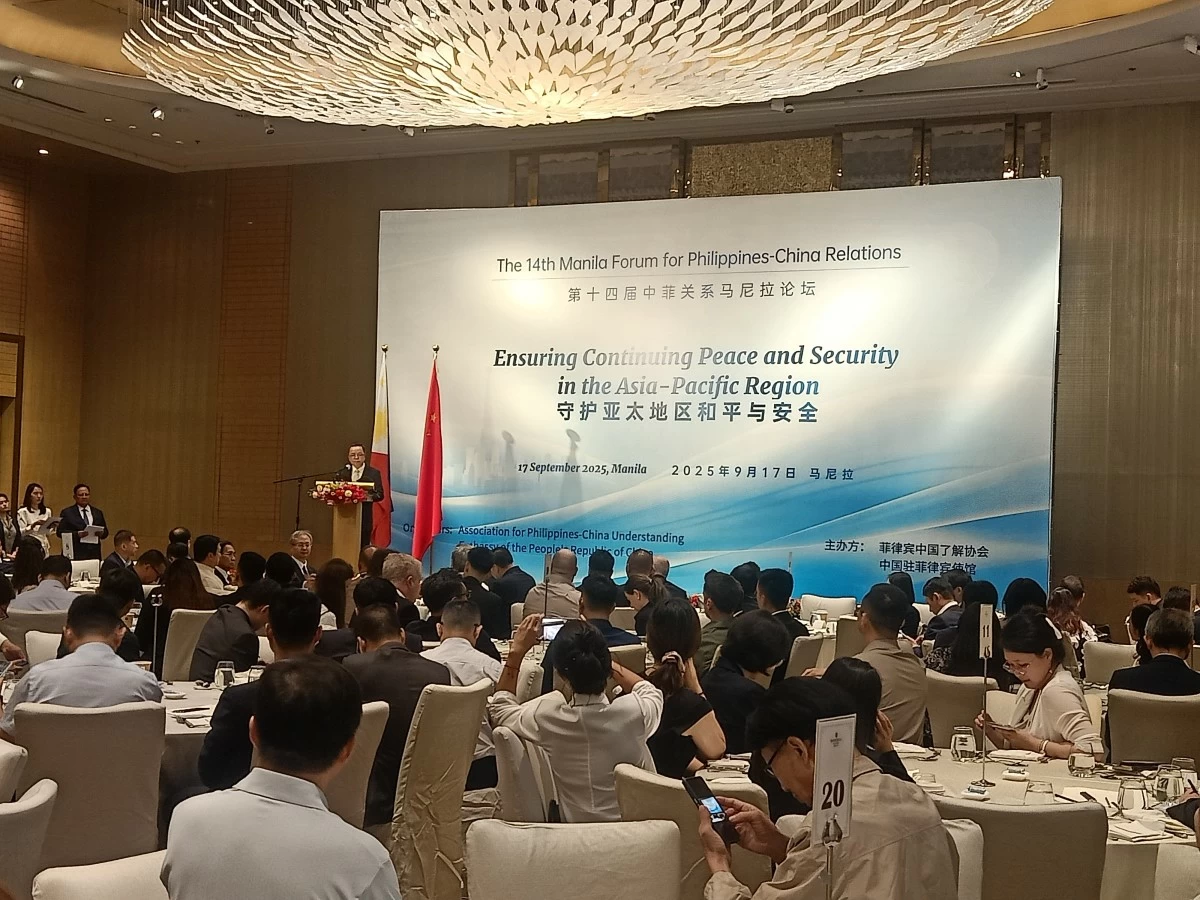
Chinese Ambassador to the Philippines Huang Xilian delivers opening remarks during the 14th Manila Forum for Philippines-China Relations at Shangri-La The Fort in Taguig City on Sept. 17, 2025. The forum gathered policymakers, diplomats, academics, and business leaders to foster dialogue on key issues affecting bilateral ties between Manila and Beijing such as security, politics, and economy. (Photo: Martin A. Sadongdong / MANILA BULLETIN)
The People’s Republic of China (PRC) on Wednesday, Sept. 17, voiced concern over growing discussions on the formation of a security grouping in the Asia-Pacific region, possibly involving the Philippines and other “like-minded” nations, which is patterned after the North Atlantic Treaty Organization (NATO).
Chinese Ambassador to the Philippines Huang Xilian said such a NATO-like military grouping could be “divisive”.
“As the Ukraine and other crises continue to spill over, some countries have sought to replicate block confrontation in the Asia-Pacific by promoting the idea of an Asia-Pacific NATO with such divisive intentions,” he said during the 14th Manila Forum for Philippines-China relations at Shangri-La The Fort in Taguig City.
He stressed that the region’s security should not be defined by military blocs, cautioning that efforts to replicate NATO’s model may trigger confrontation instead of fostering cooperation.
It was in 2024 when the idea of an Asian NATO was floated by then incoming Japanese Prime Minister Shigeru Ishiba.
Formed in 1949, the NATO is a political and military alliance of 32 member countries in Europe and North America that seeks to provide collective security against the Soviet Union.
Relating it to the present situation, Ishiba said such a military grouping would deter China from using excessive military force in Asia.
However, Huang argued that the Asia-Pacific has long benefited from frameworks centered on dialogue and economic partnerships, which he noted should remain the foundation of regional engagement.
“We must ask what sort of security architecture does our region require. One that is exclusive, built only on military alliances, or one that is distinctly Asian, [with] shared security, respectful diversity, and active dialogue?” he said.
Department of National Defense (DND) Secretary Gilberto Tedoro Jr. previously said such grouping was not feasible given diverging interests and alliances.
He had said Philippines is building an alliance with countries that are also allied with China, with which it has a territorial dispute in the WPS, thus, raising potential conflict.
Read: Chinese coast guard's water cannon attack leaves BFAR personnel with bloodied ears 
Assertive restraint
The forum gathered policymakers, diplomats, academics, and business leaders to foster dialogue on key issues affecting bilateral ties between Manila and Beijing such as security, politics, and economy. The forum carried the theme: "Ensuring Continuing Peace and Security in the Asia-Pacific Region".
Former National Security Adviser Hermogenes Esperon Jr., one of the keynote speakers, underscored the importance of a strong partnership between the Philippines and China to avoid escalating tension in the WPS.
However, he stressed that such a collaborative framework should be “rooted in trust, transparency, and shared responsibility.”
He also reaffirmed the Philippines’ commitment to defending its sovereignty in the WPS while exercising "assertive restraint" to avoid unnecessary escalation.
“The principle of assertive restraint calls for standing firm in defense of our rights, including the landmark 2016 arbitral ruling and the provisions of the United Nations Convention on the Law of the Sea or UNCLOS, while resisting the impulse to escalate tensions,” said Esperon, who also served as the chairman of the National Task Force for the West Philippine Sea (NTF-WPS) during the administration of former president Rodrigo Duterte. 
“It is a strategy rooted in legal legitimacy, moral ascendancy, and strategic discipline, demonstrating that result and history can coexist in the pursuit of regional peace and stability,” he added.
Esperon urged the cultivation of a “culture of security” across all sectors of society, emphasizing that safeguarding national interests should not be confined to the military or diplomats alone.
“Security must be embedded in the fabric of society, with every citizen as a stakeholder,” he said, pointing to ASEAN’s role in promoting dialogue and integration while calling for stronger regional mechanisms to address emerging security gaps.
Other speakers during the forum were Mr. Victor Gao, vice president of the Center for China and Globalization; Mr Su Hao, director of Center for Strategy and Peace Studies of China Foreign Affairs University; Mr. Ding Duo, director of the Research Center for International and Regional Issues at the National Institute for South China Sea Studies; and former presidential spokesperson Rigoberto Tiglao.
The forum was organized by the Association for Philippines-China Understanding and the Chinese Embassy in the Philippines.

Related Tags

Philippines-China Manila Forum WPS cooperation
ADVERTISEMENT
.most-popular .layout-ratio{ padding-bottom: 79.13%; } @media (min-width: 768px) and (max-width: 1024px) { .widget-title { font-size: 15px !important; } }

{{ articles_filter_1561_widget.title }}

.most-popular .layout-ratio{ padding-bottom: 79.13%; } @media (min-width: 768px) and (max-width: 1024px) { .widget-title { font-size: 15px !important; } }

{{ articles_filter_1562_widget.title }}

.most-popular .layout-ratio{ padding-bottom: 79.13%; } @media (min-width: 768px) and (max-width: 1024px) { .widget-title { font-size: 15px !important; } }

{{ articles_filter_1563_widget.title }}

{{ articles_filter_1564_widget.title }}

.mb-article-details { position: relative; } .mb-article-details .article-body-preview, .mb-article-details .article-body-summary{ font-size: 17px; line-height: 30px; font-family: "Libre Caslon Text", serif; color: #000; } .mb-article-details .article-body-preview iframe , .mb-article-details .article-body-summary iframe{ width: 100%; margin: auto; } .read-more-background { background: linear-gradient(180deg, color(display-p3 1.000 1.000 1.000 / 0) 13.75%, color(display-p3 1.000 1.000 1.000 / 0.8) 30.79%, color(display-p3 1.000 1.000 1.000) 72.5%); position: absolute; height: 200px; width: 100%; bottom: 0; display: flex; justify-content: center; align-items: center; padding: 0; } .read-more-background a{ color: #000; } .read-more-btn { padding: 17px 45px; font-family: Inter; font-weight: 700; font-size: 18px; line-height: 16px; text-align: center; vertical-align: middle; border: 1px solid black; background-color: white; } .hidden { display: none; }
function initializeAllSwipers() { // Get all hidden inputs with cms_article_id document.querySelectorAll('[id^="cms_article_id_"]').forEach(function (input) { const cmsArticleId = input.value; const articleSelector = '#article-' + cmsArticleId + ' .body_images'; const swiperElement = document.querySelector(articleSelector); if (swiperElement && !swiperElement.classList.contains('swiper-initialized')) { new Swiper(articleSelector, { loop: true, pagination: false, navigation: { nextEl: '#article-' + cmsArticleId + ' .swiper-button-next', prevEl: '#article-' + cmsArticleId + ' .swiper-button-prev', }, }); } }); } setTimeout(initializeAllSwipers, 3000); const intersectionObserver = new IntersectionObserver( (entries) => { entries.forEach((entry) => { if (entry.isIntersecting) { const newUrl = entry.target.getAttribute("data-url"); if (newUrl) { history.pushState(null, null, newUrl); let article = entry.target; // Extract metadata const author = article.querySelector('.author-section').textContent.replace('By', '').trim(); const section = article.querySelector('.section-info ').textContent.replace(' ', ' '); const title = article.querySelector('.article-title h1').textContent; // Parse URL for Chartbeat path format const parsedUrl = new URL(newUrl, window.location.origin); const cleanUrl = parsedUrl.host + parsedUrl.pathname; // Update Chartbeat configuration if (typeof window._sf_async_config !== 'undefined') { window._sf_async_config.path = cleanUrl; window._sf_async_config.sections = section; window._sf_async_config.authors = author; } // Track virtual page view with Chartbeat if (typeof pSUPERFLY !== 'undefined' && typeof pSUPERFLY.virtualPage === 'function') { try { pSUPERFLY.virtualPage({ path: cleanUrl, title: title, sections: section, authors: author }); } catch (error) { console.error('ping error', error); } } // Optional: Update document title if (title && title !== document.title) { document.title = title; } } } }); }, { threshold: 0.1 } ); function showArticleBody(button) { const article = button.closest("article"); const summary = article.querySelector(".article-body-summary"); const body = article.querySelector(".article-body-preview"); const readMoreSection = article.querySelector(".read-more-background"); // Hide summary and read-more section summary.style.display = "none"; readMoreSection.style.display = "none"; // Show the full article body body.classList.remove("hidden"); } document.addEventListener("DOMContentLoaded", () => { let loadCount = 0; // Track how many times articles are loaded const offset = [1, 2, 3, 4, 5, 6, 7, 8, 9, 10]; // Offset values const currentUrl = window.location.pathname.substring(1); let isLoading = false; // Prevent multiple calls if (!currentUrl) { console.log("Current URL is invalid."); return; } const sentinel = document.getElementById("load-more-sentinel"); if (!sentinel) { console.log("Sentinel element not found."); return; } function isSentinelVisible() { const rect = sentinel.getBoundingClientRect(); return ( rect.top < window.innerHeight && rect.bottom >= 0 ); } function onScroll() { if (isLoading) return; if (isSentinelVisible()) { if (loadCount >= offset.length) { console.log("Maximum load attempts reached."); window.removeEventListener("scroll", onScroll); return; } isLoading = true; const currentOffset = offset[loadCount]; window.loadMoreItems().then(() => { let article = document.querySelector('#widget_1690 > div:nth-last-of-type(2) article'); intersectionObserver.observe(article) loadCount++; }).catch(error => { console.error("Error loading more items:", error); }).finally(() => { isLoading = false; }); } } window.addEventListener("scroll", onScroll); });

Sign up by email to receive news.