






Manila Bulletin
 Philippines
National
Chinese coast guard's water cannon attack leaves BFAR personnel with bloodied ears
Philippines
National
Chinese coast guard's water cannon attack leaves BFAR personnel with bloodied ears
Philippines
National
Chinese coast guard's water cannon attack leaves BFAR personnel with bloodied ears
Chinese coast guard's water cannon attack leaves BFAR personnel with bloodied ears
Published Sep 17, 2025 01:43 pm


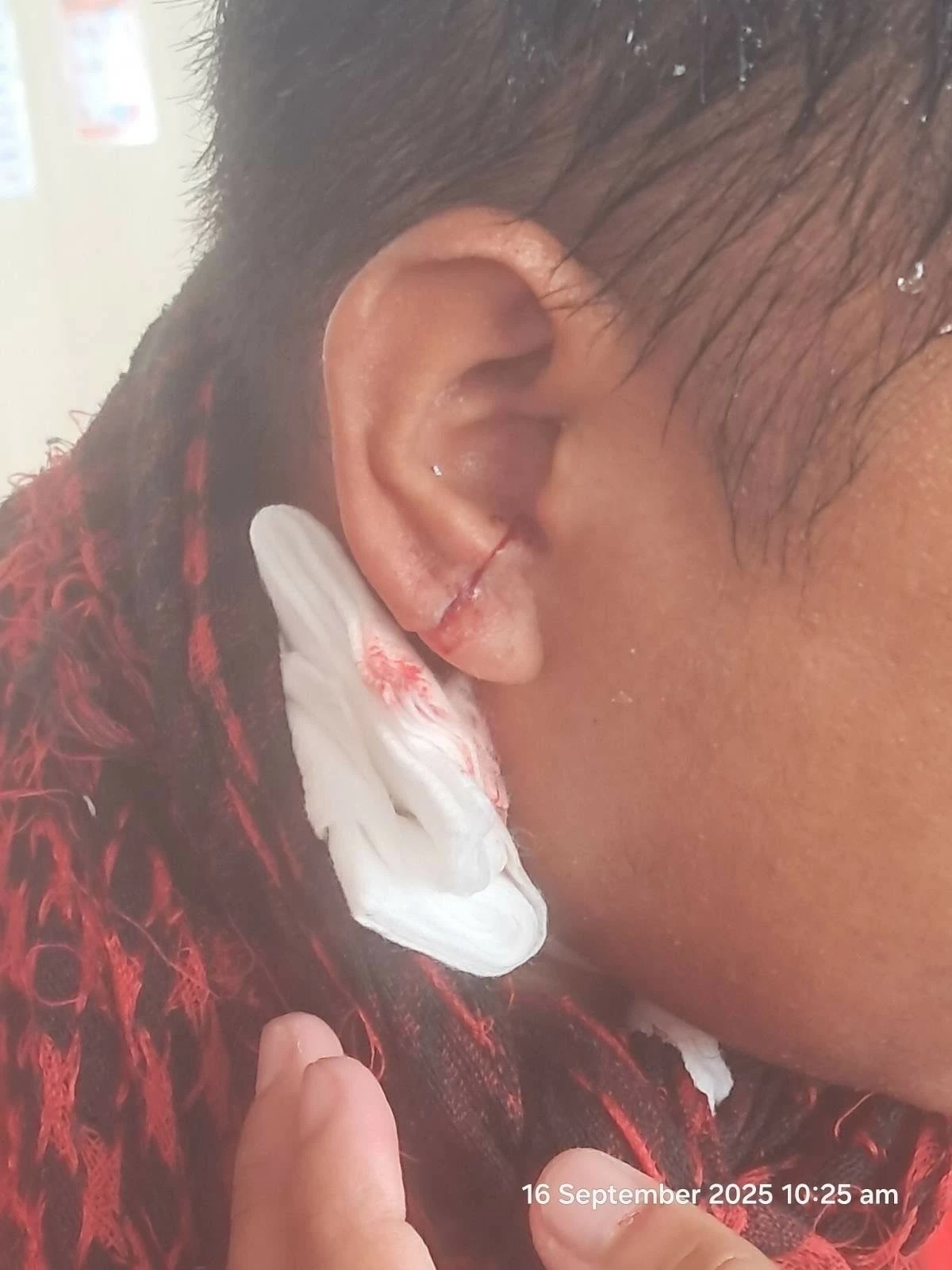
(Photo: Philippine Coast Guard)
A personnel of the Bureau of Fisheries and Aquatic Resources (BFAR) was injured when a China Coast Guard (CCG) ship fired water cannon at a Philippine vessel during a humanitarian mission in Bajo de Masinloc (Scarborough or Panatag Shoal) in the West Philippine Sea (WPS) on Tuesday, Sept. 16.
A photo handout released by the Philippine Coast Guard (PCG) showed a BFAR personnel’s ear bleeding from apparent injuries when he was hit by broken glass from a damaged window after CCG vessels with tail numbers “5201” and “21562” simultaneously shot BFAR vessel BRP Datu Gumbay Piang (MMOV 3014) with water cannon and conducted dangerous maneuvers approximately 17 nautical miles east of Bajo de Masinloc at 9:14 a.m.
Ten BFAR ships, two PCG vessels, and a civilian fishery boat M/V Mamalakaya were in the vicinity of the shoal for a “Kadiwa para sa Bagong Bayaning Mangingisda” initiative where they brought fuel, ice, and other provisions to 40 Filipino fishermen operating in the area.
“Ang isang crew ng Bureau of Fisheries and Aquatic Resources ay tinamaan ng mga nabasag na glass comng from the window sa likuran ng bridge ng barko. Ito ang naging dahilan kung bakit nagkaroon siya ng sugat sa dulo ng kanyang tenga (A crew member of the Bureau of Fisheries and Aquatic Resources was hit by shattered glass from a damaged window behind the ship’s bridge. This caused him to sustain a wound on the tip of his ear),” PCG spokesperson for WPS Commodore Jay Tarriela said in a press conference in Manila on Wednesday, Sept. 17.
While the injury was not deemed serious by the PCG, Tarriela said what the CCG did was “very hostile.”
The water cannon attack damaged the rear bridge of BRP Datu Gumbay Piang, as well as two air conditioning units, two glass windows, radio communications and internet connection systems.
During the mission, Tarriela said the PCG monitored 10 CCG vessels, five People’s Liberation Army-Navy (PLA-N) warships, and four Chinese maritime militia vessels.
At one point in the mission, a PLA-N warship with bow number “525” announced via radio communication that it would conduct a live-fire exercise in the area.
The PCG immediately advised the Filipino fishing boats and the BFAR vessels to get away from the Chinese warship. However, no live fire exercise was conducted.
“The radio broadcast was just used by the PLA Navy to threaten the large number of Filipino fishing boats fishing in the area,” he said.
Further, the PCG also monitored a Chinese maritime militia boat, “Qiong Sansha Yu 00001, that used a water cannon at a BFAR vessel.
Tarriela also denied that BRP Datu GumBay Piang intentionally rammed a CCG vessel as alleged by CCG spokesperson Gan Yu.
“What really happened here is that there were two China Coast Guard vessels conducting dangerous maneuvers against BRP Datu Gumbay Piang and they showed a clip on social media showing we bumped them, but the fact that they were using water cannon on the bridge of the BFAR vessel was not released,” he said.
“Just a common sense, they were using water cannon against the vessel from the back and front, and they were conducting dangerous maneuvers, it would really bump into their vessel. But it was not intentional, it was actually their lies once again, hiding their unlawful and bullying activities in Bajo de Masinloc,” the commodore added.
Despite the harassment, Tarriela said the PCG and BFAR will continue to support Filipino fishermen in Bajo de Masinloc.
“The Kadiwa program for the Filipino fishermen will still be carried out because we know this is a very effective way for us to support the livelihood of our ordinary fishermen who were affected by the harassment by the China Coast Guard and Chinese maritime militia,” he noted.