







PH Army, Thailand team up for disaster response drills
Published Sep 15, 2025 12:19 pm


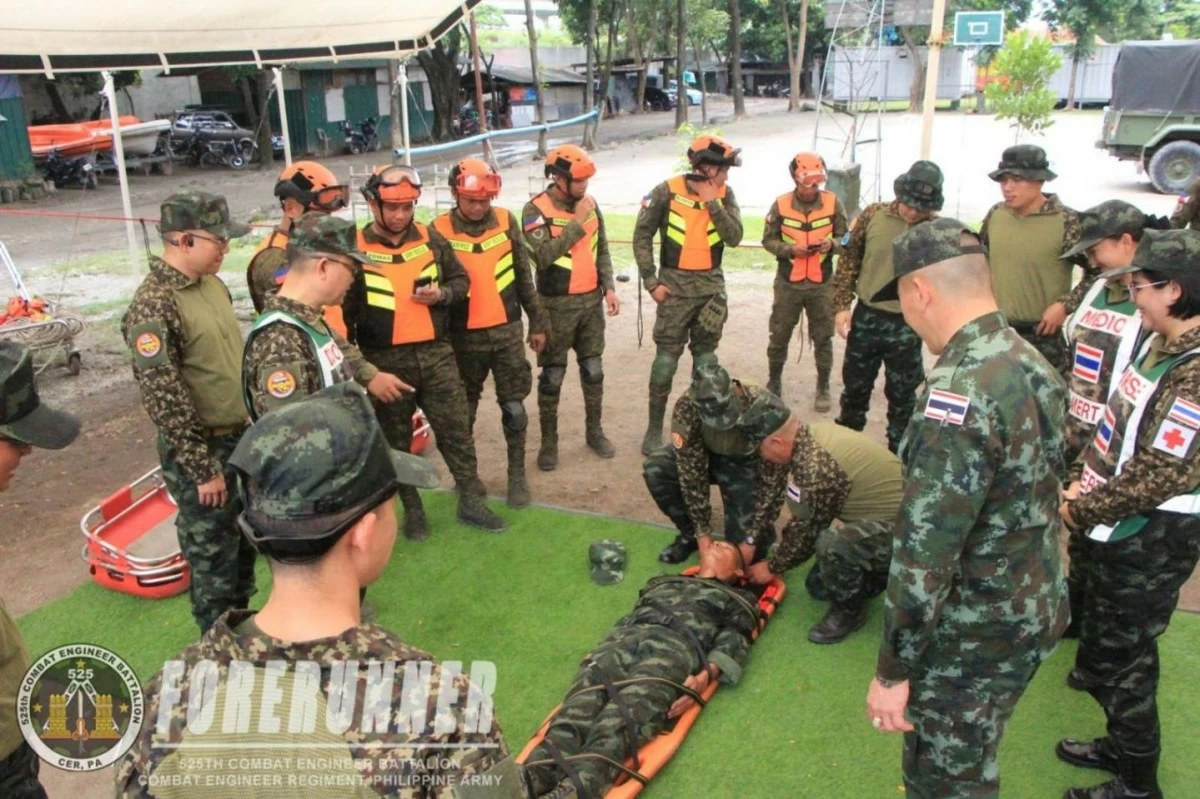
Personnel from the 525th Combat Engineer Battalion (525CEBn), the Philippine Army‘s (PA) premier disaster response unit, and the Royal Thai Army (RTA) simulate rescue operations as part of bilateral drills focused on enhancing humanitarian assistance and disaster response (HADR) interoperability at the Forerunner Training Area, Libingan ng mga Bayani in Fort Bonifacio, Taguig City from September 11 to 12, 2025. (Photo: PA)
The Philippine Army (PA) announced Monday, Sept. 15, that it has joined forces with the Royal Thai Army (RTA) for a two-day humanitarian assistance and disaster response (HADR) training at Fort Bonifacio in Taguig City.
The joint activity held at the Forerunner Training Area, Libingan ng mga Bayani from Sept. 11 to 12 featured a subject matter expert exchange (SMEE) covering collapsed structure search and rescue, rope rescue, patient handling, and medical response operations.
Col. Louie Dema-ala, PA spokesperson, said both armies demonstrated seamless teamwork in executing life-saving techniques and showed their shared commitment to saving lives in times of crisis.
“The two-day PA-RTA HADR training reaffirms both Armies’ strong bilateral relations and reinforces the Philippine Army leadership’s push for the holistic human capital of soldiers, the organization’s most valuable resource,” he said.
Personnel from the 525th Combat Engineer Battalion (525CEBn), the PA’s premier disaster response unit, staged a full capability demonstration of its search and rescue assets, giving the RTA team a firsthand look at its cutting-edge disaster response skills..
The RTA delegation also witnessed the conduct of the 3rd Quarter National Simultaneous Earthquake Drill, which highlighted the country’s nationwide disaster preparedness efforts.
The earthquake drill, which began on Sept 11. and concluded on Sept 12, simulated a magnitude 7.2 earthquake in Metro Manila and nearby provinces, triggered by the movement of the West Valley Fault.
It aimed to evaluate disaster response across multiple levels, including strategic, operational, and tactical coordination among national and regional government agencies, local government units, and uniformed services.
Dema-ala said the collaboration not only enhanced technical knowledge but also strengthened the camaraderie between Filipino and Thai soldiers, especially since both countries are no strangers to devastating natural disasters.
The Philippines, situated in the Pacific “Ring of Fire” and along the Typhoon Belt, regularly faces powerful storms, volcanic eruptions, and earthquakes such as Super Typhoon Yolanda in 2013 and the 1990 Luzon earthquake which killed thousands of people and caused millions worth of damage to infrastructure and agriculture.
Thailand, meanwhile, has grappled with catastrophic flooding, most notably the 2011 Bangkok floods, which affected millions, as well as the 2004 Indian Ocean tsunami that struck its southern coast.
Dema-ala said shared experiences of large-scale disasters have pushed Manila and Bangkok to strengthen cooperation in disaster readiness, response, and recovery.