






Manila Bulletin
 Business
The Economy
Gov't think tank touts AI as key weapon vs. corruption in flood control, infra projects
Business
The Economy
Gov't think tank touts AI as key weapon vs. corruption in flood control, infra projects
Business
The Economy
Gov't think tank touts AI as key weapon vs. corruption in flood control, infra projects
Gov't think tank touts AI as key weapon vs. corruption in flood control, infra projects
Published Sep 1, 2025 01:47 pm


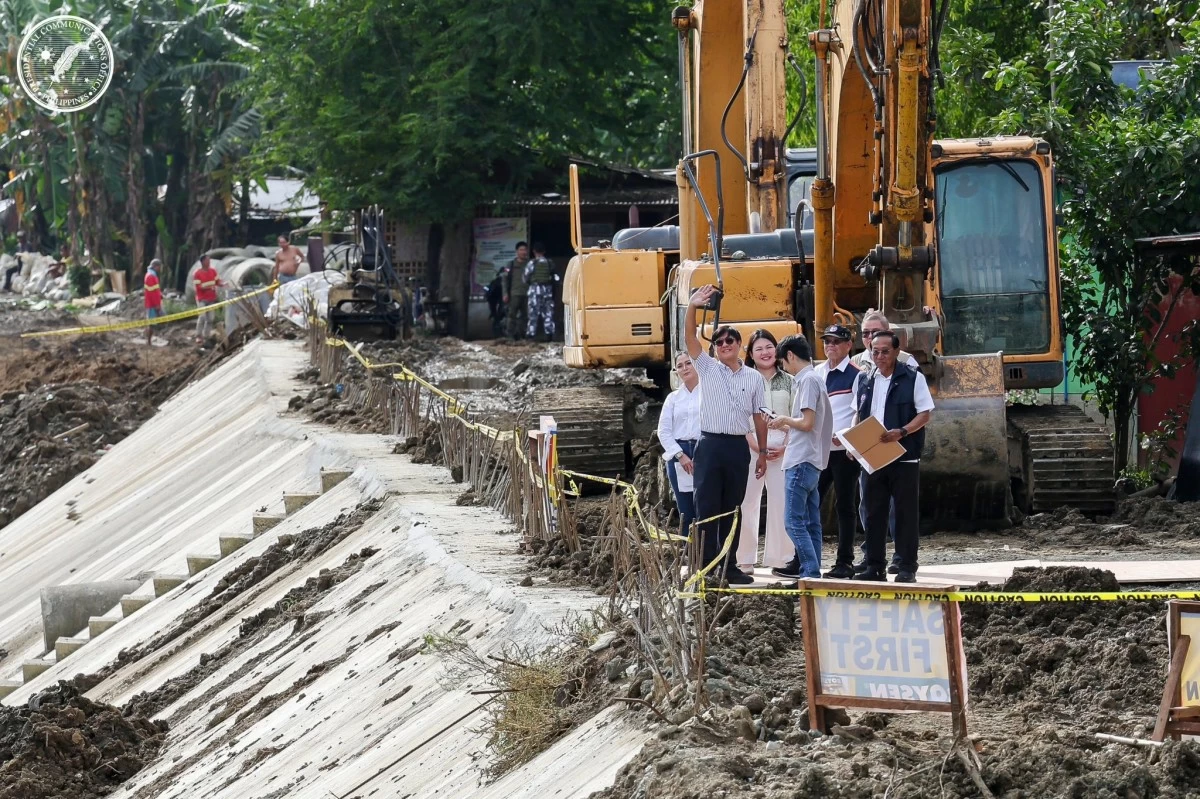
President Ferdinand R. Marcos Jr. leads the inspection of the Flood Mitigation Project in in Barangay San Isidro, Jaro, Iloilo City on Aug. 13, 2025. (Photo courtesy of PCO)
State-run think tank Philippine Institute for Development Studies (PIDS) is advocating the use of artificial intelligence (AI) to combat corruption in public infrastructure projects, including flood control.
In a press conference on Monday, Sept. 1, PIDS senior research fellow Adoracion M. Navarro pushed for AI adoption to help avoid the wastage of trillions of pesos in public funds lost to questionable infrastructure projects.
Navarro emphasized the “huge cost to be avoided” by tackling corruption in such projects.
Navarro cited reports that the government had allocated “₱1 trillion for flood control projects in the last 10 years,” noting that this figure excludes “cost piling, the bribery, and the productivity losses when floods occur.”
This illustrates the substantial financial and societal impact of corruption in flood control and the potential for AI to mitigate it.
Given the massive sums involved, especially in flood control projects, Navarro believes that deploying AI as an anti-corruption tool could be highly cost-effective in the long run.
AI-augmented tools such as AI-powered whistleblower platforms and blockchain-based reporting systems can also be adopted to enhance transparency and accountability, Navarro said.
She said these AI tools would “ensure reliability of information, not false reporting; ensure protection of the whistleblowers; and ensure that the forensics that will be undertaken will be successful.”
Navarro also emphasized that field checks are readily accessible through PhilGEPS, the government’s procurement system, which could serve as a starting point for using AI tools to enhance transparency and efficiency in procurement.
PIDS senior research fellow Kris A. Francisco stressed that the effectiveness of AI in combating corruption will largely depend on the volume and quality of data it is provided, noting that AI essentially works by analyzing patterns.
Francisco added that government data is not yet centralized, and digitalization has not been fully implemented across all agencies.
Strengthening these areas is essential for effectively using data and AI in the fight against corruption, she said.
Francisco also noted that much still needs to be addressed, particularly in data infrastructure, but emphasized that “there is still a possibility,” referring to the potential of AI to fight corruption.
PIDS also outlined three stages in fighting corruption: prevention, capture and prosecution, and sentencing reinforced by feedback systems and institutions.
At the prevention stage, AI can help flag corruption risks through risk scoring, predictive analytics, and financial disclosure analysis.
For capture and prosecution, AI tools can aid forensic investigations, asset recovery, and cartel detection.
Real-time monitoring of bank transactions can also strengthen anti-money laundering (AML) efforts, supported by a feedback loop to ensure accountability.
PIDS emphasized system auditing and reinforcement, saying that AI can evaluate government systems at scale to enhance feedback mechanisms and strengthen institutional processes.
(Ricardo M. Austria)