







Pipe mishap affects Malampaya drilling
Published Jul 30, 2025 09:31 am
|
Updated Jul 30, 2025 02:58 pm


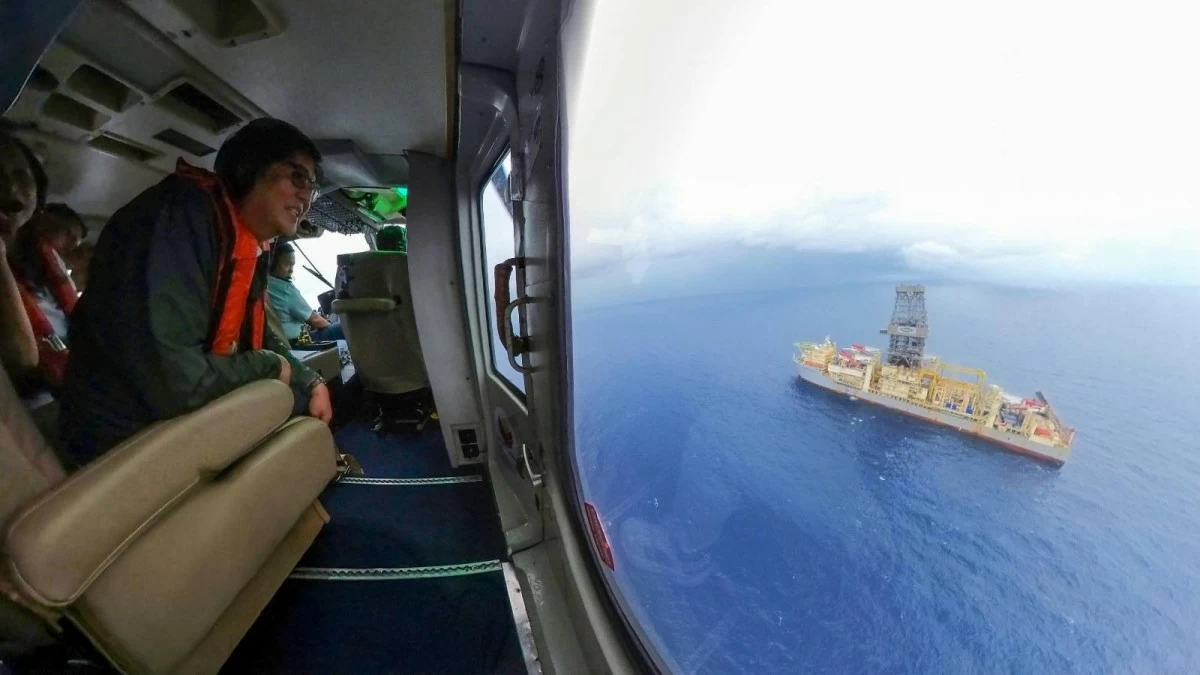
President Ferdinand R. Marcos Jr. conducts a fly-by in the ongoing Malampaya Phase IV drilling campaign in Palawan on July 14, 2025. (Photo courtesy of Malacañang)
A technical hiccup due to a pipe falling into a well has affected the pace of ongoing drilling at the Malampaya gas field, according to a highly placed source whose organization is part of the Service Contract (SC) 38 consortium for the project.
The source indicated that “there had been technical hiccup because of a pipe that had fallen into one of the wells being drilled; and that happened after the July 14 fly-by inspection of President Marcos at the gas field.”
Manila Bulletin sent queries on this matter to Malampaya operating entity Prime Energy Resources Development, but comments or replies are still being awaited as of press time.
The Department of Energy (DOE), in particular, has not given any public assessment yet on how the pipe mishap could affect the overall drilling activities being done at the gas field—especially on the anticipated flow of additional gas from the Malampaya field by 2026.
Energy Secretary Sharon S. Garin said the corresponding costs that accrued from several days of drilling that had been affected in the falling pipe incident “will be absorbed by the investor and it will have no cost to the government and consumers.”
She conveyed to Manila Bulletin that, “I was also worried about it at first, but they were able to remedy the situation by doing drilling just beside the affected well.”
No exact figures had been given by the DOE on the costs of the affected drilling days and how long was the disruption in the work program for that specified well.
At this stage, the Energy department is also being prodded to qualify if the new wells being drilled are exploratory or development wells, because the former type of drilling, in particular, will have implications on cost recovery that the SC 38 consortium could potentially invoke based on the terms of Presidential Decree (PD) 87 or the Oil and Gas Law.
Prime Energy previously announced the engagement of the “Nobel Viking” drillship of the Texas-headquartered company for the drilling program covering at least three new wells in a bid to reinforce gas production at the depleting field.
The Malampaya consortium likewise awarded a contract to One Subsea of the Schlumberger group for the supply of wellheads, Christmas trees or control equipment, and subsea production system for the project.
As previously declared by Prime Energy, part of the work commitment at the field—which commands an investment of more than $800 million—will also cover the drilling of a third exploration well, which will be at the Bagong Pag-asa block that is 15 kilometers (km) north of Malampaya.
The drilling of the new wells had been regarded as a major step to finally determine if additional gas can still be extracted from the Malampaya field—and that is tied to the 15-year extension granted by the Marcos administration to the project’s SC 38 stretching from 2024 to 2039.
Earlier technical assessments had shown that Malampaya gas may still have the capacity to produce gas until 2028 to 2029, but it will be at a declining rate that the volume it can feed to the country’s gas plants may only hover at roughly 1,500 megawatts (MW).
At its peak of production prior to the lapse of its first 25-year service contract, Malampaya has been powering more than 3,200 MW of gas-fired generation facilities that have been supplying significant capacity to Luzon grid, but extraction had been dwindling through the years; thus, that warranted drilling of new wells in the field.