







Inflation, workers' pay top concerns of Filipinos — Pulse Asia
Published Jul 17, 2025 01:05 pm


PULSE ASIA
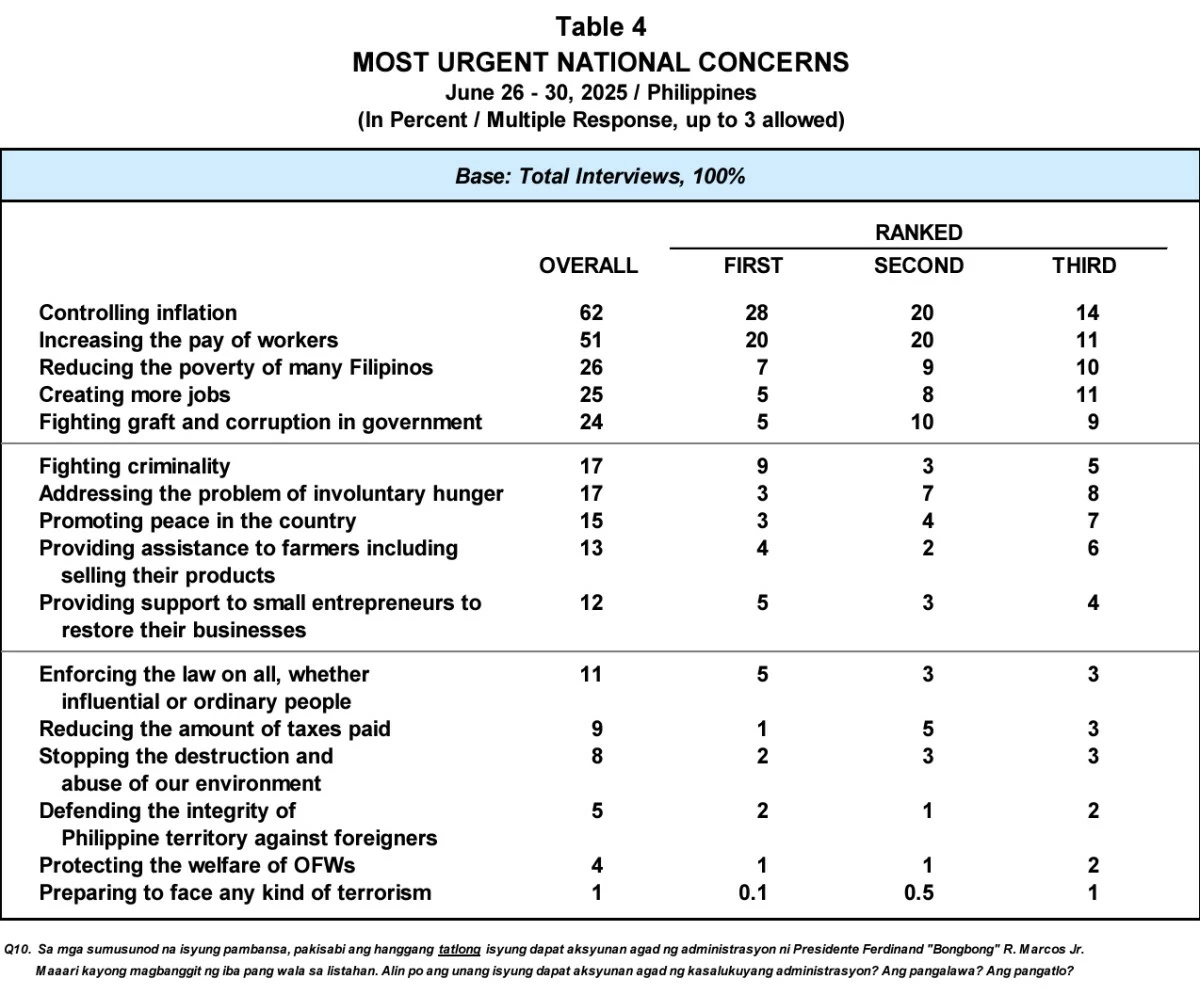
Pulse Asia’s June 2025 survey revealed that inflation remains the most urgent national concern for Filipinos, while more respondents now cite the need to increase workers’ pay compared to the previous quarter.
The survey results released on Thursday, July 17, showed that 62 percent of Filipino adults consider inflation an urgent issue, although this reflects an eight-point decline from April 2025.
Meanwhile, concern over workers’ pay rose significantly, with 51 percent of respondents identifying it as a top national concern, up 17 points from the previous quarter.
Other issues deemed urgent by at least a quarter of Filipino adults are poverty (26 percent), jobs (25 percent), and graft and corruption (24 percent).
These are followed by criminality (17 percent), involuntary hunger (17 percent), peace (15 percent), agricultural assistance (13 percent), and support for small entrepreneurs (12 percent).
Less frequently mentioned issues include the rule of law (11 percent), taxes (9 percent), and environmental degradation (8 percent).
The least urgent concerns are national territorial integrity (5 percent), welfare of overseas Filipino workers (4 percent), and terrorism (1 percent).
Across geographic areas and socio-economic groups, inflation was the only concern identified by majorities, ranging from 60 to 72 percent across regions, and 62 to 63 percent across classes.
Workers’ pay was also a majority concern in the rest of Luzon (51 percent), Visayas (54 percent), and among Classes ABC and D (both at 51 percent).
Compared to April 2025, concern about support for small entrepreneurs rose by 5 percentage points, while concern over inflation and criminality dropped by 8 and 15 points, respectively.
The sharpest increase in concern over workers’ pay was recorded in Mindanao (up 26 points), with significant gains also observed across all socio-economic classes (up 15 to 23 points).
Meanwhile, concern about inflation decreased notably in the rest of Luzon (down 12 points) and Class D (down 6 points).
Concern about criminality fell significantly in Metro Manila (down 30 points) and also declined in the rest of Luzon (down 14 points), Mindanao (down 12 points), and Class D (down 17 points).
Concern about agricultural assistance also declined in Mindanao (down 11 points).
Personal concerns
Regarding personal concerns, staying healthy and avoiding illness remains the most urgent issue for Filipino adults, with 64 percent citing it, though this is seven points lower than the same period last year.
Having a secure and well-paying job or income source was cited by 53 percent, the only other personal concern mentioned by majority of Filipinos.
Other top personal issues include having some savings (45 percent), finishing one’s schooling or supporting children’s education (44 percent), and food security (43 percent).
The least-cited concerns were avoiding being a crime victim (28 percent) and owning a house and lot (23 percent).
Majorities in all geographic areas, ranging from 53 to 69 percent, and in most socio-economic classes (64 to 74 percent), expressed concern about staying healthy, with the exception of Class E, where only 44 percent shared this concern.
Having a good job or source of income is also a concern in nearly all areas (52 to 56 percent) and classes (53 to 60 percent), except in Metro Manila and Class ABC, where only 39 percent and 49 percent, respectively, cited it as urgent.
Meanwhile, the desire to have personal savings is most common among those in Class ABC and Class E, at 54 and 53 percent, respectively.
Concern over daily food security was noted by small majorities in the Visayas (58 percent) and in Class E (51 percent).
The June 2025 Ulat ng Bayan survey was conducted by Pulse Asia Research from June 26 to 30, using face-to-face interviews with 1,200 Filipino adults aged 18 and above.
The nationwide survey has a ±2.8 percent margin of error at the 95 percent confidence level.
Subnational estimates for Metro Manila, the rest of Luzon, Visayas, and Mindanao each have a ±5.7 percent margin of error.