







DOE, oil companies agree to staggered fuel price hikes
Published Jun 23, 2025 01:40 pm


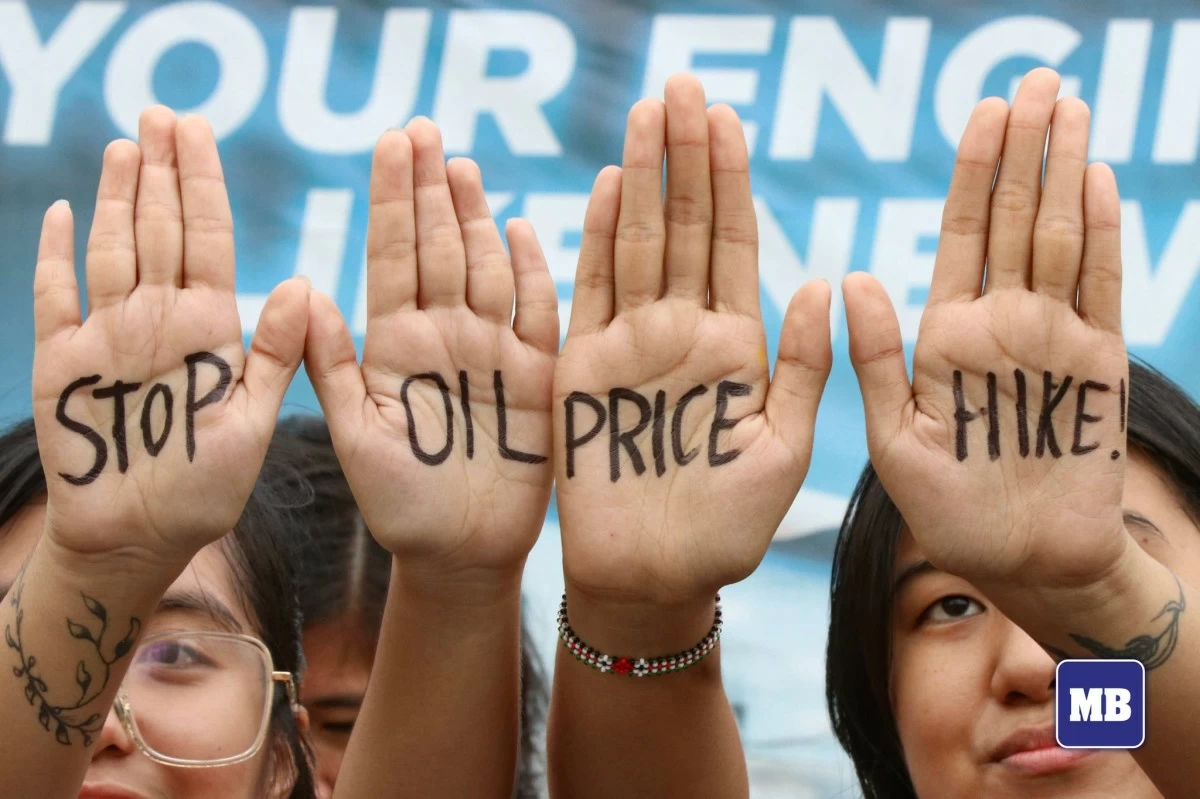
Protesters gathered at a Quezon City gas station along Commonwealth Avenue on Monday, June 23, to condemn the estimated ₱5/liter oil price increase.
The Department of Energy (DOE) announced on Monday, June 23, that the government has reached an agreement with oil companies for the staggered implementation of domestic petroleum price adjustments.
In a statement, DOE Officer-in-Charge Sharon S. Garin said this measure was taken in response to rising global oil prices driven by geopolitical tensions between Iran and Israel and overall market volatility.
On Monday, Garin and Energy Undersecretary Alessandro O. Sales met representives from Petron, Shell Pilipinas, Caltex, Jetti Petroleum, PetroGazz, Phoenix, PTT, Seaoil, Total, Unioil, Filpride, and CleanFuel.
According to Garin, the oil companies “have responded positively to our [DOE] request.”
Garin explained that the proposed staggered approach aims to ease the burden of potential larger price adjustments in the domestic market, particularly on the transport and agriculture sectors, by distributing price movements over a more manageable period, thereby cushioning the impact on Filipino consumers.
The scheduled price adjustments for this week will be implemented on a staggered basis.
Oil companies are required to submit their implementation scheme, including the breakdown of the staggered adjustments, to the DOE no later than 6:00 PM Monday.
Garin added that the DOE has also urged oil companies to increase the number of their retail stations offering fuel discounts to the transport sector, noting that this forms part of broader efforts to alleviate the burden on vulnerable groups.
Sales, who supervises the DOE-Oil Industry Management Bureau (OIMB), emphasized the critical nature of cooperation between the public and private sectors.
He said the DOE is closely monitoring global oil price benchmarks and foreign exchange trends, and urged oil companies to exercise prudence in passing on cost changes to consumers.
Sales added that much of the recent price volatility is being driven not by actual supply disruptions, but by speculative trading due to geopolitical uncertainties.
As of June 23, 2025, the average pump prices of gasoline, diesel, and kerosene are ₱55.90 per liter, ₱53.40 per liter, and ₱70.22 per liter, respectively.
Garin said the DOE continues to implement measures to ensure an adequate domestic fuel supply, including compliance with mandatory inventory requirements for oil companies.
She added that they are also working to activate existing safety nets, such as fuel subsidies and coordinated action among relevant government agencies, to protect the most affected sectors.
Garin is scheduled to meet on Tuesday, June 24, 2025, with officials from the Department of Transportation (DOTr) and the Department of Agriculture (DA) to discuss the timely rollout of targeted subsidies for public transport drivers and farmers, should the average price of crude oil breach the $80 per barrel threshold.
In a report by Reuters, the Brent crude futures increased by 1.97 percent to $78.53 per barrel, following the US’s attack on Iran’s nuclear sites. Iran is considered the third-largest crude producer of OPEC+.
As of Monday, the average price of Dubai crude oil stands at $75.16 per barrel.
Jetti Petroleum, meanwhile, explained that the price adjustments will be implemented in at least two increments, for instance, on Tuesday and Friday, with each increment reflecting 50 percent of the total price change.
However, the company noted that oil firms have the option to implement more increments throughout the week.
Jetti added that the deadline for submitting price notifications for the week's staggered adjustments has been extended from 3:00 PM to 6:00 PM on Monday.
The extension aims to provide companies more time to finalize the amount and schedule of their price increases, with the notification expected to cover the entire week's adjustments.
The DOE also strongly encouraged the public to practice fuel conservation through habits such as carpooling, avoiding unnecessary idling, observing correct tire pressure, and regular vehicle maintenance.