






The European Union Election Observation Mission (EU EOM) was left disappointed after the Commission on Elections (Comelec) withdrew an agreement that would allow observers full access to polling precincts “at any time” on Election Day.
Manila Bulletin
 Philippines
National
EU election observers disappointed, rue lack of poll center access
Philippines
National
EU election observers disappointed, rue lack of poll center access
Philippines
National
EU election observers disappointed, rue lack of poll center access
EU election observers disappointed, rue lack of poll center access
Published May 14, 2025 03:43 pm


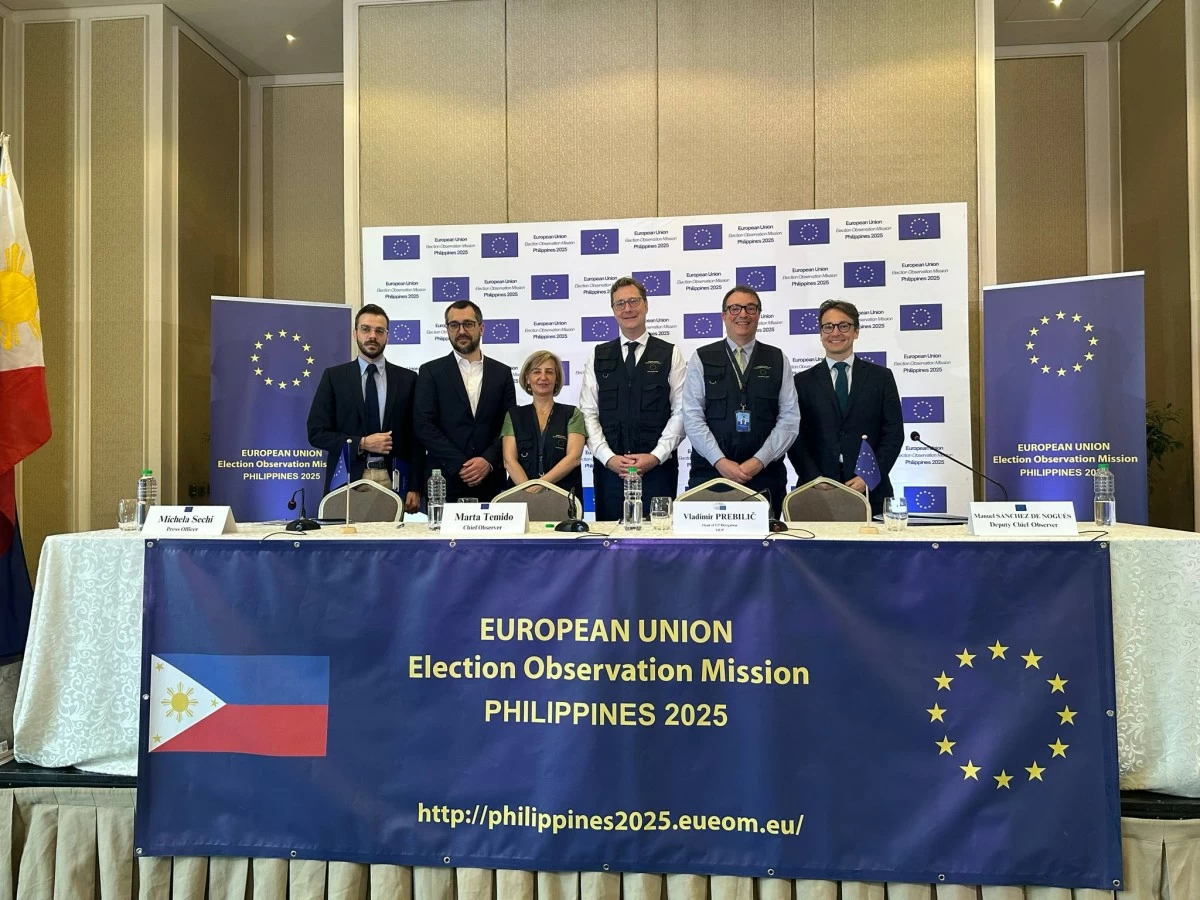
The European Union Election Observation Mission (EU EOM) presents its initial findings and conclusions on the conduct of the May 12 elections during a press conference held in Makati City. (Raymund Antonio/MANILA BULLETIN)
Vladimir Prebilič, head of the Delegation of the European Parliament that joined the EU EOM, and Marta Temido, EU EOM chief observer, lamented the lack of access to polling precincts that affected the mission’s goal to fully observe the conduct of the election process.
“This question is more for Comelec than for us because, again, we had an agreement signed and it's impossible for us to guess what was the reason for cancelling,” Prebilič told reporters during a press conference on Wednesday, May 14, to present the mission’s preliminary findings.
Noting that the Philippines was the one that invited the EU EOM to observe the elections, he stressed that the document was “quite clear” that “we are allowed to visit the precincts, what is the methodology that is going to be used.”
“There is not really much room for maneuvering here. We were really honest, clear, and transparent in our process. Based on that, the agreement was signed,” he added.
Temido, for her part, explained that the administrative agreement with Comelec granted the EU EOM “unimpeded access to all the phases of the electoral process.”
“It clearly states that on Election Day, watchers had access to all the polling places, any time, and the only explanation that we know, we publicly know, is regarding the Filipino's laws that, of course, we never would violate,” she added.
Limited access
According to Temido, observers were deployed to 92 polling precincts across the country after the closing of the polls.
However, the teams were denied access to eight of the precincts even during the counting phase, while one team was denied during the canvassing at municipal and provincial level.
“We were very surprised, shocked. The solution proposed by the Comelec to stay outside the precincts as the option to deal with the situation and to witness through a window is not compatible with our methodology. To look through a window is not to observe,” she stressed.
Prebilič furthered that the mission gained access to a document, which apparently said that foreign observers cannot be present at the electoral precincts because they are not covered by Philippine law.
“Again, they knew that already before. It's really not understandable to me why these things happened,” he said.
The official shared that they were at the Comelec a day before Election Day to clarify the issue and work out an agreement on how to continue with their mission, but “we were not received.”
No communication
“I think this was not smart for anyone. Finally, all we got was the communication of Comelec via media. We read the titles of newspapers explaining to us that we are not going to go there or we are not supposed to go there. I think this was avoidable,” he argued.
“Again, clear communication would be an option for all of us to be on the right side. What happened is impossible today to undo what was done, but let's learn something and move forward,” Prebilič added.
Both furthered that they could not give a credible assessment of the voting process and the automated counting machines because they were not given access to the polling precincts, and were only able to gain access during the tabulation of the votes.
As for the process of vote-counting, Temido said the assessment was “positive” despite a “few problematic situations.”
“I can really just praise the work of all the workers who were at the precincts. They worked really hard and they did everything they can to deliver,” Prebilič stated, noting “some problems” with the internet connection though he clarified that such challenges do not necessarily meant interference in the legitimacy of the elections.
Despite the hiccup in the EU EOM’s observation of the election process in the Philippines, Temido clarified that they hope to continue the relations with the Philippines, while Prebilič hoped for better communication with the poll body.
“We would not be here if we would be able to talk to each other. So, always communication is essential and again, if there will be any kind of problems, we are always here to understand things, but if you do not have a partner to communicate with, it's difficult. So, we really regret the situation today,” he added.