







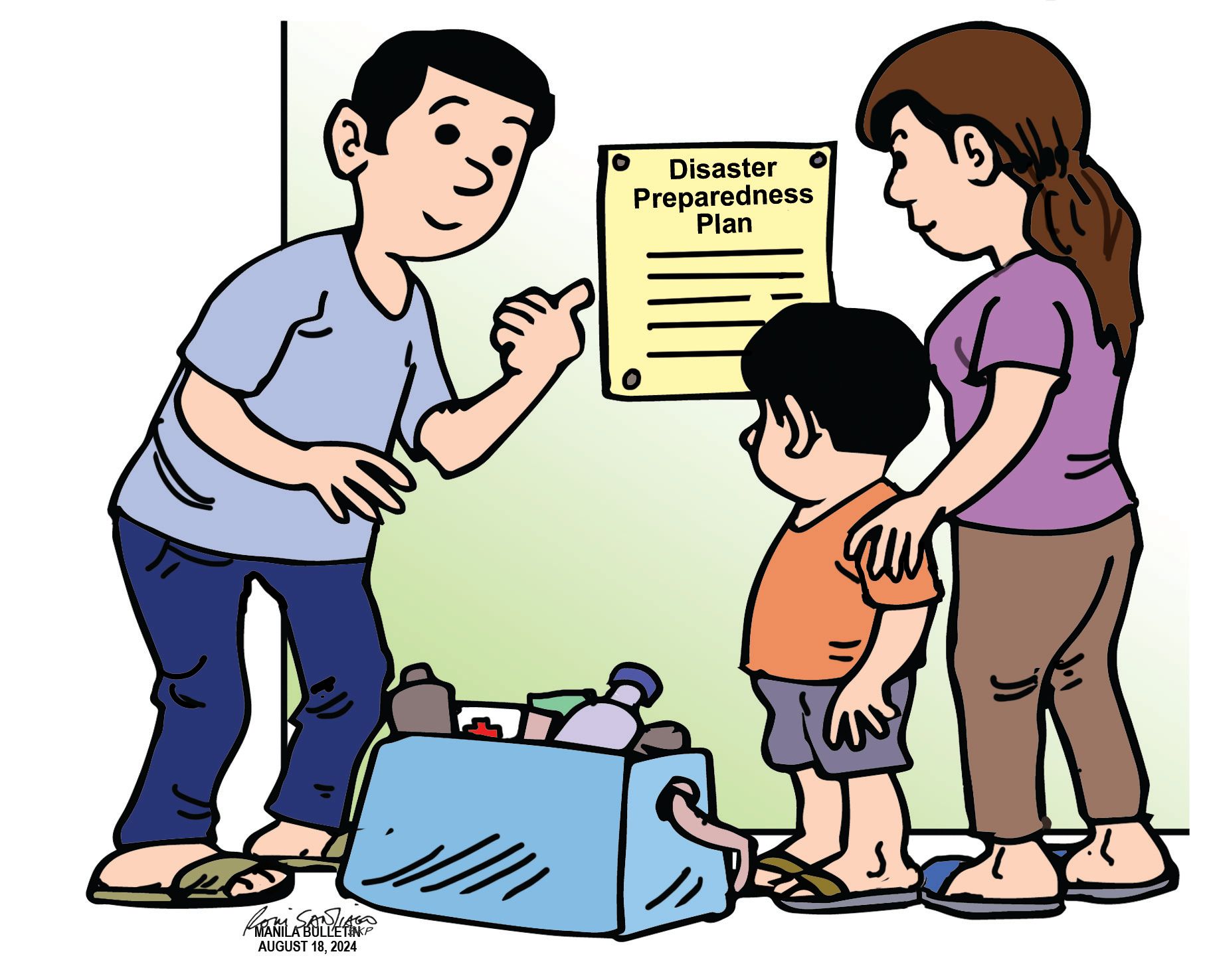
Like 84% of PH households, does your family have a disaster plan?


Here’s some good news – government efforts to educate the public on disaster preparedness has been absorbed by a “high proportion of households” who say they have a disaster plan. This is according to data from the World Risk Poll conducted every two years.
The survey ranked the Philippines as among the top four countries – all in Southeast Asia – where the highest proportion of households have a disaster plan: the Philippines (84 percent), Vietnam (83 percent), Cambodia (82 percent) and Thailand (67 percent), followed by the United States (62 percent).
“Globally, no country ranked higher than the Philippines for having experienced a natural disaster in the past five years, with 84 percent of respondents saying they had,” the report said.
“Southeast Asia, among the regions most prone to natural disaster, is where people also feel the best equipped to deal with disasters,” the analysis released on Aug. 15 said.
The Associated Press report said: 40 percent of people surveyed in Southeast Asia said they had experienced a natural disaster in the past five years, while a similar number — 36 percent — in Southern Asia said the same. But 67 percent of Southeast Asians felt among the best prepared to protect their families and 62 percent had emergency plans, while Southern Asians felt less ready, with 49 percent and 29 percent respectively.
Benedict Vigers, a research consultant with Gallup, told AP: “Southeast Asia’s success in feelings of disaster preparedness can be linked to its high exposure to disasters, its relatively high levels of resilience - from individual people to overall society, and the region’s approach to — and investment into — disaster risk management more broadly.”
The good results of the survey confirm the strong partnership of government and the private sector. It is also a recognition of the good work of government agencies, especially of the Office of Civil Defense and the National Disaster Risk Reduction and Management Council (NDRRMC). Established by Republic Act 10121 in 2010, the NDRRMC is composed of various government, non-government, civil sector and private sector organizations.
One of the well-organized programs on disaster preparedness is the National Simultaneous Earthquake Drill (NSED) which was first introduced in schools in 2002, and later conceptualized as a regular nationwide exercise in 2006. The NSED is conducted quarterly to test the preparedness of government and private agencies to respond to various scenarios that can be created by the “Big One” quake. Recently, the exercise focused on a scenario where Metro Manila suffered the most damage and tested the coordinated efforts of provincial agencies to respond.
By now, the NSED has made well known the “duck-cover-hold” response to an earthquake, an exercise which is followed by school children.
In many households, preparedness shows through the presence of “go bags” or emergency packs that hold supplies for the just-in-case disaster situations.
It’s time to check your go-bags for expired items. And it’s time to check if family members still remember the emergency plan on what to do, and where to meet in case of a flood or strong earthquake.
The survey shows 84 percent of Philippine households have a plan! Does your family have one?