






 Opinion
National Scientists: Inspiration for PH drive toward world-class innovation, global competitiveness
Opinion
National Scientists: Inspiration for PH drive toward world-class innovation, global competitiveness
National Scientists: Inspiration for PH drive toward world-class innovation, global competitiveness


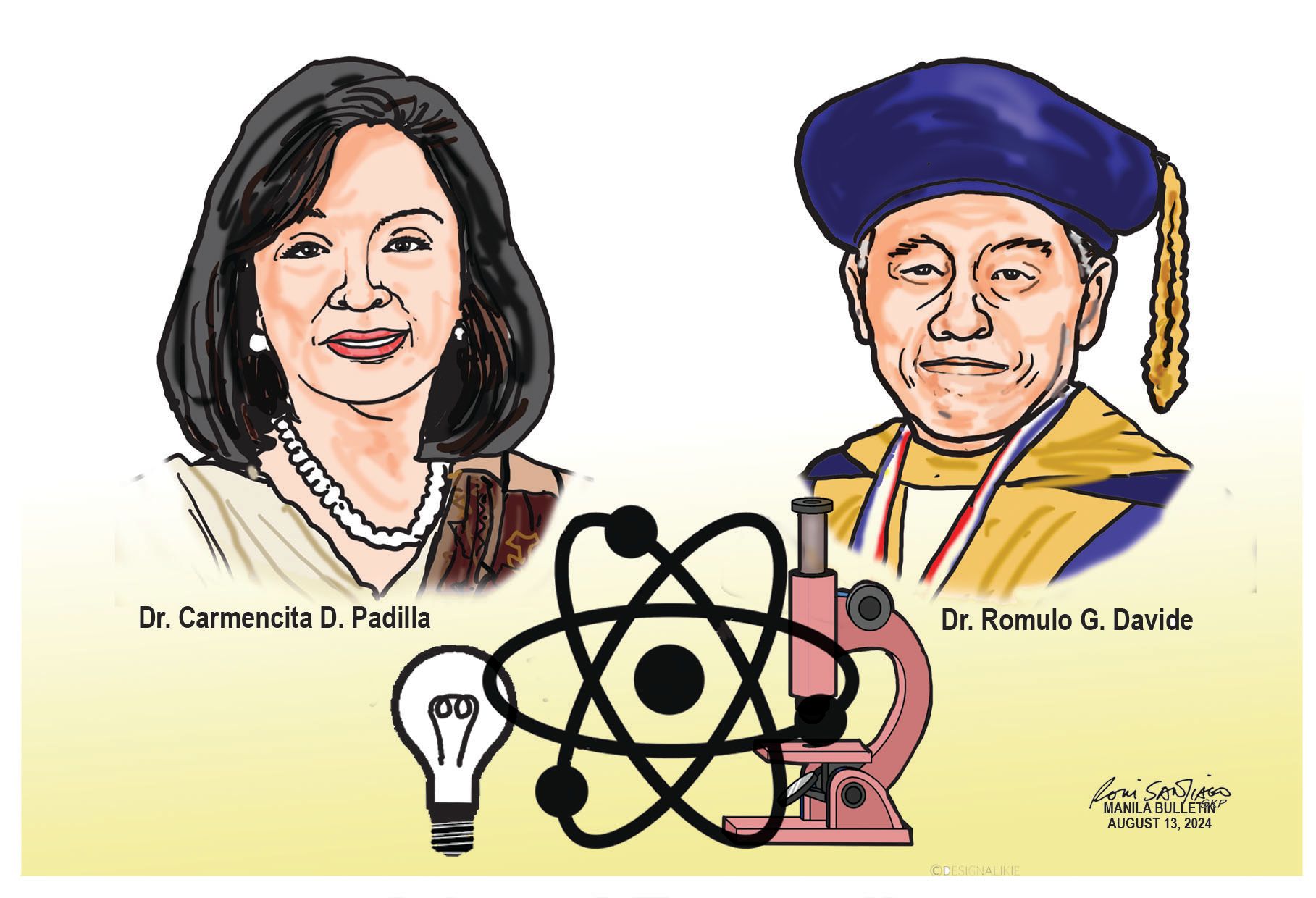
Two new National Scientists were honored by President Marcos last week: Dr. Carmencita D. Padilla and Dr. Romulo G. Davide as national scientists for their achievements in the fields of genetics and nematology and plant pathology, respectively.
Dr. Padilla greatly contributed to the enactment of Republic Act No. 9288, or the Newborn Screening Act of 2004, and RA No. 10747, or the Rare Diseases Act of the Philippines — laws that have significantly contributed to the prevention of mental retardation and death from certain congenital disorders detectable at birth.”
Dr. Davide was recognized for his work in nematology, or the study of roundworms, and plant pathology, or the study of plant diseases. His works “resulted in the development of a biological control agent against nematodes, which provided Filipino farmers with an alternative to chemical nematicides.”
With their induction to the Order of National Scientists, the country now has 44 National Scientists, who have served as the vanguard of scientific research and development since 1978.
The Philippine Development Plan 2023-2028 (PDP 2023-2028) underlines the vital importance of scientific and technological innovation by specifying four desired outcomes, namely: first, basic research and development and knowledge creation strengthened; second, market-driven and customer-centered research and development advanced; third, technology adoption, utilization, and commercialization scaled-up; and fourth, innovation and entrepreneurship accelerated.
As the current PDP 2023-2028 is a subset of Ambisyon Natin 2040, the country’s long-term development plan that was adopted in 2015, it is part of continuing efforts to fine-tune and upgrade the development agenda for scientific and technological innovation (STI).
To attain the first outcome, there is a need to re-engineer basic, technical and vocational education. As one of the prime movers of basic education reforms, new Education Secretary Sonny Angara will expectedly take steps to ensure that our senior high school graduates would attain higher scores in reading, mathematics and science that will make them more competitive. Increasing national expenditure in research and development could be challenging, given current fiscal restraints.
Public-private partnerships need to be forged to enhance collaboration that is key to attaining the second outcome. Attainment of the third outcome on accelerating the commercialization of market-oriented and inclusive STI products also depends on closer collaboration between the government and private corporations. Finally, establishing and promoting innovation hubs and other similar collaborative platforms, is key to what Economic Planning Secretary Arsenio Balisacan persistently advocates: the creation of high-quality jobs.
Pagtanaw 2050, which literally translates to looking ahead, seeks “to chart a strategic path by anticipating the factors that will influence the development of the Philippines’ scientific capital in the years leading up to 2050, while aiming to enable the country’s attainment of inclusive growth, sustainability, and competitiveness.
It declares: “At the core of STI Foresight are 12 key operational areas, namely: (a) Blue Economy; (b) Governance; (c) Business and Trade; (d) Digital Transformation and Information and Communications Technology; (e) Science Education and Talent Retention; (f) Food Security and Nutrition; (g) Health Systems; (h) Energy; (i) Water; (j) Environment and Climate Change; (k) Shelter, Transportation, and Other Infrastructure; and (l) Space Exploration.”
With our National Scientists serving as inspiring role models, let there be a renaissance in innovation and creativity that will ultimately bring to full fruition our collective ambition: “economic and social transformation for a prosperous, inclusive, and resilient economy.”