







Rallying broad-based support to sustain economic gains


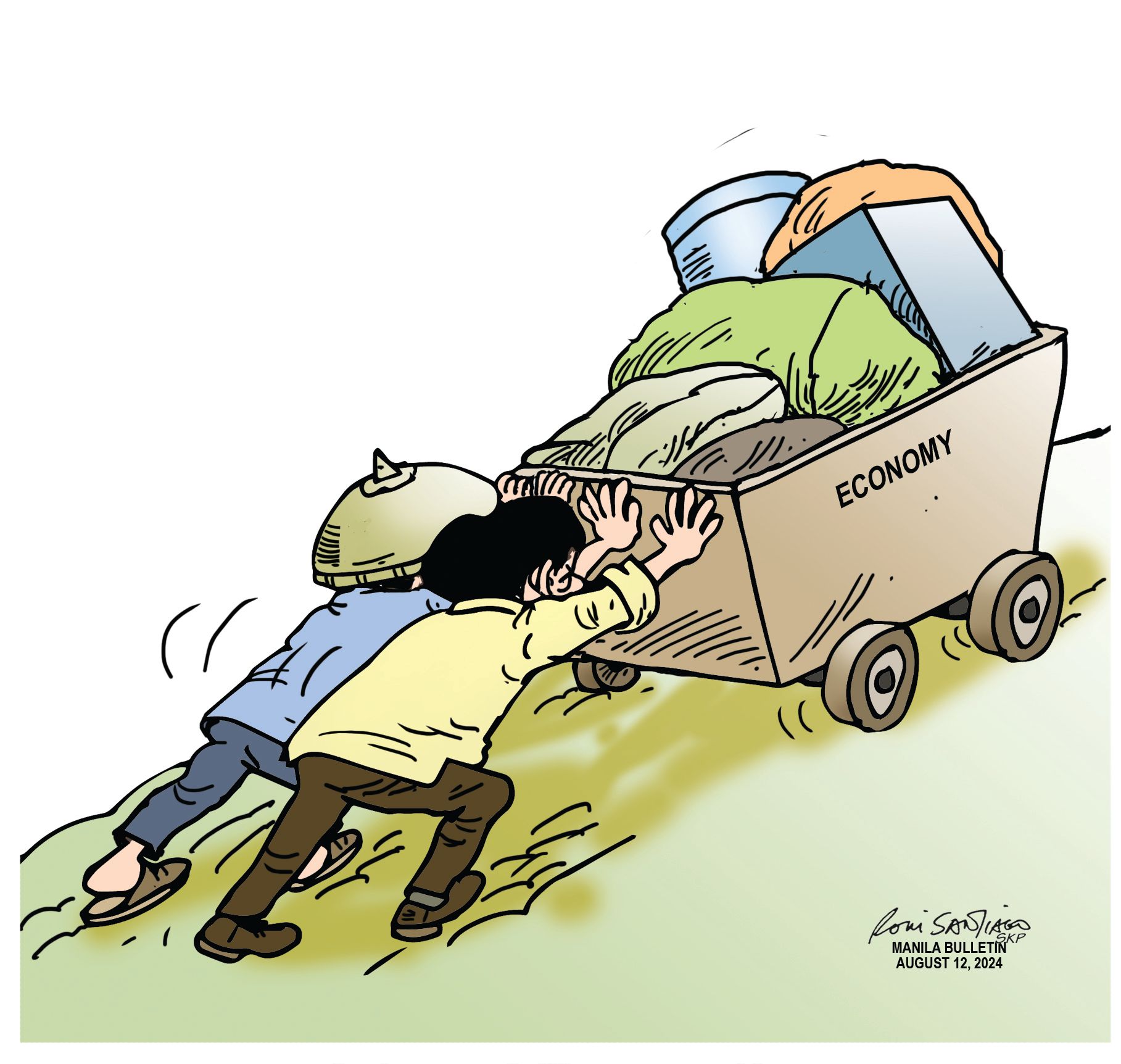
The Philippine Gross Domestic Product (GDP) posted a year-on-year growth of 6.3 percent in the second quarter of 2024, compared to the 5.8 percent growth in the first quarter, according to the Philippine Statistics Authority (PSA).
The PSA reports further that this is the highest growth rate posted since the first quarter of 2022 at the onset of the post-Covid recovery period. “The leading growth sectors were: Construction, 16.0 percent; wholesale and retail trade; repair of motor vehicles and motorcycles, 5.8 percent; and financial and insurance activities, 8.2 percent. Among the major economic sectors, industry and services posted year-on-year growth in the second quarter of 2024 with 7.7 percent and 6.8 percent, respectively. Meanwhile, the agriculture, forestry, and fishing sector posted a year-on-year decline of 2.3 percent.”
Evidently, the increased tempo of the government’s infrastructure projects is bearing fruit. On the flipside, millions of Filipino families that are dependent on farming and fishing for livelihood are still struggling to overcome the ill effects of El Niño and cope with higher prices of prime commodities. In response, President Marcos has been regularly touching base with them and extending government assistance to boost their livelihood.
Economic Planning Secretary Arsenio Balisacan pointed out that: “(T)he notable increase in government final consumption expenditure by 10.7 percent was mainly driven by the timely implementation and expanded coverage programs of various social protection, health, and education programs, coupled with the preparatory activities for the 2025 national and local elections.”
He also cited the significant improvement in jobs generation that has enabled the government to bring down unemployment to 3.1 percent in June 2024, a record low for the past two decades. Government is focusing on high-quality job creation that would, in the long-run, “speed up poverty reduction and socioeconomic transformation.”
Feeling the pulse at the grassroots, the Social Weather Stations (SWS) reported that 58 percent of respondents rated themselves poor as of June 2024, 12 points above the 46 percent in March 2024 and the highest since 59 percent in June 2008.” Quantifying these percentages: “The estimated numbers of self-rated poor families were 16.0 million in June 2024 and 12.9 million in March 2024.” According to SWS: “The percentage of respondent households rating themselves as poor was applied to the Philippine Statistics Authority medium-population projections for 2024 to arrive at the estimated numbers of self-rated poor families.”
This is the SWS report eyeball: “The national Social Weather Survey of June 23 to July 1, 2024, found 58 percent of Filipino families rating themselves as mahirap or poor, 12 percent rating themselves as borderline (by placing themselves on a horizontal line dividing poor and not poor), and 30 percent rated themselves as hindi mahirap or not poor. “Indeed, the government still has a tough road ahead. Volatile geopolitical factors could make it more difficult to achieve lower inflation, while unleashing the resources needed to spur economic growth. Although this is a tall order, it is not insurmountable — especially if the national leadership is able to rally broad-based support from the citizenry.