ADVERTISEMENT

Plastic-for-rice revolution: Nourishing both our bodies and our planet

Published Jul 11, 2024 04:08 pm

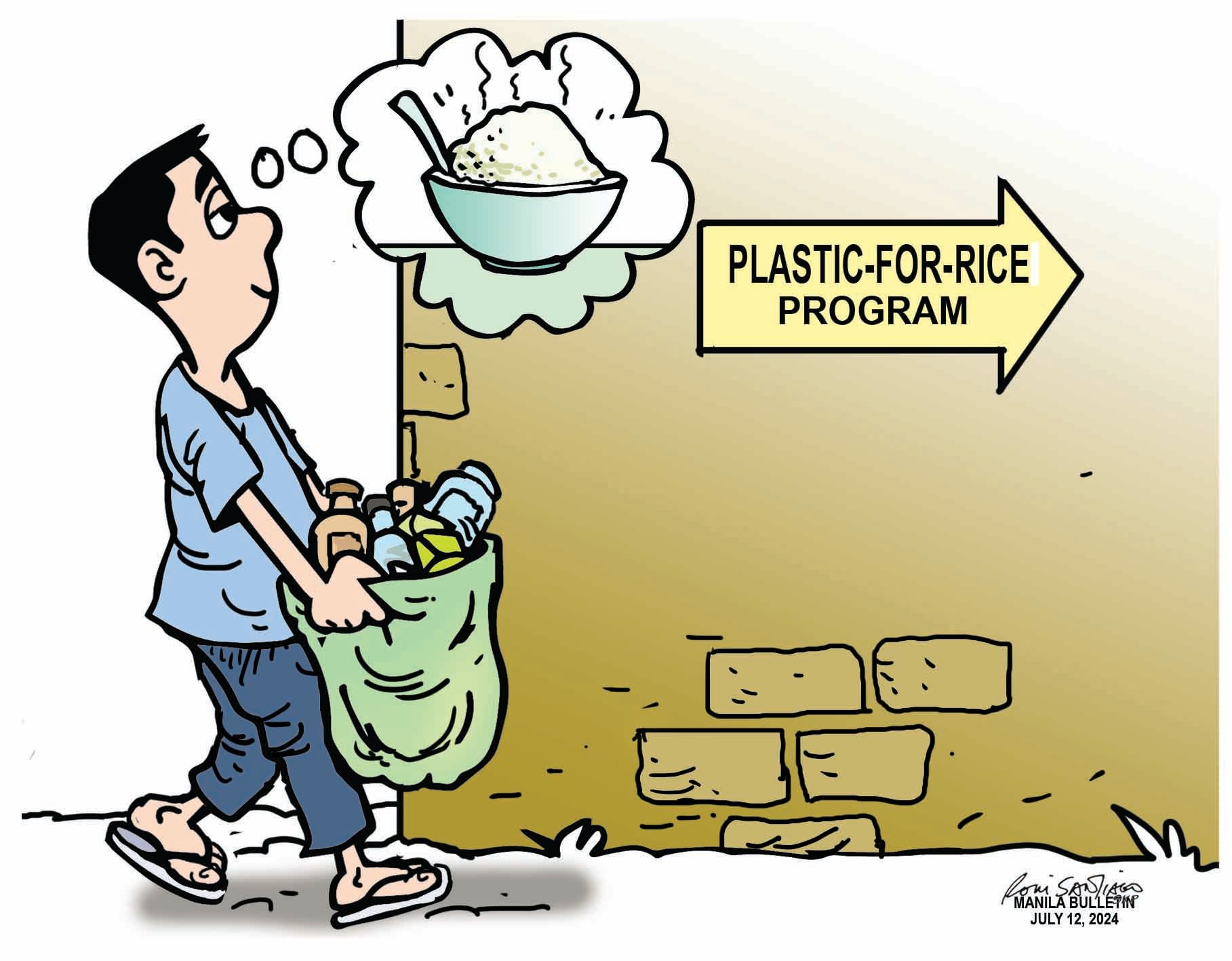
E CARTOON JUL 12, 2024.jpg

The United Nations Environment Program (UNEP) has noted that every day the equivalent of 2,000 garbage trucks full of plastic waste are dumped into the oceans, rivers, and lakes around the world.


So, you can just imagine the impact of plastic pollution on the global water systems.


This is why the plastic-for-rice program, which is gaining traction among local government units, is a welcome development in an effort to address or at least minimize the impact of plastic pollution in the country.


Plastic for rice is a simple yet ingenious solution to this problem.


As early as 2011, the local government of Sta. Barbara, Pangasinan, started practicing this by encouraging residents to exchange a kilo of plastic waste for a kilo of rice.


In Mabini, Batangas, residents can exchange their plastic waste for rice at a rate of two kilograms of plastic for one kilogram of rice. 
In Quezon City, it has its Trash-for-Cash Back Program, while Angeles City, Pampanga, has the “Walang Plastikan: Plastic Palit Bigas” Program that was launched in 2022.


These local government initiatives not only address poverty but also contribute to environmental preservation.


By incentivizing plastic collection, these programs reduce litter and prevent plastic waste from ending up in our oceans. Despite the country’s natural beauty, it remains one of the leading marine plastic polluters. Through the exchange system, it encourages responsible waste disposal and promotes a cleaner environment.


Apart from environmental gains, these programs help alleviate poverty, which still persist in the country. Providing rice or cash in exchange for plastic empowers communities economically while fostering environmental consciousness.


The success of the plastic collection programs in some localities should serve as an inspiration for the government to adopt similar policies nationwide. Imagine, every city and town in the country encouraging citizens to trade plastic for essential goods? Such a shift could revolutionize waste management and benefit both people and the planet we live in.


Beyond this simple solution, the government has to strengthen existing waste management laws and enforce stricter penalties for plastic pollution. It can also offer incentives such as tax breaks or subsidies to businesses that reduce plastic use or invest in sustainable alternatives. It should continue to educate citizens about responsible plastic use and disposal.


On the part of the private sector, businesses must develop eco-friendly packaging and promote circular economy practices. The United Nations Development Program defines a circular economy as minimizing waste and promoting a sustainable use of natural resources, through smarter product design, longer use, recycling and more, as well as regenerating nature. It is also crucial for the private sector to collaborate with non-governmental organizations and local communities to organize plastic collection drives and recycling initiatives. Brands can educate consumers about sustainable choices and promote reusable products.


For individuals, they can help address plastic pollution by minimizing the use of single-use plastics and opting for reusable bags, bottles, and containers. They can repurpose plastic items creatively or donate them to recycling centers. Properly segregating plastic waste and supporting recycling efforts are other ways an individual can contribute to help address plastic pollution.


The Plastic-for-Rice or the Trash-for-Cash Back programs exemplify how small actions can lead to significant change. Let us rally behind the success of these programs. Together, we can transform plastic waste into a resource — nourishing both our bodies and our planet.
 

Related Tags

Editorial Manila Bulletin
ADVERTISEMENT
.most-popular .layout-ratio{ padding-bottom: 79.13%; } @media (min-width: 768px) and (max-width: 1024px) { .widget-title { font-size: 15px !important; } }

{{ articles_filter_1561_widget.title }}

.most-popular .layout-ratio{ padding-bottom: 79.13%; } @media (min-width: 768px) and (max-width: 1024px) { .widget-title { font-size: 15px !important; } }

{{ articles_filter_1562_widget.title }}

.most-popular .layout-ratio{ padding-bottom: 79.13%; } @media (min-width: 768px) and (max-width: 1024px) { .widget-title { font-size: 15px !important; } }

{{ articles_filter_1563_widget.title }}

{{ articles_filter_1564_widget.title }}

.mb-article-details { position: relative; } .mb-article-details .article-body-preview, .mb-article-details .article-body-summary{ font-size: 17px; line-height: 30px; font-family: "Libre Caslon Text", serif; color: #000; } .mb-article-details .article-body-preview iframe , .mb-article-details .article-body-summary iframe{ width: 100%; margin: auto; } .read-more-background { background: linear-gradient(180deg, color(display-p3 1.000 1.000 1.000 / 0) 13.75%, color(display-p3 1.000 1.000 1.000 / 0.8) 30.79%, color(display-p3 1.000 1.000 1.000) 72.5%); position: absolute; height: 200px; width: 100%; bottom: 0; display: flex; justify-content: center; align-items: center; padding: 0; } .read-more-background a{ color: #000; } .read-more-btn { padding: 17px 45px; font-family: Inter; font-weight: 700; font-size: 18px; line-height: 16px; text-align: center; vertical-align: middle; border: 1px solid black; background-color: white; } .hidden { display: none; }
function initializeAllSwipers() { // Get all hidden inputs with cms_article_id document.querySelectorAll('[id^="cms_article_id_"]').forEach(function (input) { const cmsArticleId = input.value; const articleSelector = '#article-' + cmsArticleId + ' .body_images'; const swiperElement = document.querySelector(articleSelector); if (swiperElement && !swiperElement.classList.contains('swiper-initialized')) { new Swiper(articleSelector, { loop: true, pagination: false, navigation: { nextEl: '#article-' + cmsArticleId + ' .swiper-button-next', prevEl: '#article-' + cmsArticleId + ' .swiper-button-prev', }, }); } }); } setTimeout(initializeAllSwipers, 3000); const intersectionObserver = new IntersectionObserver( (entries) => { entries.forEach((entry) => { if (entry.isIntersecting) { const newUrl = entry.target.getAttribute("data-url"); if (newUrl) { history.pushState(null, null, newUrl); let article = entry.target; // Extract metadata const author = article.querySelector('.author-section').textContent.replace('By', '').trim(); const section = article.querySelector('.section-info ').textContent.replace(' ', ' '); const title = article.querySelector('.article-title h1').textContent; // Parse URL for Chartbeat path format const parsedUrl = new URL(newUrl, window.location.origin); const cleanUrl = parsedUrl.host + parsedUrl.pathname; // Update Chartbeat configuration if (typeof window._sf_async_config !== 'undefined') { window._sf_async_config.path = cleanUrl; window._sf_async_config.sections = section; window._sf_async_config.authors = author; } // Track virtual page view with Chartbeat if (typeof pSUPERFLY !== 'undefined' && typeof pSUPERFLY.virtualPage === 'function') { try { pSUPERFLY.virtualPage({ path: cleanUrl, title: title, sections: section, authors: author }); } catch (error) { console.error('ping error', error); } } // Optional: Update document title if (title && title !== document.title) { document.title = title; } } } }); }, { threshold: 0.1 } ); function showArticleBody(button) { const article = button.closest("article"); const summary = article.querySelector(".article-body-summary"); const body = article.querySelector(".article-body-preview"); const readMoreSection = article.querySelector(".read-more-background"); // Hide summary and read-more section summary.style.display = "none"; readMoreSection.style.display = "none"; // Show the full article body body.classList.remove("hidden"); } document.addEventListener("DOMContentLoaded", () => { let loadCount = 0; // Track how many times articles are loaded const offset = [1, 2, 3, 4, 5, 6, 7, 8, 9, 10]; // Offset values const currentUrl = window.location.pathname.substring(1); let isLoading = false; // Prevent multiple calls if (!currentUrl) { console.log("Current URL is invalid."); return; } const sentinel = document.getElementById("load-more-sentinel"); if (!sentinel) { console.log("Sentinel element not found."); return; } function isSentinelVisible() { const rect = sentinel.getBoundingClientRect(); return ( rect.top < window.innerHeight && rect.bottom >= 0 ); } function onScroll() { if (isLoading) return; if (isSentinelVisible()) { if (loadCount >= offset.length) { console.log("Maximum load attempts reached."); window.removeEventListener("scroll", onScroll); return; } isLoading = true; const currentOffset = offset[loadCount]; window.loadMoreItems().then(() => { let article = document.querySelector('#widget_1690 > div:nth-last-of-type(2) article'); intersectionObserver.observe(article) loadCount++; }).catch(error => { console.error("Error loading more items:", error); }).finally(() => { isLoading = false; }); } } window.addEventListener("scroll", onScroll); });

Sign up by email to receive news.