







IYCRMM: Crime-solving goes globetrotting
Book reviews on "The Silver Bone," "The Last Murder at the End of the World," "High Vaultage," "The Murder of Mr. Ma," "How To Solve Your Own Murder, and "The Busy Body"


True Crime and Crime Fiction have become such reading favorites all around the world that it’s not surprising to find wonderful examples of Crime Fiction from different points of the globe. Quite often, these works expand the genre to provide eloquent social commentary. Here are some of the latest… and best.
The Silver Bone by Andrey Kirov
Set in the city of Kyiv in Ukraine in 1919, when World War I had ended but political turmoil persisted, with as many as six factions vying for control of the country, this wryly humorous novel is both a crime mystery and a history lesson. Kirov, the author of Jimi Hendrix Live in Lviv, returned to his beleaguered nation when it was invaded by Russia—he had been living in the USA at the time.
In Silver Bone, our protagonist is the one-eared rookie detective, Samson Kolechko. We are introduced to Samson in a highly charged, dramatic, and visceral manner: his father is bludgeoned to death by Bolsheviks during a street protest, and Samson is saved from further injury by his father, resulting in the loss of an ear. Remarkably, he manages to save the ear, catching it in his hand.
Two Red Army soldiers commandeer the apartment where Samson used to live with his father, and before long, Samson realizes they’ve been looting to facilitate their plans of desertion. When he reports this, Samson is recruited into the force. As a reluctant detective, Samson soon finds that he can achieve a lot as a member of what passes for law enforcement during this unstable political time. Samson’s infatuation with a young girl who works in the Census Bureau becomes an added incentive to stay on the force, as it means he can help her and her family.
With an element of East European-style magical realism, the saved ear, placed in a tin box, allows Samson to hear what’s going on at police HQ even when he is in his apartment. It’s a clever gimmick.

The Last Murder at the End of the World by Stuart Turton
Turton, the author of The Seven Deaths of Evelyn Hardcastle, which was celebrated in 2018 as the "future of crime and mystery fiction" and won a Costa Book Award for First Novel, has released his third novel. Once again, it’s a high-concept mystery novel, set in the near future on an island that serves as the last outpost of humanity—the rest of the world having been destroyed by a deadly fog. On this island, there are 122 villagers and three scientists, plus an elaborate security system that keeps the fog at bay, preventing it from engulfing the island.
The mystery begins when one scientist is found murdered, the security system is compromised, and there are 107 hours to solve the murder and repair the system to prevent the approaching fog from overtaking the island. What seems to be an omniscient narrator is, in fact, an AI created by the lead scientist to help maintain order and regularity of lifestyle on the island. The intricate plotting raises questions about what makes us essentially human, and be prepared for some surprises along the way.
This darkly drawn future world is not what we would normally anticipate. While there are elements of science fiction, they are never outlandish or out of place. The internal logic of the story ensures that while suspension of disbelief may be required, it is not at the expense of credible enjoyment. The short-term memories of all the island’s inhabitants have been erased, creating a situation where the murderer is unaware that they committed the crime the previous night. It’s fascinating stuff, especially once you’re invested in the book.
High Vaultage by Chris and Jen Sugden
Described as a mash-up of Douglas Adams and Charles Dickens, the Sugden writing tandem reimagines an 1887 London that’s been rechristened Even Greater London. It’s a steampunk, biopunk alternative past where Queen Victoria reigns, but she’s been reassembled and re-engineered due to assassination attempts and near-fatal ailments. We meet Clara Entwhistle and Archibald Fleet, who together have formed the very first private detective agency. Clara is a journalist who loves crime-solving, while Archie is a "resurrected" police officer. Despite being revived, he’s listed as "deceased," so the force had to let him go to avoid the anomaly of having someone officially listed as dead employed and receiving a salary.
When a mysterious kidnapping is reported to the agency, this case comes alongside that of a private bank whose premises have been broken into, though nothing was physically taken. The break-in at the bank is just one of several such occurrences that have baffled both the police force and the media. Each time, nothing is stolen, but a disoriented person is found in the vault. When the coincidences pile up, with the disoriented people always being Brunel engineers, Entwhistle and Fleet realize that something rather disturbing is going on. These Brunel engineers are behind the perpetual retooling of Even Greater London, and whatever has gone amiss has great repercussions for the business of running the country. Conspiracy theories abound, and there’s deductive reasoning and humor as the plot chugs along.
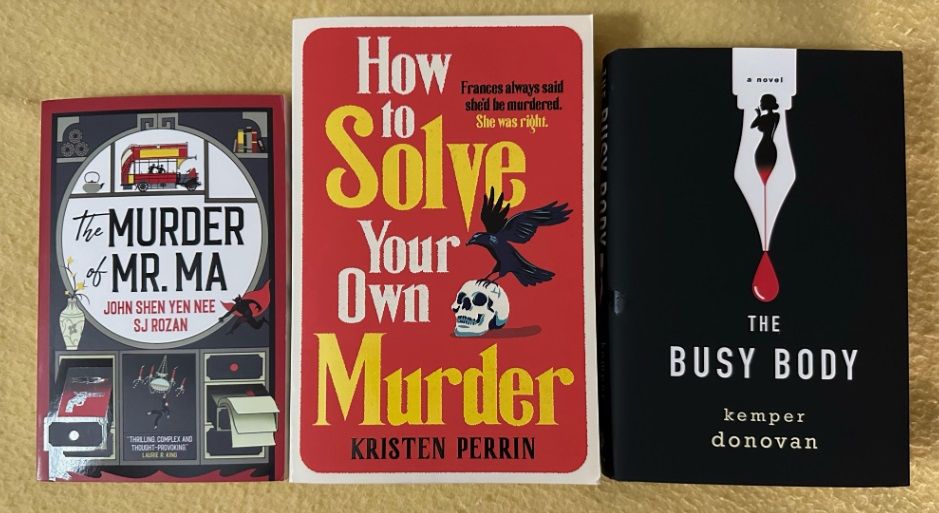
The Murder of Mr. Ma by John Shen Yen Nee & SJ Rozan
Set in London in 1924, the pairing of Chinese academic Lao She and fellow Chinese Judge Dee Ren Jie leads to an unlikely Holmes and Watson team-up composed of Chinese visitors to London. A serial killer targeting Chinese immigrants prompts the partnership, promoted by none other than Lord Bertrand Russell. This mix of true history, real historical figures, and the imagined duo of Chinese detectives makes this a unique mystery thriller. Imagine the Guy Ritchie Sherlock Holmes film franchise with Downey and Law, but with renowned Chinese actors portraying the lead roles. A fatal, deadly butterfly sword appears to be the major clue behind the killings.
Dee is investigating the murders of men he knew during World War I, members of the Chinese Labour Corps who were used in France as the first wave facing the German forces. Encounters with the aristocracy, the street-child telegraph, and dealings with churchmen and thieves all add local color to this novel. Blatant racism and a cavalier disregard for political correctness are depicted, reflecting the era. Skirmishes featuring Chinese martial arts amaze the London city folk, adding to the cinematic quality of the action and deduction. This novel has the potential to be adapted into a TV series, which would be something to look forward to. In the meantime, find a cozy seat and enjoy this engaging novel.
How To Solve Your Own Murder by Kristen Perrin
There are two distinct timelines in this mystery novel. One is set in 1965, when we meet 16-year-old Frances Adams. Highly impressionable, she is captivated by a fortune teller at a country fair who predicts that she will one day be murdered. Along with other cryptic statements, this prediction rules her life and turns her into something of a recluse at the Castle Knoll estate in Dorset. The other timeline occurs sixty years later, when grand-niece Annie Adams, in between jobs in London, is asked to visit Aunt Frances to discuss her will. This will be the first time she meets her great-aunt. But when she arrives at the Castle with the family lawyer and other relatives, they find that Frances has suddenly expired.
Needles coming out from the thorns of the roses that Frances handled earlier in the morning suggest that the 1965 prediction has finally come true. As Frances' last act of revenge against the skeptical friends and family members who had disregarded the prophecy for decades, her newly revised will stipulates that whoever solves her murder inherits her millions. Annie, Saxon Gravesend, and Oliver, the grandson of the family lawyer, are all tasked with resolving the mystery of Frances' demise—which, it turns out, is from an overdose of iron, not the roses.
The stage is set for the two timelines to intersect as we follow Annie in solving the mystery. The stakes rise even higher as Annie uncovers truths about her own provenance, making this an engaging read.
The Busy Body by Kemper Donovan
Donovan is known for his podcast All About Agatha, so it’s clear where his loyalties and predilections lie. This contemporary murder mystery pays reverential homage to Agatha Christie and her locked room mysteries. The narrator is a renowned ghostwriter, and when we meet her, her agent is asking if she’s ready to take on Dorothy Chase Gibson. Gibson is a former Senator and an independent candidate for President. She split the vote and is now blamed for the shocking result of having an ultra-conservative in the White House. She has ‘retired’ to her Maine estate. When a neighbor dies under mysterious circumstances and Dorothy becomes implicated in the toxicology report, a fresh mystery has come to this upmarket Maine town.
While the politician Gibson is wonderfully fleshed out and becomes a riveting character to follow, full credit goes to Donovan for making our unnamed narrator just as interesting. With a mind of her own and motives galore, we truly enjoy being led by her on this thrilling journey. And thrilling it is, as in classic Agatha Christie mode, there are MacGuffins, red herrings, and sidebar journeys that add to the atmosphere without detracting from the case at hand. The powers of deductive reasoning of the Senator are pitted against those of our narrator, and it’s fun to watch them operate as a team while trying to outguess each other.
There’s a bodyguard who becomes the object of lust for our narrator, and while it’s a fine narrative strand, one could criticize how many pages are devoted to this subplot. But, all in all, a very fine read!