






 Philippines
National
Back-to-back cyclones in the Philippines 'supercharged' by climate change — int'l study
Philippines
National
Back-to-back cyclones in the Philippines 'supercharged' by climate change — int'l study
Back-to-back cyclones in the Philippines 'supercharged' by climate change — int'l study
Record-breaking event exposes country's vulnerability to climate risks


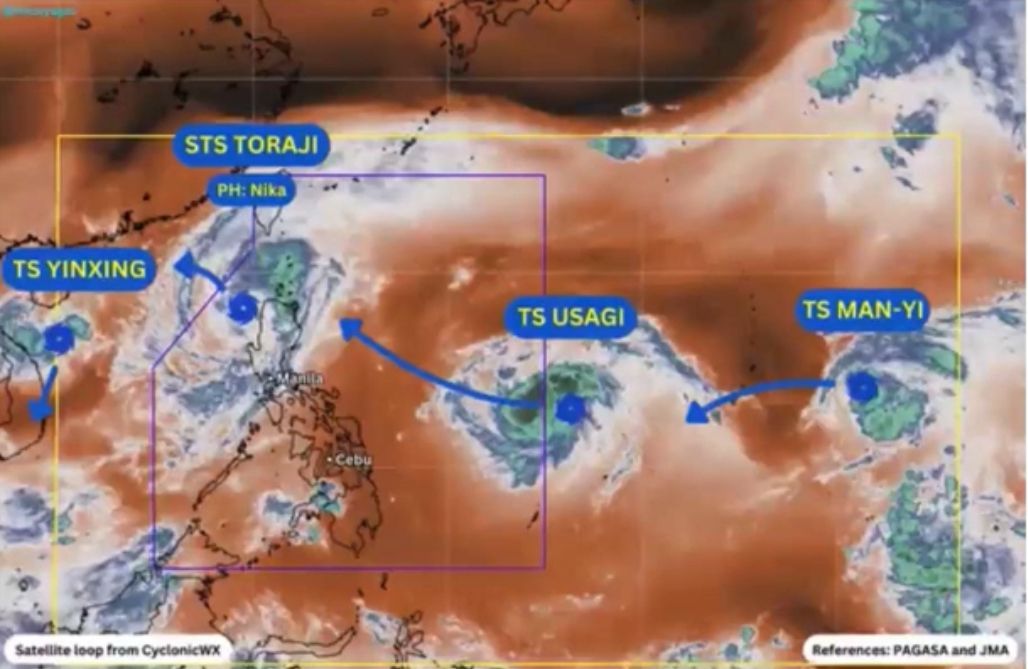
An international study has confirmed that climate change “supercharged” the record-breaking typhoon season in the Philippines, which saw six consecutive tropical cyclones in less than a month.
The Philippines, already no stranger to powerful tropical cyclones, faced an unprecedented barrage of cyclones that included Severe Tropical Storm Kristine (international name: Trami, Oct. 21-25), Super Typhoon Leon (Kong-rey, Oct. 27-Nov. 1), Typhoon Marce (Yinxing, Nov. 4-Nov. 8), Typhoon Nika (Toraji, Nov. 9-12), Super Typhoon Ofel (Usagi, Nov. 12-15), and Super Typhoon Pepito (Man-yi, Nov. 14-18).
In the World Weather Attribution (WWA) study released on Dec. 12, scientists analyzed the rare occurrence of these back-to-back cyclones that devastated the Philippines.
“The 2024 typhoon season in the Philippines was extraordinary, with six typhoons affecting the country within just 30 days, several of them simultaneously active in the region. This clustering of storms in November, never before witnessed in the basin, affected more than 13 million people, destroying lives and livelihoods and putting enormous strain on resources and infrastructure,” the report read.
November saw an exceptional overlap of typhoons in the region, with as many as four named storms simultaneously active in the Pacific, a record since tracking began in 1951.
READ MORE: https://mb.com.ph/2024/11/19/a-record-breaking-event
The devastation was particularly severe in northern Luzon, where several areas were struck multiple times within a matter of weeks.
The WWA’s study focused on understanding whether climate change influenced the environmental conditions leading to such an unusually high number of typhoons.
Researchers found that the potential intensity of storms in the region has become about seven times more likely, with the maximum intensity of a typhoon increasing by approximately 14.5 kilometers per hour.
The study suggests that global warming, largely caused by the burning of fossil fuels, is responsible for this trend.
While climate models indicated a smaller change in potential intensity, combining observational data with these models revealed that the observed intensity in 2024 is about 1.7 times more likely due to climate change.
The study also predicts that, under current emission scenarios, the intensity of future storms could increase by another 7.2 kilometers per hour by the end of the century, contributing to more frequent and severe storms.
The study also assessed the likelihood of multiple major typhoons making landfall in the Philippines in a single year.
“Using a statistical model we find that in today’s climate, warmed by 1.3°C, such an event is expected once every 15 (6.5-45) years. That is 25 percent more frequent than it would have been had we not burned fossil fuels. In a 2°C warmer climate from pre-industrial times we expect at least three major typhoons hitting in a single year every 12 years (best estimate),” it pointed out.
“Overall, our results show that conditions conducive to the development of consecutive typhoons in this region have been enhanced by global warming, and the chance of multiple major typhoons making landfall will continue to increase as long as we continue to burn fossil fuels,” it said.
While acknowledging the Philippines' proactive disaster risk management framework, including proposed legislation to formalize anticipatory action through a State of Imminent Disaster for preemptive resource allocation, the study emphasizes the extraordinary challenge of maintaining continuity and resilience in the face of escalating climate risks.