ADVERTISEMENT

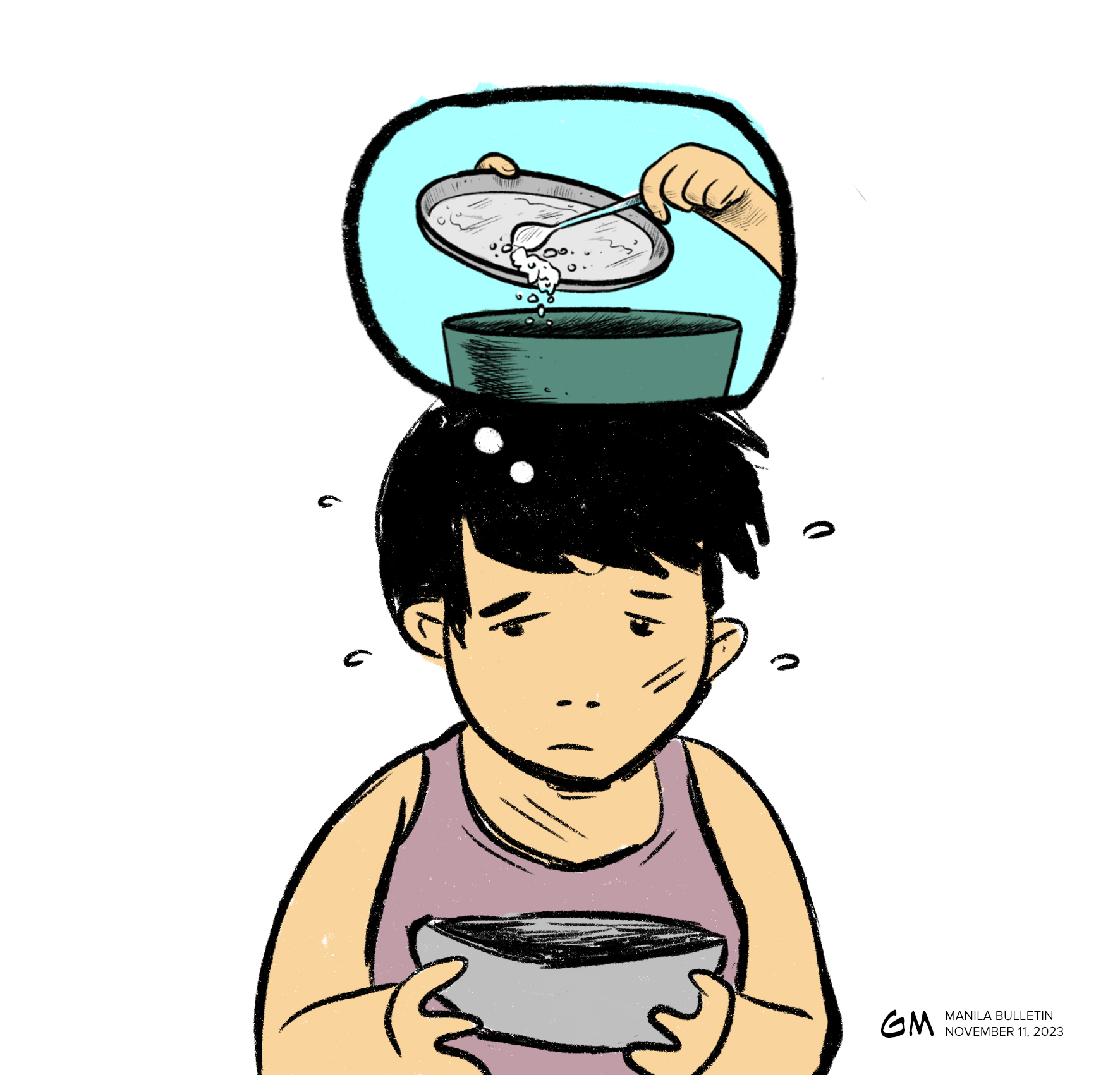
Be RICEponsible: Each year, wasted rice can feed 2.5 M people

Published Nov 10, 2023 04:04 pm

E CARTOON NOV 11 2023 (1).jpg

Rice is our staple food.  To Filipinos, no meal is complete without rice. Unfortunately, because it is a staple, many people have developed the bad habit of taking more than enough rice on one’s plate – and leaving to waste what is not consumed.


Each Filipino wastes at least two tablespoons – or 10 grams of rice – annually. The accumulated amount can feed at least 2.5 million people each year, according to the Philippine Rice Research Institute (PhilRice). 


The government agency has a cost for that waste – ₱7 million worth of rice – a significant amount especially when viewed as a fund that could be used to feed more hungry people. And there are many hungry people in the population. A recent survey conducted by OCTA Research said that 11.3 million Filipino households, or 43 percent, described themselves as food-poor in the second quarter of 2023; and 3.9 million families experienced hunger in the second quarter of 2023 (16 percent of them went hungry often or always).  A household is listed as having five members.


According to the Philippine Statistics Authority, “based on the preliminary results of the family income and expenditure survey in 2021, poverty incidence among the population was recorded at 18.1 percent,” which is 19.99 million Filipinos.


We cannot afford to waste rice.  It is a situation that each of us can take an active role to solve.  


Rice wastage has been traced to many bad habits, one of them, the “takaw-mata” attitude, a term describing persons who get too much food on their plates simply because it looked appetizing.  Dining out at food establishments, which many now do, has also been identified as a source of rice wastage due to the minimum one-cup rice order, the “unli-rice” promo, and the food buffet.


While some may not think twice about ordering more than a cup of rice for a meal, there are many who are unable to consume a cup and leave much to be wasted. The “unli-rice” and buffet always attract the “takaw mata” attitude to add more to the waste.


Already, there are some 46 local government units that have passed ordinances for restaurants to serve half-cups of rice.  To extend this practice around the country, Dr. Karen Eloisa Barroga, PhilRice deputy executive director, said the agency plans to revive Senate Bill 1863, the proposed “Anti-Rice Wastage Act” which was filed by then senator Ferdinand R. Marcos Jr. in 2013.  The bill seeks to impose fines on establishments that refuse to serve half-cup rice orders.


The agency, which is attached to the Department of Agriculture, has also started to disseminate data on rice wastage to food establishments to encourage them to implement measures to cut the waste.


The fact that our annual rice wastage can feed at least 2.5 million people is the focus of the “Be RICEponsible” campaign launched by PhilRice last Thursday to mark National Rice Awareness Month. Presidential Proclamation No. 524 signed in January 2004 had proclaimed November for this observance.  Activities during the month aim to boost awareness not only on cutting rice wastage but also on efforts to address malnutrition and poverty, and attain rice self-sufficiency.


Many of us have heard this from our elders who used to say – Finish what’s on your plate because many go to sleep hungry.  Today, government agencies have placed figures that tell us how much rice we waste and how many people feel hungry more than once a day.


It is time to “Be RICEponsible!” 
 

Related Tags

EDITORIAL Manila Bulletin
ADVERTISEMENT
.most-popular .layout-ratio{ padding-bottom: 79.13%; } @media (min-width: 768px) and (max-width: 1024px) { .widget-title { font-size: 15px !important; } }

{{ articles_filter_1561_widget.title }}

.most-popular .layout-ratio{ padding-bottom: 79.13%; } @media (min-width: 768px) and (max-width: 1024px) { .widget-title { font-size: 15px !important; } }

{{ articles_filter_1562_widget.title }}

.most-popular .layout-ratio{ padding-bottom: 79.13%; } @media (min-width: 768px) and (max-width: 1024px) { .widget-title { font-size: 15px !important; } }

{{ articles_filter_1563_widget.title }}

{{ articles_filter_1564_widget.title }}

.mb-article-details { position: relative; } .mb-article-details .article-body-preview, .mb-article-details .article-body-summary{ font-size: 17px; line-height: 30px; font-family: "Libre Caslon Text", serif; color: #000; } .mb-article-details .article-body-preview iframe , .mb-article-details .article-body-summary iframe{ width: 100%; margin: auto; } .read-more-background { background: linear-gradient(180deg, color(display-p3 1.000 1.000 1.000 / 0) 13.75%, color(display-p3 1.000 1.000 1.000 / 0.8) 30.79%, color(display-p3 1.000 1.000 1.000) 72.5%); position: absolute; height: 200px; width: 100%; bottom: 0; display: flex; justify-content: center; align-items: center; padding: 0; } .read-more-background a{ color: #000; } .read-more-btn { padding: 17px 45px; font-family: Inter; font-weight: 700; font-size: 18px; line-height: 16px; text-align: center; vertical-align: middle; border: 1px solid black; background-color: white; } .hidden { display: none; }
function initializeAllSwipers() { // Get all hidden inputs with cms_article_id document.querySelectorAll('[id^="cms_article_id_"]').forEach(function (input) { const cmsArticleId = input.value; const articleSelector = '#article-' + cmsArticleId + ' .body_images'; const swiperElement = document.querySelector(articleSelector); if (swiperElement && !swiperElement.classList.contains('swiper-initialized')) { new Swiper(articleSelector, { loop: true, pagination: false, navigation: { nextEl: '#article-' + cmsArticleId + ' .swiper-button-next', prevEl: '#article-' + cmsArticleId + ' .swiper-button-prev', }, }); } }); } setTimeout(initializeAllSwipers, 3000); const intersectionObserver = new IntersectionObserver( (entries) => { entries.forEach((entry) => { if (entry.isIntersecting) { const newUrl = entry.target.getAttribute("data-url"); if (newUrl) { history.pushState(null, null, newUrl); let article = entry.target; // Extract metadata const author = article.querySelector('.author-section').textContent.replace('By', '').trim(); const section = article.querySelector('.section-info ').textContent.replace(' ', ' '); const title = article.querySelector('.article-title h1').textContent; // Parse URL for Chartbeat path format const parsedUrl = new URL(newUrl, window.location.origin); const cleanUrl = parsedUrl.host + parsedUrl.pathname; // Update Chartbeat configuration if (typeof window._sf_async_config !== 'undefined') { window._sf_async_config.path = cleanUrl; window._sf_async_config.sections = section; window._sf_async_config.authors = author; } // Track virtual page view with Chartbeat if (typeof pSUPERFLY !== 'undefined' && typeof pSUPERFLY.virtualPage === 'function') { try { pSUPERFLY.virtualPage({ path: cleanUrl, title: title, sections: section, authors: author }); } catch (error) { console.error('ping error', error); } } // Optional: Update document title if (title && title !== document.title) { document.title = title; } } } }); }, { threshold: 0.1 } ); function showArticleBody(button) { const article = button.closest("article"); const summary = article.querySelector(".article-body-summary"); const body = article.querySelector(".article-body-preview"); const readMoreSection = article.querySelector(".read-more-background"); // Hide summary and read-more section summary.style.display = "none"; readMoreSection.style.display = "none"; // Show the full article body body.classList.remove("hidden"); } document.addEventListener("DOMContentLoaded", () => { let loadCount = 0; // Track how many times articles are loaded const offset = [1, 2, 3, 4, 5, 6, 7, 8, 9, 10]; // Offset values const currentUrl = window.location.pathname.substring(1); let isLoading = false; // Prevent multiple calls if (!currentUrl) { console.log("Current URL is invalid."); return; } const sentinel = document.getElementById("load-more-sentinel"); if (!sentinel) { console.log("Sentinel element not found."); return; } function isSentinelVisible() { const rect = sentinel.getBoundingClientRect(); return ( rect.top < window.innerHeight && rect.bottom >= 0 ); } function onScroll() { if (isLoading) return; if (isSentinelVisible()) { if (loadCount >= offset.length) { console.log("Maximum load attempts reached."); window.removeEventListener("scroll", onScroll); return; } isLoading = true; const currentOffset = offset[loadCount]; window.loadMoreItems().then(() => { let article = document.querySelector('#widget_1690 > div:nth-last-of-type(2) article'); intersectionObserver.observe(article) loadCount++; }).catch(error => { console.error("Error loading more items:", error); }).finally(() => { isLoading = false; }); } } window.addEventListener("scroll", onScroll); });

Sign up by email to receive news.