ADVERTISEMENT

Cambodia claims it has wiped out online scam compounds after a sweeping crackdown

Published Aug 29, 2026 03:25 pm
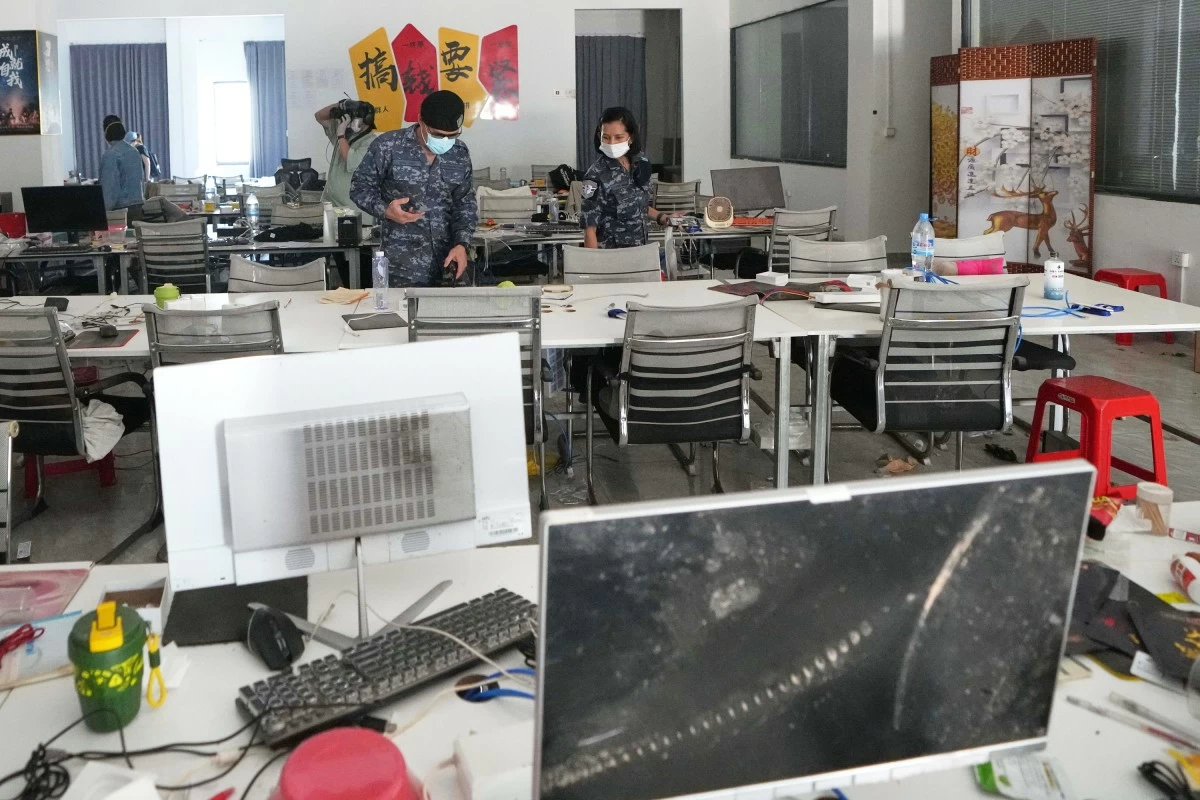
Thai soldiers inspect a workstation at the scam compound in O'Smach, Cambodia, April 7, 2026. (AP file photo)
PHNOM PENH, Cambodia (AP) — Cambodia, notorious for being a major center for international online scams, claimed Friday it no longer hosts any of the compounds where the lucrative cybercrime was carried out, although some remain skeptical.
The government’s Ad-Hoc Commission for Combating Online Scams, CCOS, claimed success for its crackdown at a Thursday meeting with about 50 representatives of foreign diplomatic missions and international organizations led by Senior Minister Chhay Sinarith, who heads the anti-scam agency, it said in a statement issued Friday.
“This follows the complete eradication of large-scale online scam operations, strict legal actions against perpetrators, networks and involved officials, alongside the systematic establishment of a cybersecurity legal framework,” it said.
Chhay Sinarith's claims were met with both skepticism and guarded optimism from independent groups that have tracked the scam compounds, which are infamous not only for bilking billions of dollars from people all over the world, but also for carrying out human trafficking.
Thousands of foreign nationals, who are employed to run “romance” and cryptocurrency scams to swindle victims, are often recruited with false job offers and then forced to work in conditions of near-slavery.
Such scams caused estimated combined losses of $88.3 billion to $114.1 billion in 2025, said a report in July by the United Nations Office on Drugs and Crime.
“The strong confidence placed in the (Cambodian) government’s assertion that all scamming operations in Cambodia have been eradicated is severely misplaced,” Mark Taylor, an independent international anti-trafficking consultant and former head of an anti-trafficking program in Cambodia, told The Associated Press.
“There are credible indicators that significant scamming operations continue and that recruitment of foreign workers into Cambodia for scamming work continues."
Blue Dragon Children’s Foundation, a Vietnam-based anti-human trafficking organization, took more of a wait-and-see attitude.
“There is no doubt that some of Cambodia’s criminal compounds used for online scamming have closed,” said Michael Brosowski, the group’s founder and strategic director, citing a drastic decrease in calls from people who have been trafficked, although the calls have not stopped.
“We hope that the Cambodian government will keep its commitment to close down these compounds and give greater protection to victims of this crime."
Chhay Sinarith said that from July 2025 to Aug. 20, 2026, law enforcement forces investigated 793 suspected scam locations and raided 624 sites, while detaining nearly 30,000 suspects representing 39 nationalities.
Cambodian authorities rescued and deported 58,266 foreign nationals, he said, and 3,477 criminal suspects from 29 nationalities were arrested and placed in pretrial detention.
The crackdown was highlighted by the takedown of two alleged kingpins of the illicit trade, Chen Zhi and Li Xiong, influential Chinese businessmen who had also become Cambodian citizens and were extradited earlier this year after their arrests.
Cambodian lawmakers unanimously adopted a new law in March targeting online scam operations with sentences of up to life in prison, following a government pledge to shut down the centers by the end of April.
ADVERTISEMENT
.most-popular .layout-ratio{ padding-bottom: 79.13%; } @media (min-width: 768px) and (max-width: 1024px) { .widget-title { font-size: 15px !important; } }

{{ articles_filter_1561_widget.title }}

.most-popular .layout-ratio{ padding-bottom: 79.13%; } @media (min-width: 768px) and (max-width: 1024px) { .widget-title { font-size: 15px !important; } }

{{ static_articles_1562_widget.title }}

.most-popular .layout-ratio{ padding-bottom: 79.13%; } @media (min-width: 768px) and (max-width: 1024px) { .widget-title { font-size: 15px !important; } }

{{ articles_filter_1563_widget.title }}

{{ articles_filter_1564_widget.title }}

.mb-article-details { position: relative; } .mb-article-details .article-body-preview, .mb-article-details .article-body-summary{ font-size: 17px; line-height: 30px; font-family: "Libre Caslon Text", serif; color: #000; } .mb-article-details .article-body-preview iframe , .mb-article-details .article-body-summary iframe{ width: 100%; margin: auto; } .read-more-background { background: linear-gradient(180deg, color(display-p3 1.000 1.000 1.000 / 0) 13.75%, color(display-p3 1.000 1.000 1.000 / 0.8) 30.79%, color(display-p3 1.000 1.000 1.000) 72.5%); position: absolute; height: 200px; width: 100%; bottom: 0; display: flex; justify-content: center; align-items: center; padding: 0; } .read-more-background a{ color: #000; } .read-more-btn { padding: 17px 45px; font-family: Inter; font-weight: 700; font-size: 18px; line-height: 16px; text-align: center; vertical-align: middle; border: 1px solid black; background-color: white; } .hidden { display: none; }
function initializeAllSwipers() { // Get all hidden inputs with cms_article_id document.querySelectorAll('[id^="cms_article_id_"]').forEach(function (input) { const cmsArticleId = input.value; const articleSelector = '#article-' + cmsArticleId + ' .body_images'; const swiperElement = document.querySelector(articleSelector); if (swiperElement && !swiperElement.classList.contains('swiper-initialized')) { new Swiper(articleSelector, { loop: true, pagination: false, navigation: { nextEl: '#article-' + cmsArticleId + ' .swiper-button-next', prevEl: '#article-' + cmsArticleId + ' .swiper-button-prev', }, }); } }); } setTimeout(initializeAllSwipers, 3000); const intersectionObserver = new IntersectionObserver( (entries) => { entries.forEach((entry) => { if (entry.isIntersecting) { const newUrl = entry.target.getAttribute("data-url"); if (newUrl) { history.pushState(null, null, newUrl); let article = entry.target; // Extract metadata const author = article.querySelector('.author-section').textContent.replace('By', '').trim(); const section = article.querySelector('.section-info ').textContent.replace(' ', ' '); const title = article.querySelector('.article-title h1').textContent; // Parse URL for Chartbeat path format const parsedUrl = new URL(newUrl, window.location.origin); const cleanUrl = parsedUrl.host + parsedUrl.pathname; // Update Chartbeat configuration if (typeof window._sf_async_config !== 'undefined') { window._sf_async_config.path = cleanUrl; window._sf_async_config.sections = section; window._sf_async_config.authors = author; } // Track virtual page view with Chartbeat if (typeof pSUPERFLY !== 'undefined' && typeof pSUPERFLY.virtualPage === 'function') { try { pSUPERFLY.virtualPage({ path: cleanUrl, title: title, sections: section, authors: author }); } catch (error) { console.error('ping error', error); } } // Optional: Update document title if (title && title !== document.title) { document.title = title; } } } }); }, { threshold: 0.1 } ); function showArticleBody(button) { const article = button.closest("article"); const summary = article.querySelector(".article-body-summary"); const body = article.querySelector(".article-body-preview"); const readMoreSection = article.querySelector(".read-more-background"); // Hide summary and read-more section summary.style.display = "none"; readMoreSection.style.display = "none"; // Show the full article body body.classList.remove("hidden"); } document.addEventListener("DOMContentLoaded", () => { let loadCount = 0; // Track how many times articles are loaded const offset = [1, 2, 3, 4, 5, 6, 7, 8, 9, 10]; // Offset values const currentUrl = window.location.pathname.substring(1); let isLoading = false; // Prevent multiple calls if (!currentUrl) { console.log("Current URL is invalid."); return; } const sentinel = document.getElementById("load-more-sentinel"); if (!sentinel) { console.log("Sentinel element not found."); return; } function isSentinelVisible() { const rect = sentinel.getBoundingClientRect(); return ( rect.top < window.innerHeight && rect.bottom >= 0 ); } function onScroll() { if (isLoading) return; if (isSentinelVisible()) { if (loadCount >= offset.length) { console.log("Maximum load attempts reached."); window.removeEventListener("scroll", onScroll); return; } isLoading = true; const currentOffset = offset[loadCount]; window.loadMoreItems().then(() => { let article = document.querySelector('#widget_1690 > div:nth-last-of-type(2) article'); intersectionObserver.observe(article) loadCount++; }).catch(error => { console.error("Error loading more items:", error); }).finally(() => { isLoading = false; }); } } window.addEventListener("scroll", onScroll); });

Sign up by email to receive news.