ADVERTISEMENT

Why a newly formed lake is sparking fears of more flooding along the Nepal-China border

Published Aug 28, 2026 09:10 pm
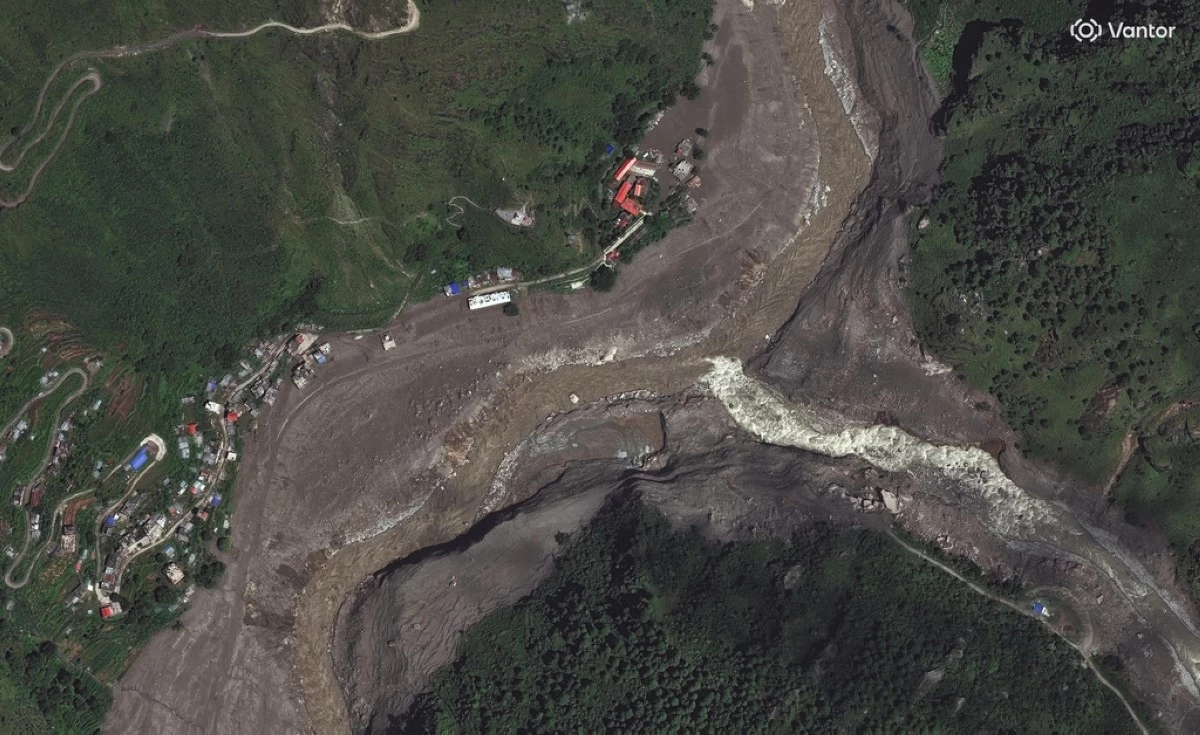
This satellite image provided by Vantor shows destruction at Syapru Besi, Nepal on Thursday, Aug. 27, 2026. (Satellite image ©2026 Vantor via AP)
BENGALURU, India (AP) — Even as rescuers worked through mud and debris Friday in areas devastated by a catastrophic flash flood along the Himalayan border between Nepal and China, authorities warned that a newly formed, overflowing lake could trigger further flooding.
Nepalese authorities said all security personnel, rescue workers and members of the public deployed in rescue and relief efforts have been told to remain on high alert and immediately move to a safe location if necessary.
Nepal police spokesperson Abi Narayan Kafle told The Associated Press that the rescue operation is continuing but with authorities remaining on high alert.
"It hasn't stopped," he said.
Where is the lake?
Satellite imagery shown by Chinese state broadcaster CCTV seems to indicate that the newly formed lake was in the same area as where the glacial detachment event happened on Wednesday that resulted in the chain of events leading to catastrophic damage downstream.
Nepal's disaster management authority said that satellite imagery and preliminary assessments indicate that the river has been blocked upstream, creating a growing lake that could burst and trigger a sudden downstream flood.
CCTV reported Friday morning that the lake's barrier was more than 10 kilometers (6 miles) from Gyirong Port, the border crossing with Nepal that was engulfed by mud and floodwater.
The broadcaster said that the lake was at an elevation of 2,950 meters (9,680 feet), about 1,000 meters (3,280 feet) above Gyirong Port.
How did it form?
Climate scientists tracking developments in the Himalayan region said that Wednesday's glacial collapse has resulted in several small water bodies forming as debris is still strewn across the region.
"Another dammed lake was formed by the August 26th ice-rock avalanche and this has begun to outflow," said Qianggong Zhang of the International Center for Integrated Mountain Development.
The lake holds a few million cubic meters of water and is located in a valley section with a limited elevation drop to downstream areas, said Zhang, who is head of climate and environmental risks at the Kathmandu-based climate research group.
The amount of water is the equivalent of around 1,200 Olympic-sized swimming pools.
What are the concerns?
With hundreds killed and more than 1,500 people missing and as the region tries to recover from the catastrophe, the possibility of another disaster has sent alarm bells ringing.
"There is still a lot of glacial melts going on because of high temperatures and the water is accumulating at various points, as there is bound to be a lot of debris and rock on the river's path," said Jakob Steiner, a geoscientist at the University of Graz in Austria who is based in Dhaka, Bangladesh.
Both Zhang and Steiner said that the alerts should be taken seriously, as many rescuers are putting themselves at great risk to find the missing, but it's unlikely that a flash flood as devastating as the one on Wednesday will happen again.

Related Tags

world news Nepal China Lake flood
ADVERTISEMENT
.most-popular .layout-ratio{ padding-bottom: 79.13%; } @media (min-width: 768px) and (max-width: 1024px) { .widget-title { font-size: 15px !important; } }

{{ articles_filter_1561_widget.title }}

.most-popular .layout-ratio{ padding-bottom: 79.13%; } @media (min-width: 768px) and (max-width: 1024px) { .widget-title { font-size: 15px !important; } }

{{ static_articles_1562_widget.title }}

.most-popular .layout-ratio{ padding-bottom: 79.13%; } @media (min-width: 768px) and (max-width: 1024px) { .widget-title { font-size: 15px !important; } }

{{ articles_filter_1563_widget.title }}

{{ articles_filter_1564_widget.title }}

.mb-article-details { position: relative; } .mb-article-details .article-body-preview, .mb-article-details .article-body-summary{ font-size: 17px; line-height: 30px; font-family: "Libre Caslon Text", serif; color: #000; } .mb-article-details .article-body-preview iframe , .mb-article-details .article-body-summary iframe{ width: 100%; margin: auto; } .read-more-background { background: linear-gradient(180deg, color(display-p3 1.000 1.000 1.000 / 0) 13.75%, color(display-p3 1.000 1.000 1.000 / 0.8) 30.79%, color(display-p3 1.000 1.000 1.000) 72.5%); position: absolute; height: 200px; width: 100%; bottom: 0; display: flex; justify-content: center; align-items: center; padding: 0; } .read-more-background a{ color: #000; } .read-more-btn { padding: 17px 45px; font-family: Inter; font-weight: 700; font-size: 18px; line-height: 16px; text-align: center; vertical-align: middle; border: 1px solid black; background-color: white; } .hidden { display: none; }
function initializeAllSwipers() { // Get all hidden inputs with cms_article_id document.querySelectorAll('[id^="cms_article_id_"]').forEach(function (input) { const cmsArticleId = input.value; const articleSelector = '#article-' + cmsArticleId + ' .body_images'; const swiperElement = document.querySelector(articleSelector); if (swiperElement && !swiperElement.classList.contains('swiper-initialized')) { new Swiper(articleSelector, { loop: true, pagination: false, navigation: { nextEl: '#article-' + cmsArticleId + ' .swiper-button-next', prevEl: '#article-' + cmsArticleId + ' .swiper-button-prev', }, }); } }); } setTimeout(initializeAllSwipers, 3000); const intersectionObserver = new IntersectionObserver( (entries) => { entries.forEach((entry) => { if (entry.isIntersecting) { const newUrl = entry.target.getAttribute("data-url"); if (newUrl) { history.pushState(null, null, newUrl); let article = entry.target; // Extract metadata const author = article.querySelector('.author-section').textContent.replace('By', '').trim(); const section = article.querySelector('.section-info ').textContent.replace(' ', ' '); const title = article.querySelector('.article-title h1').textContent; // Parse URL for Chartbeat path format const parsedUrl = new URL(newUrl, window.location.origin); const cleanUrl = parsedUrl.host + parsedUrl.pathname; // Update Chartbeat configuration if (typeof window._sf_async_config !== 'undefined') { window._sf_async_config.path = cleanUrl; window._sf_async_config.sections = section; window._sf_async_config.authors = author; } // Track virtual page view with Chartbeat if (typeof pSUPERFLY !== 'undefined' && typeof pSUPERFLY.virtualPage === 'function') { try { pSUPERFLY.virtualPage({ path: cleanUrl, title: title, sections: section, authors: author }); } catch (error) { console.error('ping error', error); } } // Optional: Update document title if (title && title !== document.title) { document.title = title; } } } }); }, { threshold: 0.1 } ); function showArticleBody(button) { const article = button.closest("article"); const summary = article.querySelector(".article-body-summary"); const body = article.querySelector(".article-body-preview"); const readMoreSection = article.querySelector(".read-more-background"); // Hide summary and read-more section summary.style.display = "none"; readMoreSection.style.display = "none"; // Show the full article body body.classList.remove("hidden"); } document.addEventListener("DOMContentLoaded", () => { let loadCount = 0; // Track how many times articles are loaded const offset = [1, 2, 3, 4, 5, 6, 7, 8, 9, 10]; // Offset values const currentUrl = window.location.pathname.substring(1); let isLoading = false; // Prevent multiple calls if (!currentUrl) { console.log("Current URL is invalid."); return; } const sentinel = document.getElementById("load-more-sentinel"); if (!sentinel) { console.log("Sentinel element not found."); return; } function isSentinelVisible() { const rect = sentinel.getBoundingClientRect(); return ( rect.top < window.innerHeight && rect.bottom >= 0 ); } function onScroll() { if (isLoading) return; if (isSentinelVisible()) { if (loadCount >= offset.length) { console.log("Maximum load attempts reached."); window.removeEventListener("scroll", onScroll); return; } isLoading = true; const currentOffset = offset[loadCount]; window.loadMoreItems().then(() => { let article = document.querySelector('#widget_1690 > div:nth-last-of-type(2) article'); intersectionObserver.observe(article) loadCount++; }).catch(error => { console.error("Error loading more items:", error); }).finally(() => { isLoading = false; }); } } window.addEventListener("scroll", onScroll); });

Sign up by email to receive news.