ADVERTISEMENT

Death toll rises in Nepal-China border disaster as lake poses new flood threat

Published Aug 28, 2026 01:38 pm
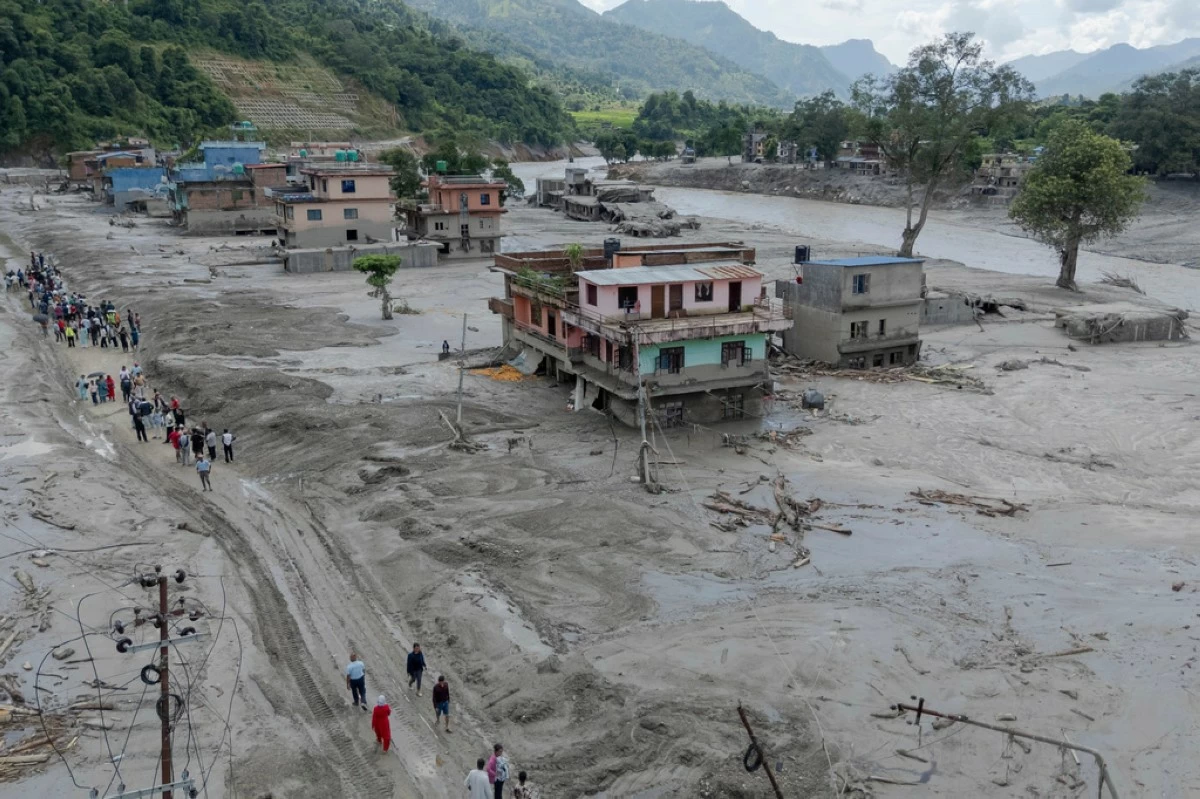
In this photo released by Xinhua News Agency, a drone photo shows a flood-hit area in Nuwakot, Nepal on Thursday, Aug. 27, 2026. (Sulav Shrestha/Xinhua via AP)
KATHMANDU, Nepal (AP) — Rescuers were racing to find hundreds of people still missing two days after a catastrophic flash flood struck the Himalayan border between Nepal and China, as the death toll rose Friday and authorities warned that an overflowing lake formed after the disaster could trigger further flooding.
Nepal police said Friday morning that the country’s death toll had risen to 469 from 390 a day earlier, while China had not updated its report of just three deaths in Tibet. Together, the two countries have said that more than 1,500 people are missing.
Nepali and Chinese authorities warned of further flooding from a lake that formed upstream after Wednesday’s disaster and was already overflowing. They urged people in potentially affected areas to move to safer ground. China’s Ministry of Water Resources said Thursday that the lake held around 2 million cubic meters (70 million cubic feet) of water and was expected to receive another 3 million cubic meters (106 million cubic feet) over the next three days.
Chinese state broadcaster CCTV reported Friday morning that the lake’s barrier was more than 10 kilometers (6 miles) from Gyirong Port, the border crossing with Nepal that was engulfed by mud and floodwater.
CCTV said the lake was at an elevation of 2,950 meters (9,680 feet), about 1,000 meters (3,280 feet) above Gyirong Port.
Nepal Army said that a team was sent to the border point to inspect the Bhotekoshi River amid the potential of more floods.
Thousands of people have been evacuated
Nepal’s National Disaster Risk Reduction and Management Authority said Friday that 3,253 people had been airlifted by helicopter from the country’s disaster area.
Flood survivors, including injured people, were taken to Kathmandu and other locations. Foreigners from multiple countries were among the missing, many of them trekkers and pilgrims.
Nepali Army spokesperson Brig. Gen. Raja Ram Basnet told The Associated Press that a team had been deployed Friday to the Upper Trishuli-1 Hydropower Project near the Nepal-China border following reports that people were trapped inside a tunnel.
“It is complicated to find the entry and exit points of the tunnel because everything has been covered by mud,” Basnet said. “Our first priority is rescuing the stranded people.”
Videos of the disaster showed floodwaters destroying buildings, bridges and vehicles as people ran in front of the stories-high torrent. In the aftermath, broken concrete lay upended in expanses of brown mud that also caked buildings and buried streets.
Families around the world hear the news of missing loved ones
Rajan Tamang, a restaurant owner in New York City, said he learned from family in Kathmandu that his mother and sister were among those who died, while many other relatives and friends remained missing.
“My family was just waking up, and they didn’t even get any information, and suddenly this flood came. Some of them are missing, some of them lost their life and only a few is alive,” he told The Associated Press after a vigil in New York.
U.S. President Donald Trump said the flooding was terrible to see, describing how “strong, well-built buildings were wiped out like they were toothpicks.”
Speaking to reporters in the Oval Office, Trump said the U.S. spoke with Nepalese leaders and offered to provide “anything they want.”
Scientists who've studied satellite images said bedrock underneath a glacier high in the Himalayan region had collapsed, taking part of the glacier with it. The rocks and melted water swelled the rivers in the valleys below, causing a torrent of water that swept buildings, bridges and earth downstream.

Related Tags

world news Nepal flash flood disaster
ADVERTISEMENT
.most-popular .layout-ratio{ padding-bottom: 79.13%; } @media (min-width: 768px) and (max-width: 1024px) { .widget-title { font-size: 15px !important; } }

{{ articles_filter_1561_widget.title }}

.most-popular .layout-ratio{ padding-bottom: 79.13%; } @media (min-width: 768px) and (max-width: 1024px) { .widget-title { font-size: 15px !important; } }

{{ static_articles_1562_widget.title }}

.most-popular .layout-ratio{ padding-bottom: 79.13%; } @media (min-width: 768px) and (max-width: 1024px) { .widget-title { font-size: 15px !important; } }

{{ articles_filter_1563_widget.title }}

{{ articles_filter_1564_widget.title }}

.mb-article-details { position: relative; } .mb-article-details .article-body-preview, .mb-article-details .article-body-summary{ font-size: 17px; line-height: 30px; font-family: "Libre Caslon Text", serif; color: #000; } .mb-article-details .article-body-preview iframe , .mb-article-details .article-body-summary iframe{ width: 100%; margin: auto; } .read-more-background { background: linear-gradient(180deg, color(display-p3 1.000 1.000 1.000 / 0) 13.75%, color(display-p3 1.000 1.000 1.000 / 0.8) 30.79%, color(display-p3 1.000 1.000 1.000) 72.5%); position: absolute; height: 200px; width: 100%; bottom: 0; display: flex; justify-content: center; align-items: center; padding: 0; } .read-more-background a{ color: #000; } .read-more-btn { padding: 17px 45px; font-family: Inter; font-weight: 700; font-size: 18px; line-height: 16px; text-align: center; vertical-align: middle; border: 1px solid black; background-color: white; } .hidden { display: none; }
function initializeAllSwipers() { // Get all hidden inputs with cms_article_id document.querySelectorAll('[id^="cms_article_id_"]').forEach(function (input) { const cmsArticleId = input.value; const articleSelector = '#article-' + cmsArticleId + ' .body_images'; const swiperElement = document.querySelector(articleSelector); if (swiperElement && !swiperElement.classList.contains('swiper-initialized')) { new Swiper(articleSelector, { loop: true, pagination: false, navigation: { nextEl: '#article-' + cmsArticleId + ' .swiper-button-next', prevEl: '#article-' + cmsArticleId + ' .swiper-button-prev', }, }); } }); } setTimeout(initializeAllSwipers, 3000); const intersectionObserver = new IntersectionObserver( (entries) => { entries.forEach((entry) => { if (entry.isIntersecting) { const newUrl = entry.target.getAttribute("data-url"); if (newUrl) { history.pushState(null, null, newUrl); let article = entry.target; // Extract metadata const author = article.querySelector('.author-section').textContent.replace('By', '').trim(); const section = article.querySelector('.section-info ').textContent.replace(' ', ' '); const title = article.querySelector('.article-title h1').textContent; // Parse URL for Chartbeat path format const parsedUrl = new URL(newUrl, window.location.origin); const cleanUrl = parsedUrl.host + parsedUrl.pathname; // Update Chartbeat configuration if (typeof window._sf_async_config !== 'undefined') { window._sf_async_config.path = cleanUrl; window._sf_async_config.sections = section; window._sf_async_config.authors = author; } // Track virtual page view with Chartbeat if (typeof pSUPERFLY !== 'undefined' && typeof pSUPERFLY.virtualPage === 'function') { try { pSUPERFLY.virtualPage({ path: cleanUrl, title: title, sections: section, authors: author }); } catch (error) { console.error('ping error', error); } } // Optional: Update document title if (title && title !== document.title) { document.title = title; } } } }); }, { threshold: 0.1 } ); function showArticleBody(button) { const article = button.closest("article"); const summary = article.querySelector(".article-body-summary"); const body = article.querySelector(".article-body-preview"); const readMoreSection = article.querySelector(".read-more-background"); // Hide summary and read-more section summary.style.display = "none"; readMoreSection.style.display = "none"; // Show the full article body body.classList.remove("hidden"); } document.addEventListener("DOMContentLoaded", () => { let loadCount = 0; // Track how many times articles are loaded const offset = [1, 2, 3, 4, 5, 6, 7, 8, 9, 10]; // Offset values const currentUrl = window.location.pathname.substring(1); let isLoading = false; // Prevent multiple calls if (!currentUrl) { console.log("Current URL is invalid."); return; } const sentinel = document.getElementById("load-more-sentinel"); if (!sentinel) { console.log("Sentinel element not found."); return; } function isSentinelVisible() { const rect = sentinel.getBoundingClientRect(); return ( rect.top < window.innerHeight && rect.bottom >= 0 ); } function onScroll() { if (isLoading) return; if (isSentinelVisible()) { if (loadCount >= offset.length) { console.log("Maximum load attempts reached."); window.removeEventListener("scroll", onScroll); return; } isLoading = true; const currentOffset = offset[loadCount]; window.loadMoreItems().then(() => { let article = document.querySelector('#widget_1690 > div:nth-last-of-type(2) article'); intersectionObserver.observe(article) loadCount++; }).catch(error => { console.error("Error loading more items:", error); }).finally(() => { isLoading = false; }); } } window.addEventListener("scroll", onScroll); });

Sign up by email to receive news.