






Manila Bulletin
 Philippines
Mindanao
Davao Region remains Mindanao's largest economy with P1.14-T GRDP
Philippines
Mindanao
Davao Region remains Mindanao's largest economy with P1.14-T GRDP
Philippines
Mindanao
Davao Region remains Mindanao's largest economy with P1.14-T GRDP
Davao Region remains Mindanao's largest economy with P1.14-T GRDP
By Ivy Tejano
Published Aug 24, 2026 05:12 pm


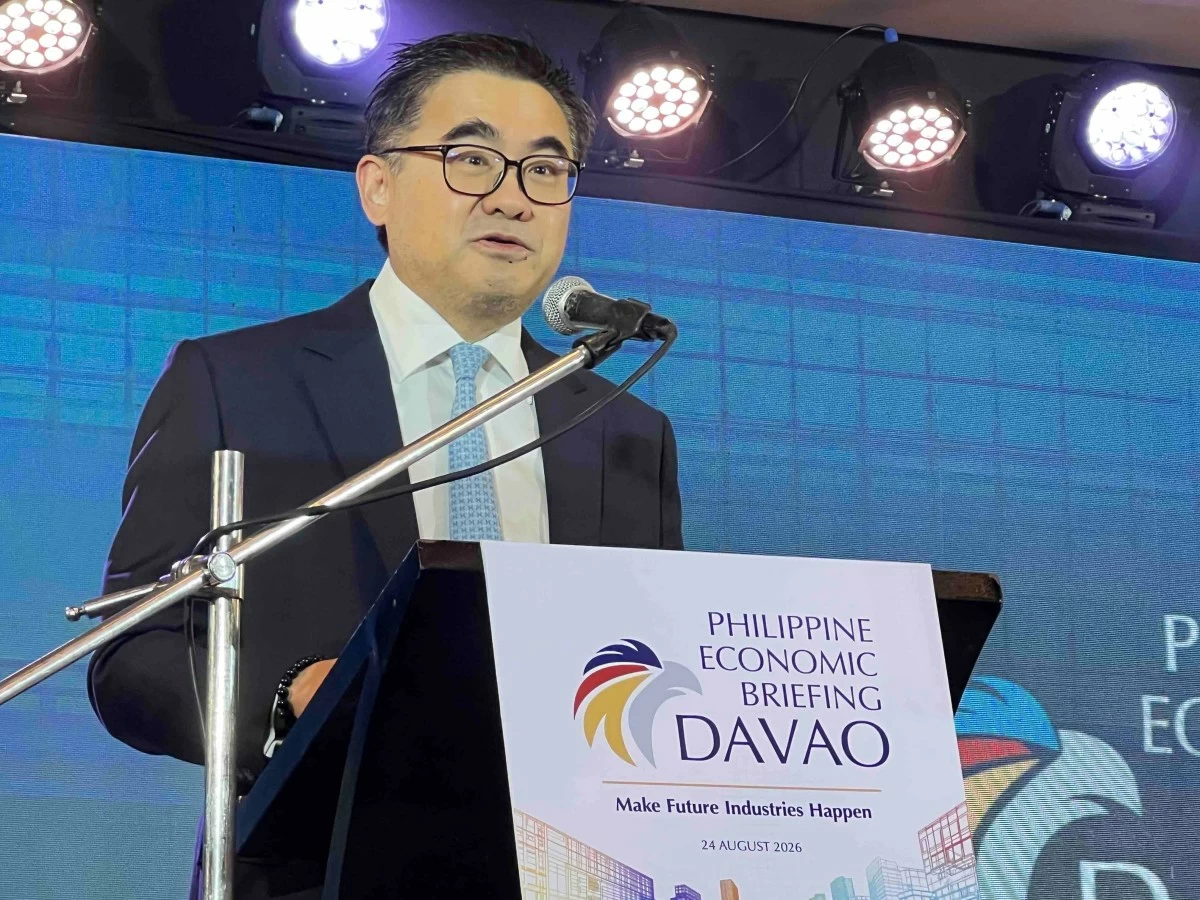
Department of Finance Secretary Frederick D. Go announced on Monday, Aug. 24, that Davao Region remains Mindanao’s first largest economy with a 2025 GRDP of P1.14 trillion. Go delivers the closing keynote address during the Philippine Economic Briefing–Davao organized by the Bangko Sentral ng Pilipinas, along with the Board of Investment and DOF, in Davao City. (Photo via Ivy Tejano / MB)
DAVAO CITY – Davao Region continues to be Mindanao’s largest economy in 2025, posting a gross regional domestic product (GRDP) of P1.14 trillion and growing 5.1 percent, according to Department of Finance (DOF) Secretary Frederick D. Go on Monday, August 24.
Go stressed this as he delivered the closing keynote address at the Philippine Economic Briefing–Davao that was organized by the Bangko Sentral ng Pilipinas (BSP), the Board of Investment (BOI) and DOF, and held at the DusitD2 Hotel in Lanang, Davao City.
The region’s growth outpaced the country’s 4.4-percent expansion, making Davao the fifth-largest and fourth-fastest-growing regional economy in the Philippines, Go said before business leaders, industry representatives, chambers, and civil society groups.
The briefing highlighted the country’s economic outlook, key reforms, and investment priorities while showcasing opportunities across Mindanao’s strategic sectors, including infrastructure, agriculture, energy, manufacturing, tourism, logistics, and digital services.
“Davao is an important part of the Philippine growth story. It is the economic center of Mindanao. The region has been connecting businesses, employees, capital, and markets,” Go said.
He also described Davao City as one of the fastest-growing, highly urbanized cities in the country, underscoring its role as a regional economic hub and gateway to Mindanao.
Go urged investors to expand in Mindanao, saying the region is positioned to play a larger role in the next phase of Philippine economic growth as the government pursues investment reforms, infrastructure development, and measures to lower the cost of doing business.
He said Mindanao’s investment story is moving beyond its traditional strengths in agriculture, minerals, energy, and human capital toward higher-value industries, better jobs, and more sustainable growth.
The finance secretary emphasized the government’s role in creating conditions that would allow economic growth to translate into more jobs, investments, and opportunities for Filipinos.
Among the reforms he highlighted were the CREATE MORE Act, the new Public-Private Partnership Code, the amended Investors’ Lease Act, green lanes for strategic investments, reforms in right-of-way acquisition, the Capital Markets Efficiency Promotion Act, and the enhanced mining fiscal regime.
The amended Investors’ Lease Act allows land leases of up to 99 years, while the Capital Markets Efficiency Promotion Act reduced the stock transaction tax from 0.6 percent to 0.1 percent, Go said.
Go also highlighted efforts by government agencies to reduce friction costs for businesses.
At the Securities and Exchange Commission (SEC), registration and securities registration fees were reduced to help micro, small and medium enterprises formalize and access financing, while the cost of obtaining official SEC documents was also lowered.
In the Bureau of Customs (BOC), the validity of importer accreditation was extended from one year to three years, reducing the need for annual renewal.
Meanwhile, the Bureau of Internal Revenue (BIR) reduced the creditable withholding tax rate for local wholesale manufacturers and direct importers of motor vehicles, medicines, fuels, and related products from one percent to 0.5 percent, Go said.
On infrastructure, Go said the government’s public-private partnership reforms were already producing results, citing the privatization of the Manila, Bohol-Panglao, and Laguindingan international airports during the first half of the administration’s term.
The PPP Center currently has 209 flagship infrastructure projects, 49 of which are under public-private partnership arrangements, covering sectors such as education, healthcare, and transportation, he said.
Go said the 2026 Strategic Investment Priority Plan, approved in June, would steer investments toward priority sectors and help businesses maximize incentives under the CREATE MORE Act.
Despite slower economic growth in the second half of 2025 and the first half of 2026, Go said the country’s long-term fundamentals remain intact, citing firm domestic demand, continued export growth, strong revenue performance, overseas Filipino remittances, and expansion in the business process outsourcing sector.
He said remittances grew by 3.3 percent to $35.6 billion in 2025, while the BPO industry expanded by 5.3 percent to $40 billion. Total exports increased by 8.7 percent to $115 billion, with goods exports reaching a 15-year high of $84.5 billion.
Go attributed the recent slowdown largely to lower government spending and said the administration intends to accelerate public infrastructure expenditures in the second half of the year and return to more normal spending levels in 2027.
He said economic growth is expected to return to the five- to six-percent range as temporary shocks ease and infrastructure spending resumes.
Go also cited the Philippines’ recent move into the World Bank’s upper-middle-income category, saying the development could improve access to financing, strengthen the country’s credit profile, and boost investor confidence.
He said national government debt stood at around 64 percent of gross domestic product at the end of 2025, while general government debt was about 57 percent, leaving fiscal space relative to the World Bank’s cited 70 percent threshold for general government debt-to-GDP.
The finance secretary also pointed to the planned inclusion of peso-denominated Philippine government bonds in JPMorgan’s Government Bond Index-Emerging Markets in 2027 as a development that could help reduce borrowing costs for the government, businesses, and consumers.
Go said the government is also expanding the country’s trade network, with four bilateral and eight ASEAN-related trade agreements currently in place and eight additional free trade agreements under negotiation.
He said the Philippines had recently concluded agreements with Chile and South Korea, while negotiations with Canada and the European Union remain among the government’s anticipated trade deals.
Go also cited major investments as signs of improving investor confidence, including HD Hyundai’s roughly $ 300 million investment in Subic and Mitsubishi Motors’ planned P7 Billion investment in Santa Rosa, Laguna, which is expected to produce about 60,000 vehicles annually once fully operational.
For Mindanao, Go said opportunities remain substantial but will require cooperation among the national government, local governments, the private sector, and development partners.
He called on business leaders and industry partners to invest, build, and grow in Mindanao, helping develop globally competitive industries and create more opportunities for Filipinos.
The PEB in Davao, Go said, reinforces the administration’s commitment to integrating Mindanao’s growth opportunities into the national economic agenda and ensuring that the region’s economic gains translate into broader development.
“The next chapter of Philippine growth will be shaped in Mindanao. So let us make future industries happen here and in the Philippines,” Go said.