






 Business
The Economy
Is Philippines in 'stagflation lite'? Balisacan, Remolona say not quite
Business
The Economy
Is Philippines in 'stagflation lite'? Balisacan, Remolona say not quite
Is Philippines in 'stagflation lite'? Balisacan, Remolona say not quite


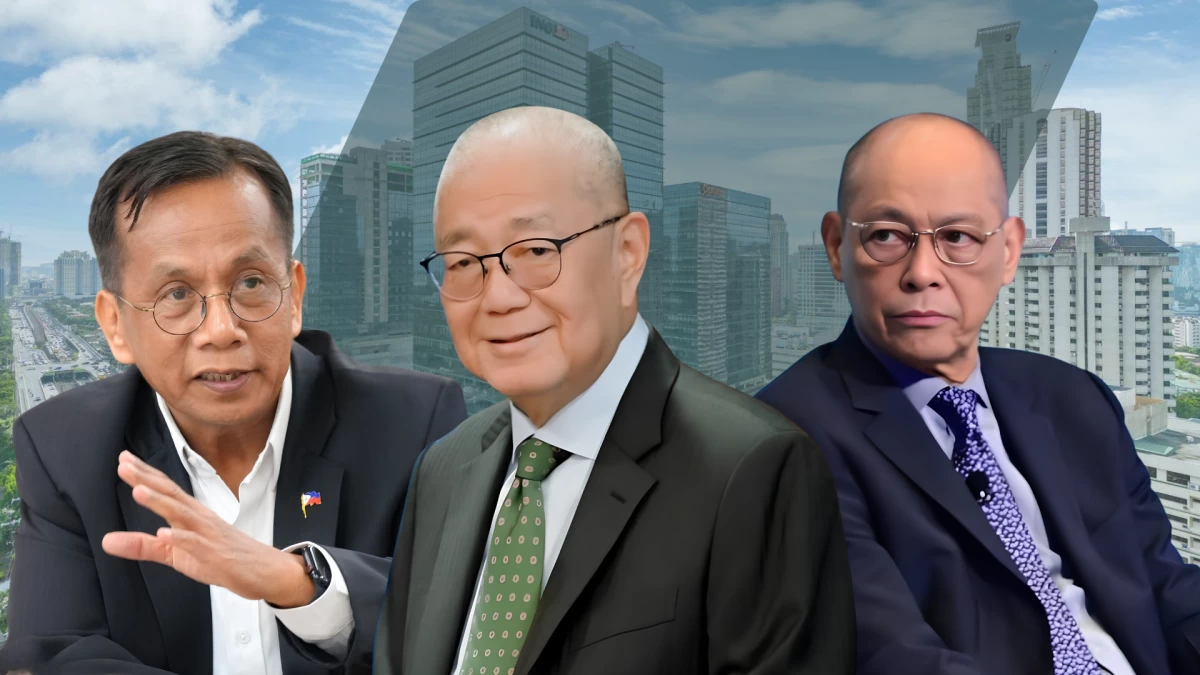
The Philippines remains far from stagflation despite high inflation and sluggish economic growth, members of the Marcos Jr. administration’s economic team said, pushing back against Monetary Board Member (MBM) Benjamin E. Diokno’s characterization of the current situation as “stagflation lite.”
Stagflation is generally understood as the simultaneous occurrence of elevated inflation, stagnant economic growth, and high unemployment, although economists do not have universally accepted numerical thresholds for determining when an economy has entered such a period.
Speaking at the Economic Journalists Association of the Philippines (EJAP) Economic Forum last Friday, Aug. 14, Department of Economy, Planning, and Development (DEPDev) Secretary Arsenio M. Balisacan said calling the country’s present economic situation stagflation would be “stretching it too far.”
Balisacan, the country’s chief economist, said stagflation has no standard operational definition, unlike a recession, which is commonly associated with two consecutive quarters of economic contraction.
The economy expanded by just 2.3 percent year-on-year in the second quarter, slowing further from 2.8 percent in the first quarter and marking the weakest quarterly growth since the Covid-19 pandemic.
Balisacan noted that the latest growth rate remains above the country’s population growth of around 1.7 percent. He added that removing short-term “noise” from labor market data would still show declining trends in unemployment and underemployment.
His assessment differs from that of Diokno, a former Bangko Sentral ng Pilipinas (BSP) governor as well as former finance and budget secretary who currently sits on the BSP’s policy-making Monetary Board (MB).
As reported in Manila Bulletin’s The Daybreak Briefing newsletter last week, Diokno described the current economic situation as “stagflation lite,” arguing that low-income households are already bearing the brunt of high prices, shrinking job opportunities, and sluggish economic growth.
Diokno pointed to the dismal second-quarter gross domestic product (GDP) growth, which he said was roughly keeping pace with population growth and therefore translated into virtually no growth in output per person.
Balisacan, however, expects economic activity to improve in the second half of 2026, particularly if the government accelerates the utilization of public funds following a contraction of nearly 30 percent in public spending for two consecutive quarters.
The DEPDev chief acknowledged that a potentially severe El Niño poses a downside risk to the outlook, although he expressed hope that its impact on the Philippines would be less severe than currently predicted internationally.
BSP Governor Eli M. Remolona Jr. likewise said stagflation is not a useful description of current economic conditions, arguing that the term usually entails an outright economic contraction.
“Stagflation usually means negative growth. We’re still growing. But what’s also true is we’re below potential,” Remolona said.
The BSP chief said the Philippine economy’s potential growth is around five to six percent, or possibly close to 5.8 percent based on growth achieved in recent years.
With actual GDP growth running substantially below that level, Remolona said the economy is experiencing a negative output gap, or a situation in which actual economic activity falls below its potential.
The output gap, rather than whether the economy can be labeled as experiencing stagflation, matters for monetary policy because it allows the BSP to assess the weakness of economic activity alongside inflationary pressures.
According to Remolona, a negative output gap means the BSP can be less aggressive in raising its policy rate to contain inflation, as monetary authorities take into account both weak economic growth and their expectations for inflation.
“We don’t even think, are we in a stagflation or not? We don’t really care,” Remolona said.
The Philippine Statistics Authority (PSA) earlier reported that the unemployment rate rose year-on-year and month-on-month to 4.9 percent in June, equivalent to 2.59 million unemployed Filipinos.
Headline inflation, meanwhile, eased for the third consecutive month to 6.2 percent in July, but remained above the government’s two- to four-percent target range. - Danielle T. Bayani