






Manila Bulletin
 Philippines
National
Radioactive materials found at Davao steel plant; NBI, PAOCC rescue 174 workers
Philippines
National
Radioactive materials found at Davao steel plant; NBI, PAOCC rescue 174 workers
Philippines
National
Radioactive materials found at Davao steel plant; NBI, PAOCC rescue 174 workers
Radioactive materials found at Davao steel plant; NBI, PAOCC rescue 174 workers
Published Aug 14, 2026 03:14 pm


At A Glance
- The National Bureau of Investigation (NBI) and Presidential Anti-Organized Crime Commission (PAOCC) rescued 174 Filipino workers from Davao Mighty Steel Corp. after authorities allegedly found radioactive-bearing materials and substandard reinforcing steel bars at the facility.
- PAOCC said that tests detected Uranium-238, Thorium-228, Thorium-232 and Radium-226 in the plant and its products. Four of eight steel samples also failed the mandatory mass-variation requirement under PNS 49:2020, it added.
- Probe expands: The NBI referred the case to the DOJ for possible violations of nuclear safety, hazardous waste, environmental and consumer laws. Authorities will also trace affected steel products in the market, following a similar raid on Philippine Sanjia-Steel Corp. in Misamis Oriental where 69 Chinese nationals were arrested.
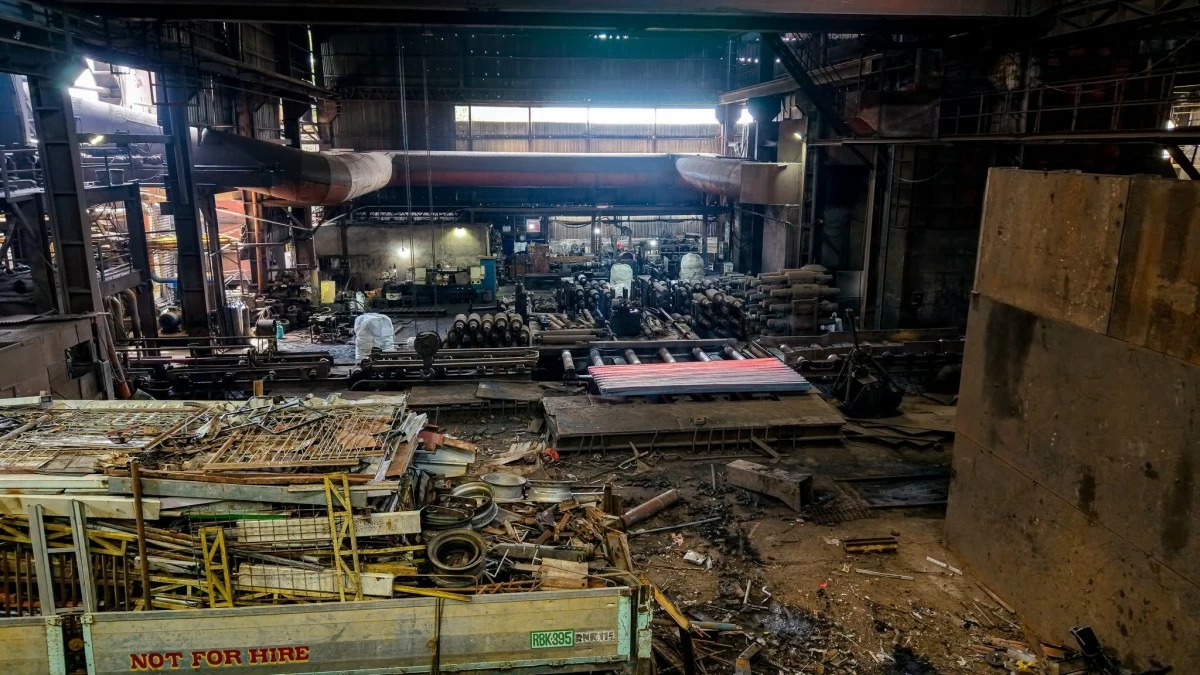
(Photo: Presidential Anti-Organized Crime Commission)
Law enforcement agents from the National Bureau of Investigation (NBI) and Presidential Anti-Organized Crime Commission (PAOCC) rescued 174 Filipino employees from a steel manufacturing facility in Davao City after inspectors allegedly found radioactive substances and questioned the quality of reinforcing bars being produced there, it was announced Friday, Aug. 14.
The operation at Davao Mighty Steel Corp. in Barangay Ilang, Bunawan was led by the National Bureau of Investigation (NBI) with the Presidential Anti-Organized Crime Commission (PAOCC) and several government security and technical units.
NBI Director Melvin Matibag and PAOCC Executive Director Undersecretary Benjamin C. Acorda Jr. went to Davao City as part of the operation which began with reports that the company was allegedly producing and distributing substandard reinforcing steel bars.
According to PAOCC, the Philippine Nuclear Research Institute (PNRI) detected radioactive isotopes in Davao Mighty Steel products already being sold commercially.
The NBI and PAOCC, with assistance from the PNRI, Philippine Air Force and Philippine Coast Guard CBRN units, PCG Special Operations Group and the 10th Infantry Division of the Philippine Army, implemented search warrants at the Davao Mighty Steel facility on Aug. 13.
The operation resulted in the rescue of the 174 workers from an environment that contained radioactive-bearing materials, dust, fumes, wastes and production residues.
‘Radioactive’
PAOCC said that technical examinations found Uranium-238, Thorium-228, Thorium-232 and Radium-226 in several parts of the plant as well as in finished Davao Mighty Steel reinforcing bars, furnace-related materials, residual black sand, industrial powders, dust, wastes, wastewater and other production and stored materials.
The PNRI also certified that the company and its identified officers and personnel had no license or authority to acquire, receive, possess, use, store, sell, transfer, import or export nuclear or radioactive materials.
The Department of Environment and Natural Resources (DENR) found a separate problem involving the company's environmental clearance after its inspection showed that the firm's Environmental Compliance Certificate (ECC) allegedly did not declare or authorize the presence, handling, processing, storage, or use of radioactive materials at the site.
The NBI also looked into the quality of steel products already circulating in Mindanao where it found out that out of eight Davao Mighty Steel reinforcing bar samples purchased from commercial hardware stores in the region, four failed the mandatory mass-variation requirement under PNS 49:2020, the quality standard set by the national government for reinforcing steel bars used in construction, which supposedly meant that 50 percent of the samples did not meet the prescribed standard.
Substandard?
Moreover, the findings raised another concern after investigators found Davao Mighty Steel-marked reinforcing bars among the debris of structures that collapsed following the magnitude 7.8 Mindanao earthquake on June 8.
PAOCC said the bars were documented in rubble from schools, hospitals, government buildings, barangay health centers and residences in parts of Sarangani, Davao del Sur, and Davao Occidental.
However, Acorda cautioned against immediately linking the steel to the structural failures.
He explained that the presence of the company's reinforcing bars in the collapsed structures does not by itself establish that the steel caused the collapses, stressing that determining the reasons for the failures remains subject to proper engineering assessment.
“We will follow the evidence, enforce the law, and ensure that those responsible are held accountable in accordance with law and due process,” Acorda said.
The NBI has referred the case to the Department of Justice for appropriate proceedings and it said possible violations include Republic Act No. 12305, or the Philippine National Nuclear Energy Safety Act; Republic Act No. 6969, or the Toxic Substances and Hazardous and Nuclear Wastes Control Act; Presidential Decree No. 1586, or the Philippine Environmental Impact Statement System; and Republic Act No. 7394, or the Consumer Act of the Philippines.
The PAOCC said the government would coordinate with the PNRI, DENR, Department of Trade and Industry, Department of Labor and Employment, Department of Health and other agencies to secure the radioactive-bearing materials and protect workers and nearby communities.
It said they will also trace steel products that may already be in the market and work to keep potentially unsafe reinforcing bars from entering the country's construction supply chain.
To recall, the NBI and PAOCC also raided a warehouse of the Philippine Sanjia-Steel Corp. (SANJIA) in Tagoloan, Misamis Oriental and arrested 69 Chinese nationals after authorities allegedly discovered radioactive materials at the steel products being produced there.