






 Business
Trade & Industry
Trump administration flags Philippines as 'weak link' in China tariff evasion network
Business
Trade & Industry
Trump administration flags Philippines as 'weak link' in China tariff evasion network
Trump administration flags Philippines as 'weak link' in China tariff evasion network


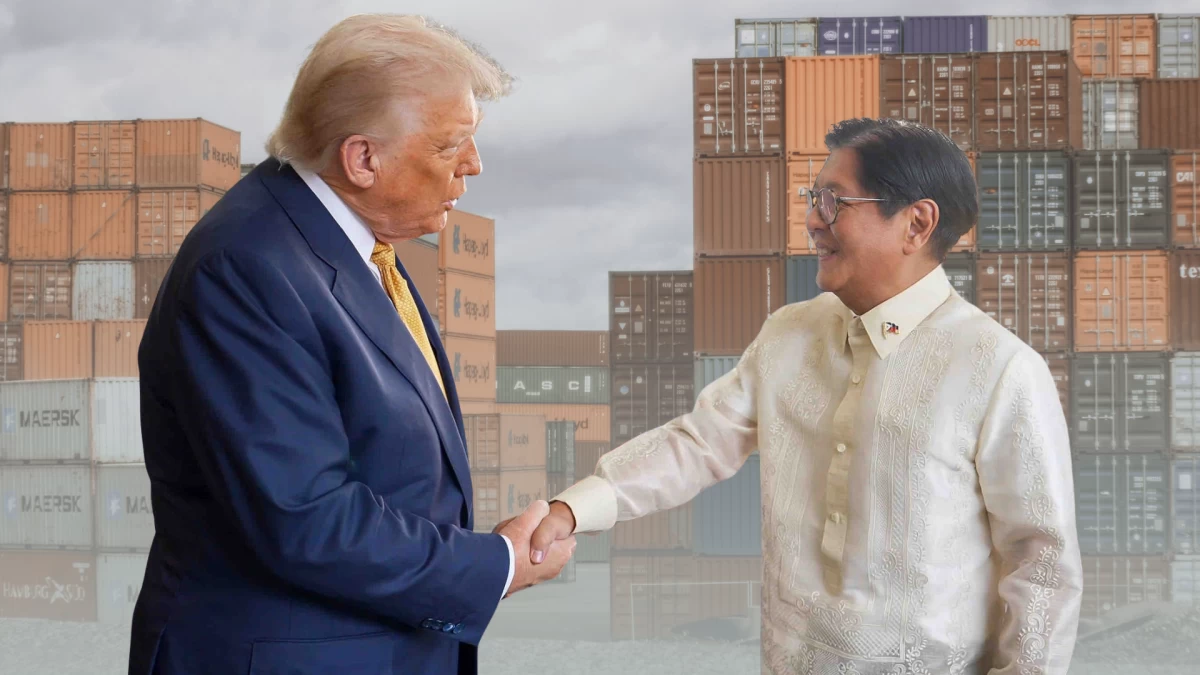
The Trump administration has accused the Philippines of playing a key role in a “shadow transshipment network” that allows China to evade tariffs on products entering the United States (US).
In a report titled “The Great Transshipment Scam,” the White House classified the Philippines under the third tier, referred to as “small, opportunistic Chinese targets” of the alleged transshipment network led by China.
The third tier covers smaller economies with lower absolute transshipment volumes but “specific weak-link advantages,” including low-cost labor, free zones, port or border access, or bonded warehousing.
It also includes economies with niche assembly capacity, preferential US access, or limited customs enforcement capacity, making them “attractive opportunistic targets” for China-linked rerouting.
Apart from the Philippines, 25 other economies are also under the third tier, such as Singapore, Cambodia, Myanmar, Switzerland, and United Arab Emirates (UAE).
The White House defines the shadow transshipment network as a distributed system of finishing hubs and processing corridors that enables China to evade higher US tariffs.
The first tier of this network covers economies that possess large absolute volumes of China-linked goods, including Canada, Israel, Japan, South Korea, and the European Union (EU).
Meanwhile, the second tier points to economies with significant transshipment volumes combined with deeper integration into China-linked supply chains, such as Indonesia, Malaysia, Thailand, and Vietnam.
Based on the report, the core role of the Philippines in the transshipment network includes light assembly, relabeling, and re-export of China-linked goods.
The report noted that exporters from higher-tariff jurisdictions such as China are taking advantage of differences in US tariff implementation across countries to route goods through lower-tariff jurisdictions before entering the American market.
Essentially, Chinese exporters are reportedly sending products that would otherwise be subject to higher tariffs to third countries with lower tariffs, where they would then be relabeled or repackaged to create the appearance that they were not produced in China.
On average, US tariffs on Chinese exports are estimated at around 50 percent. In comparison, tariffs imposed on Philippine goods are significantly lower at 12.5 percent.
Citing analysis from the government and private sector, the White House said the US loses between $40 billion and as much as $303 billion in value due to these illegal transshipment flows.
“This is America’s message to the shadow transshipment network—our warning to the world: stop evading and avoiding the Trump tariffs through illegal transshipment,” the White House said in the report.
“Those who continue will be caught. Those who cooperate will be treated as partners in restoring a fair and honest trading system,” it added.
At present, the Philippines is in close coordination with the US as it looks to secure a possible removal of the 12.5 percent tariff imposed on its exports.
The Office of the US Trade Representative (USTR) earlier imposed a 12.5-percent tariff on the Philippines after it determined that the country had failed to impose and effectively enforce a prohibition on imports made with forced labor.
This is higher than the initial 10-percent tariff, which was implemented following the US Supreme Court’s decision to strike down the Trump administration’s so-called reciprocal tariffs.
A preliminary assessment by the Department of Trade and Industry (DTI) showed that around 34 percent of the country’s exports to the US are covered by the USTR’s 12.5-percent duty.