ADVERTISEMENT

Secret funds, public money, public accountability

Published Aug 14, 2026 12:05 am  |  Updated Aug 13, 2026 04:32 pm
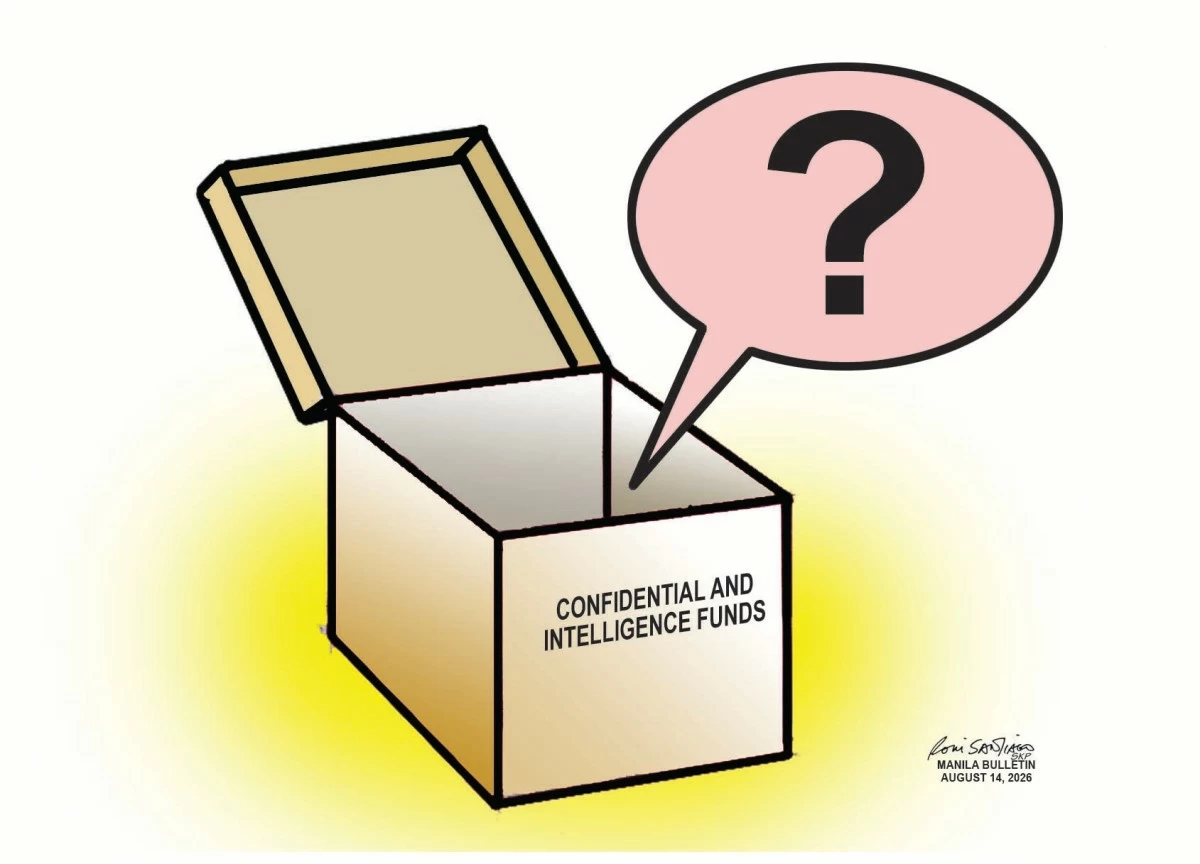
Confidential and intelligence funds (CIFs) exist for a legitimate purpose: protecting the state when secrecy is essential to protecting lives, operations and national security. But secrecy should never be synonymous to weak accountability.
The controversy surrounding the alleged misuse of confidential and intelligence funds has been there for a while—an institutional problem in which public money can be difficult for the public, and sometimes even auditors, to trace. It is once again in the limelight in the ongoing impeachment trial of Vice President Sara Duterte.
This is precisely why the 2027 national budget presents an opportunity for Congress to fix what went wrong in the past.
The proposed ₱7.2-trillion 2027 national budget is now before Congress, with transparency and efficient spending identified by the government as priorities. Congress should translate those promises into concrete safeguards for CIFs, rather than merely adjust their amounts.
The first reform should be categorical: confidential funds should be restricted to agencies with a clear national-security, law-enforcement or intelligence mandate. Civilian offices whose primary functions are education, social welfare, health, administration or public information should not routinely receive CIFs simply because an executive official asserts a need for surveillance. Existing budget rules already recognize that confidential expenses concern surveillance activities in civilian agencies, while intelligence expenses involve information-gathering with a direct impact on national security. The better question is whether civilian agencies need such extraordinary funds at all.
If exceptional circumstances justify an allocation, Congress should require a written justification, measurable objectives, a defined spending ceiling and periodic review. No CIF should be treated as a discretionary political fund.
Second, COA oversight must be strengthened, not diluted by confidentiality. Existing Joint Circular No. 2015-01 already provides rules for the entitlement, release, use, reporting and audit of CIFs. But rules are meaningful only when documentation, verification and consequences are real. Every peso should have a secure audit trail—from authorization and withdrawal to recipient, purpose, accomplishment and liquidation—while protecting genuinely sensitive operational information.
Third, accountability must attach to people, not merely offices. The official who requests, approves, receives, disburses or certifies CIF expenditures must be identifiable and answerable. Quarterly accomplishment reports should go beyond saying money was “utilized.” They should explain what objective was pursued, what activities were undertaken, what measurable results were achieved and why the expenditure was necessary. Existing budget provisions already require quarterly reporting on CIF accomplishments. Congress should make those reports substantive and enforce penalties for false, incomplete or deliberately misleading certifications.
There must also be consequences. Unsupported, unauthorized or demonstrably improper expenditures should trigger disallowance, restitution and administrative or criminal proceedings where warranted. Public office cannot be a shield against personal responsibility.
Finally, accountability cannot rest on COA and Congress alone. Filipinos can examine budget documents, attend legislative hearings, support credible investigative journalism, report irregularities through lawful channels and demand answers from elected representatives. Citizens need not know operational secrets; they have every right to know whether public money produced legitimate public results.
National security deserves resources. But national security also deserves public trust.
The 2027 budget should therefore make one principle unmistakable: confidentiality may protect an operation, but it must never protect misuse. Confidential and intelligence funds should be necessary, narrowly defined, traceable, auditable and personally accountable. Anything less risks turning a tool designed to protect the Republic into a loophole that undermines it.
ADVERTISEMENT
.most-popular .layout-ratio{ padding-bottom: 79.13%; } @media (min-width: 768px) and (max-width: 1024px) { .widget-title { font-size: 15px !important; } }

{{ articles_filter_1561_widget.title }}

.most-popular .layout-ratio{ padding-bottom: 79.13%; } @media (min-width: 768px) and (max-width: 1024px) { .widget-title { font-size: 15px !important; } }

{{ static_articles_1562_widget.title }}

.most-popular .layout-ratio{ padding-bottom: 79.13%; } @media (min-width: 768px) and (max-width: 1024px) { .widget-title { font-size: 15px !important; } }

{{ articles_filter_1563_widget.title }}

{{ articles_filter_1564_widget.title }}

.mb-article-details { position: relative; } .mb-article-details .article-body-preview, .mb-article-details .article-body-summary{ font-size: 17px; line-height: 30px; font-family: "Libre Caslon Text", serif; color: #000; } .mb-article-details .article-body-preview iframe , .mb-article-details .article-body-summary iframe{ width: 100%; margin: auto; } .read-more-background { background: linear-gradient(180deg, color(display-p3 1.000 1.000 1.000 / 0) 13.75%, color(display-p3 1.000 1.000 1.000 / 0.8) 30.79%, color(display-p3 1.000 1.000 1.000) 72.5%); position: absolute; height: 200px; width: 100%; bottom: 0; display: flex; justify-content: center; align-items: center; padding: 0; } .read-more-background a{ color: #000; } .read-more-btn { padding: 17px 45px; font-family: Inter; font-weight: 700; font-size: 18px; line-height: 16px; text-align: center; vertical-align: middle; border: 1px solid black; background-color: white; } .hidden { display: none; }
function initializeAllSwipers() { // Get all hidden inputs with cms_article_id document.querySelectorAll('[id^="cms_article_id_"]').forEach(function (input) { const cmsArticleId = input.value; const articleSelector = '#article-' + cmsArticleId + ' .body_images'; const swiperElement = document.querySelector(articleSelector); if (swiperElement && !swiperElement.classList.contains('swiper-initialized')) { new Swiper(articleSelector, { loop: true, pagination: false, navigation: { nextEl: '#article-' + cmsArticleId + ' .swiper-button-next', prevEl: '#article-' + cmsArticleId + ' .swiper-button-prev', }, }); } }); } setTimeout(initializeAllSwipers, 3000); const intersectionObserver = new IntersectionObserver( (entries) => { entries.forEach((entry) => { if (entry.isIntersecting) { const newUrl = entry.target.getAttribute("data-url"); if (newUrl) { history.pushState(null, null, newUrl); let article = entry.target; // Extract metadata const author = article.querySelector('.author-section').textContent.replace('By', '').trim(); const section = article.querySelector('.section-info ').textContent.replace(' ', ' '); const title = article.querySelector('.article-title h1').textContent; // Parse URL for Chartbeat path format const parsedUrl = new URL(newUrl, window.location.origin); const cleanUrl = parsedUrl.host + parsedUrl.pathname; // Update Chartbeat configuration if (typeof window._sf_async_config !== 'undefined') { window._sf_async_config.path = cleanUrl; window._sf_async_config.sections = section; window._sf_async_config.authors = author; } // Track virtual page view with Chartbeat if (typeof pSUPERFLY !== 'undefined' && typeof pSUPERFLY.virtualPage === 'function') { try { pSUPERFLY.virtualPage({ path: cleanUrl, title: title, sections: section, authors: author }); } catch (error) { console.error('ping error', error); } } // Optional: Update document title if (title && title !== document.title) { document.title = title; } } } }); }, { threshold: 0.1 } ); function showArticleBody(button) { const article = button.closest("article"); const summary = article.querySelector(".article-body-summary"); const body = article.querySelector(".article-body-preview"); const readMoreSection = article.querySelector(".read-more-background"); // Hide summary and read-more section summary.style.display = "none"; readMoreSection.style.display = "none"; // Show the full article body body.classList.remove("hidden"); } document.addEventListener("DOMContentLoaded", () => { let loadCount = 0; // Track how many times articles are loaded const offset = [1, 2, 3, 4, 5, 6, 7, 8, 9, 10]; // Offset values const currentUrl = window.location.pathname.substring(1); let isLoading = false; // Prevent multiple calls if (!currentUrl) { console.log("Current URL is invalid."); return; } const sentinel = document.getElementById("load-more-sentinel"); if (!sentinel) { console.log("Sentinel element not found."); return; } function isSentinelVisible() { const rect = sentinel.getBoundingClientRect(); return ( rect.top < window.innerHeight && rect.bottom >= 0 ); } function onScroll() { if (isLoading) return; if (isSentinelVisible()) { if (loadCount >= offset.length) { console.log("Maximum load attempts reached."); window.removeEventListener("scroll", onScroll); return; } isLoading = true; const currentOffset = offset[loadCount]; window.loadMoreItems().then(() => { let article = document.querySelector('#widget_1690 > div:nth-last-of-type(2) article'); intersectionObserver.observe(article) loadCount++; }).catch(error => { console.error("Error loading more items:", error); }).finally(() => { isLoading = false; }); } } window.addEventListener("scroll", onScroll); });

Sign up by email to receive news.