







When early politicking sinks the economy
Published Aug 12, 2026 12:22 pm


The Philippines is falling behind its neighbors—not because the region is weak, but because domestic politics has become an economic drag.
While much of ASEAN continues to post respectable numbers, the Philippines has slowed sharply. Its 2.3 percent growth in the second quarter of 2026 was the weakest among the large regional economies that have reported figures. In an environment where Vietnam is racing ahead, Singapore is holding up, and Indonesia remains steady, the Philippines looks increasingly like the laggard.
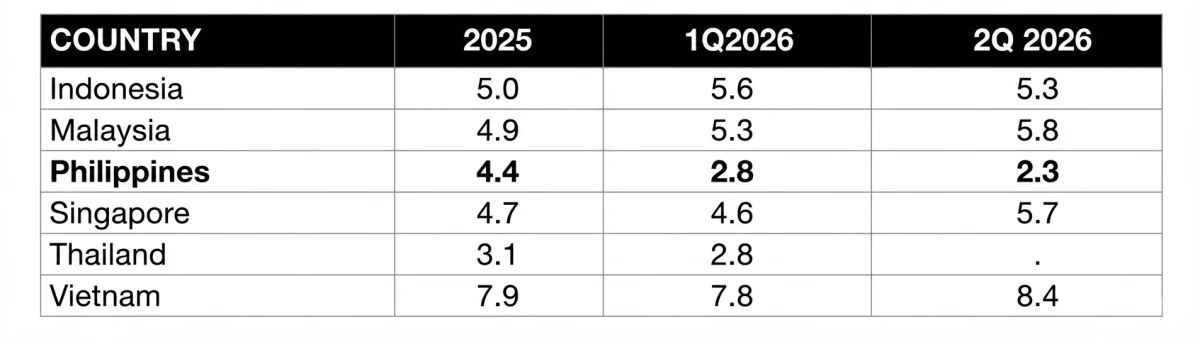
Economic weakness is rarely the product of politics alone. External headwinds such as inflation, volatile fuel prices, muted private investment, and public construction delays all play a role. However, politics shapes how these shocks are managed. When government attention shifts early to electoral maneuvering, the dull but essential work of execution suffers: projects stall, investors hesitate, and households turn cautious.
This comparison is more than a league table. It is a clear warning. The Philippines entered this period with the same tailwinds as its peers: resilient services, steady remittances, a young workforce, and an expanding consumer market. Yet these advantages are being offset by self-inflicted uncertainty. Growth has become hostage to distraction. That is the cost of premature campaigning. It turns policy into messaging and encourages short-term calculation over long-term repair. The economy does not stop for politics, but if politics starts too early, growth may well do so.
When President Ferdinand Marcos Jr. took office, the Philippine economy was on a steep upward trajectory, coming off an 8.1 percent growth rate in the first quarter of 2022. The country was among the fastest-growing in a dynamic region, and its outlook was bright. Today, however, the Philippines has fallen toward the bottom of the regional growth table. The question is unavoidable: how did this happen?
Politics reared its ugly head too soon. Just a year and a half into its non-extendable six-year term, the Marcos Jr. administration abandoned its economic “North Star” to back the People’s Initiative for Reform Modernization and Action (PIRMA). This initiative was a move to amend constitutional provisions for political gain, aiming for a shift toward a parliamentary system or an extension of terms.
The movement took off in September 2023 and gained rapid momentum through the fourth quarter. Early discussions intensified in October, signature drives and drafting began in November, and active debates over Charter change dominated December. By January 2024, signature campaigns had expanded across municipalities nationwide.
By February and March of 2024, however, the initiative lost steam as questions emerged over procedures and signatures. By April and May, it screeched to a halt under intense legal and political challenge. The Supreme Court ultimately ruled that the initiative could not be used to amend the Constitution in the manner attempted, and that the signature-gathering process was legally defective, expressing serious concerns about altering the nation's fundamental law too easily.
As a result of the ruling, the People’s Initiative lost political support, but the damage was already done. Time and resources that should have been devoted to sustaining economic growth, lifting citizens out of poverty, and closing the infrastructure gap were wasted on political maneuvering.
Worse, the administration lost its core credibility. That loss of trust has lingered and intensified through the Vice President's impeachment trial and the polarizing State of the Nation Address in July 2025.
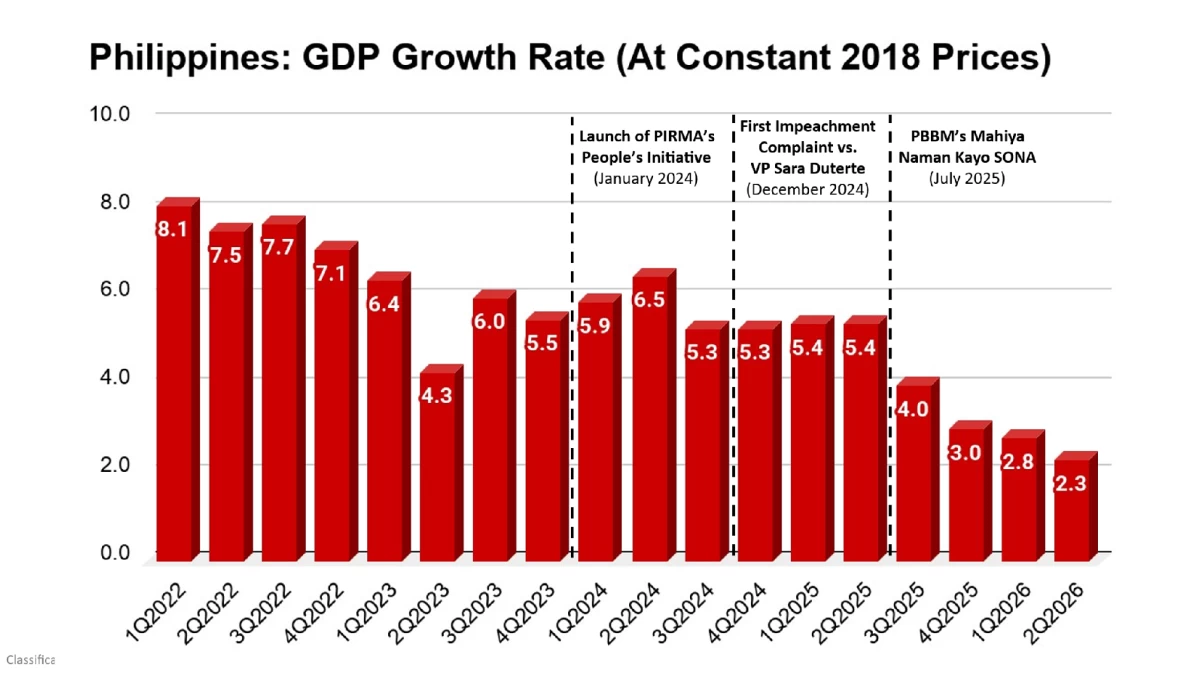
Source: Philippine Statistics Authority
The collapse of Philippine economic growth—from 8.1 percent in early 2022 to 2.3 percent in mid-2026—is largely domestic. It would be irrational to blame this sharp slowdown solely on external forces. The responsibility lies at home, driven by the misallocation of the national budget, flawed policies, poor program execution, and political distraction.
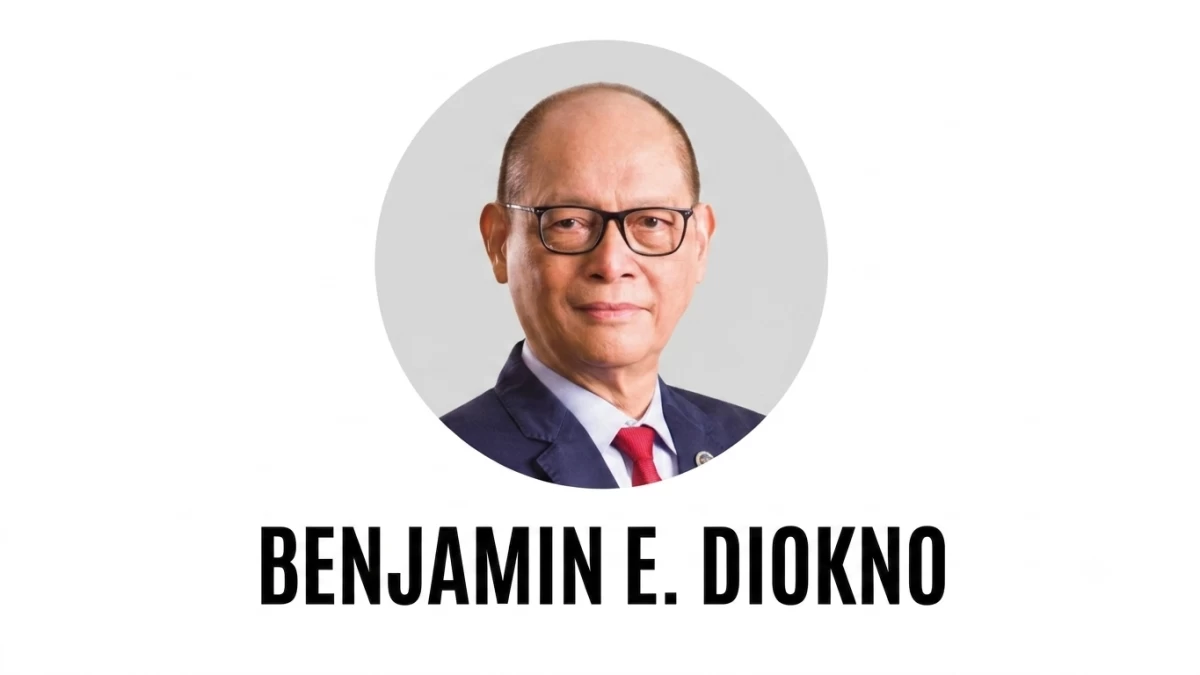
Benjamin E. Diokno is an economist, professor emeritus of Economics, and monetary board member of the Bangko Sentral ng Pilipinas. He was Secretary of Budget and Management under three administrations (Corazon Aquino, Joseph Estrada, and Rodrigo Duterte). He served as Chairman of the Board and BSP Governor from 2019-2022 and Secretary of Finance under Ferdinand Marcos, Jr. from 2022-2024.