






Manila Bulletin
 Business
Trade & Industry
Mitsubishi Motors prepares ₱7-billion Philippine hybrid hub with global export ambitions
Business
Trade & Industry
Mitsubishi Motors prepares ₱7-billion Philippine hybrid hub with global export ambitions
Business
Trade & Industry
Mitsubishi Motors prepares ₱7-billion Philippine hybrid hub with global export ambitions
Mitsubishi Motors prepares ₱7-billion Philippine hybrid hub with global export ambitions
Published Aug 10, 2026 03:27 pm


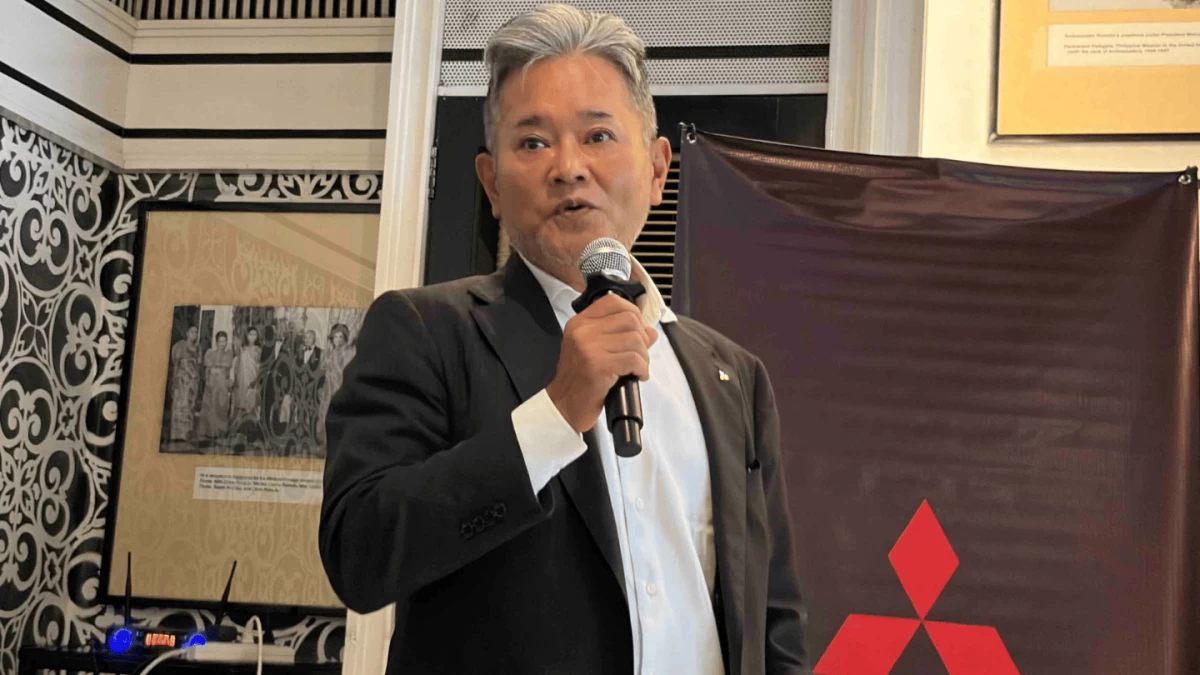
MMPC Chairman Noriaki Hirakata
Mitsubishi Motors Philippines Corp. (MMPC) is open to exporting locally produced hybrid electric vehicles (HEVs) to other countries as part of efforts to strengthen its foothold in the domestic market.
MMPC Chairman Noriaki Hirakata said the company may export Philippine-made HEVs down the line once local production begins under the government’s Electric Vehicle Incentive Strategy (EVIS) program.
“There is no limitation. As long as there is a safety and emission regulation permit, we can export made-in-the-Philippines [units] anywhere,” he told reporters on Monday, August 10.
Hirakata said the HEVs could be exported to neighboring Southeast Asian countries and as far as the Middle East, Africa, and Latin America.
MMPC currently produces the Mirage G4 and L300 models for the domestic market at its manufacturing facility in Santa Rosa, Laguna.
Under the EVIS program, MMPC will also manufacture its enrolled HEV model at the facility—a vehicle described as “positioned to serve the mobility needs of families.”
Established under Executive Order (EO) No. 121, the EVIS program aims to encourage local EV manufacturing through incentives granted in the form of tax payment certificates. To qualify, companies must invest at least ₱5 billion in the domestic production of enrolled EV models, which must be made available in the local or export market within three years of registration.
Hirakata said MMPC has already submitted its intent to participate in the program, backed by a ₱7-billion investment commitment. The capital covers local production of the HEV model, as well as the assembly of batteries and other vehicle components. MMPC plans to begin pilot production in the third quarter of 2027, with full commercial production expected by mid-2028.
Once operational, Hirakata said the EVIS program could boost MMPC’s annual production capacity from roughly 50,000 vehicles to 70,000.
For now, MMPC is focusing on producing a single EV model locally, though that scope could expand based on market demand.
“If the demand is stronger than we expected, we need to invest more,” Hirakata said.
The Philippines is currently the largest market for Japanese automotive giant Mitsubishi Motors Corp. (MMC) outside Japan. To reinforce its position, MMC previously named the Philippines a priority market under its mid- to long-term business strategy, alongside Japan and Vietnam.
In the country, MMC intends to leverage local HEV production to “further enhance [the] brand’s position.” At the same time, the company plans to expand sales of higher-margin models through broader sales financing options while maintaining its push in the medium- to lower-priced vehicle segments.
According to joint sales data from the Chamber of Automotive Manufacturers of the Philippines Inc. (CAMPI) and the Truck Manufacturers Association (TMA), MMPC is the country’s second-largest automotive firm, holding a 17.76 percent market share based on sales of 36,321 vehicles.
Hirakata said the company's target this year is to raise its local market share to 20 percent, with a medium-term goal of reaching at least 25 percent.